The concept of poverty is diffrent among the various countries. Specifically, low income countries has more poverty than high income countries and similarly underdeveloped as weel as developing countries has high level of poverty as compared to the more developed nations. However, the important questions is that what constitute the poverty? Is poverty linked to high level of unemployment? Can Poverty influences the economic growth and development? What is the vicious circle of poverty?
So, these are some of the questions which linked to what constitute the poverty, how to measure it? how countries can addresses the poverty problem? is there any universal measure of poverty? and if it is asny measure then how it affects the developing, underdeveloped and developed economies of the world today?
In this article, I will be trying to give answers of all this questions and explain the concept of “Multidimensional Poverty Index” and its various indicators. In recent years it is more popular due to its inclusiveness of difreent economic and social indicators in the development process. For more authenticity I will provide diffrent graphs and charts for analysis. It will help the readers to analyses and understand properly diffrent concpets which I mentioned throughout this article.
For too long, poverty has been defined narrowly, often solely through the lens of income. While income undoubtedly plays a crucial role, it fails to capture the multifaceted realities of deprivation. People experiencing poverty face a multitude of challenges that extend far beyond their bank accounts. They might grapple with inadequate healthcare, lack of education, poor sanitation, insufficient housing, and limited access to opportunities. These interwoven deprivations form a complex web, trapping individuals and communities in a cycle of disadvantage.
This is where the concept of multidimensional poverty steps in. It’s about recognizing that poverty is not a singular state, but rather a constellation of interconnected deprivations. By measuring poverty across various dimensions, such as health, education, and living standards, we gain a much richer understanding of its true scope and impact.
But why is understanding multidimensional poverty so crucial? Well, imagine a doctor trying to diagnose a patient based solely on their fever. Just treating the fever wouldn’t address the underlying illness, would it? Similarly, tackling poverty solely through income-based interventions misses the mark. By pinpointing the specific deprivations different individuals and communities face, we can design interventions that are more targeted, effective, and sustainable.
What is the concept of Poverty?
Poverty is a complex concept that has been understood and defined in various ways throughout history and across different cultures. At its core, it refers to the state of being without sufficient resources to meet basic needs for a decent standard of living. This can include food, water, shelter, clothing, healthcare, education, and security.
Absolute vs. Relative Poverty:
There are two main approaches to understanding poverty: absolute poverty and relative poverty.
- Absolute poverty defines a minimum level of income or resources below which a person or household is considered poor. This level is typically based on the cost of meeting basic needs such as food and shelter. The World Bank’s global poverty line, for example, is currently set at $1.90 per day (PPP).
- Relative poverty defines poverty in relation to the average income or wealth of a particular society. People or households are considered poor if they fall below a certain threshold, such as the bottom 10% of income earners in a country.
Multidimensional Poverty:
In recent years, there has been a growing recognition that poverty is more than just a lack of income or resources. It is also about a lack of opportunities, capabilities, and choices. Amartya Sen, a Nobel laureate economist, developed the concept of capability poverty, which focuses on the ability of people to achieve the things they value in life.
The Multidimensional Poverty Index (MPI), developed by Oxford University, is a tool that captures the various dimensions of poverty. It looks at 10 indicators across three categories: health, education, and living standards.
Causes of Poverty:
The causes of poverty are complex and vary depending on the context. However, some of the common factors include:
- Inequality: The unequal distribution of income and wealth can lead to some people having very little, while others have much more than they need.
- Lack of access to education and healthcare: Education and healthcare are essential for breaking the cycle of poverty. Without them, people are less likely to get good jobs and more likely to fall sick.
- Conflict and violence: Conflict and violence can destroy livelihoods and infrastructure, making it difficult for people to escape poverty.
- Discrimination: People who are discriminated against on the basis of their race, gender, ethnicity, or other factors are more likely to be poor.
Impacts of Poverty:
Poverty has a wide range of negative impacts on individuals, families, and communities. These include:
- Hunger and malnutrition: People living in poverty often do not have enough to eat, which can lead to health problems.
- Illness and disease: People living in poverty are more likely to get sick and die from preventable diseases.
- Lack of education: Children living in poverty are less likely to go to school or complete their education.
- Limited opportunities: People living in poverty have fewer opportunities to get good jobs and improve their lives.
- Social exclusion: People living in poverty can be excluded from their communities and denied their basic rights.
Eradicating Poverty:
Eradicating poverty is a complex challenge, but it is possible. Some of the key strategies include:
- Investing in education and healthcare: Education and healthcare are essential for breaking the cycle of poverty.
- Creating jobs and promoting economic growth: Economic growth can lead to more jobs and higher incomes, which can help to reduce poverty.
- Social protection: Social protection programs, such as social insurance and safety nets, can help to protect people from falling into poverty or poverty traps.
- Empowering women and girls: Women and girls are often disproportionately affected by poverty. Empowering them through education, economic opportunities, and access to healthcare can help to reduce poverty.
- Addressing inequality: Reducing inequality is essential for reducing poverty. This can be done through progressive taxation, policies that promote equal access to education and healthcare, and measures to combat discrimination.
Poverty is a global problem that affects billions of people. It is a complex issue with a variety of causes and impacts. However, it is also a solvable problem. By working together, we can create a world where everyone has the opportunity to live a decent life.
Specific Data On Poverty from 1991 to 2020 —
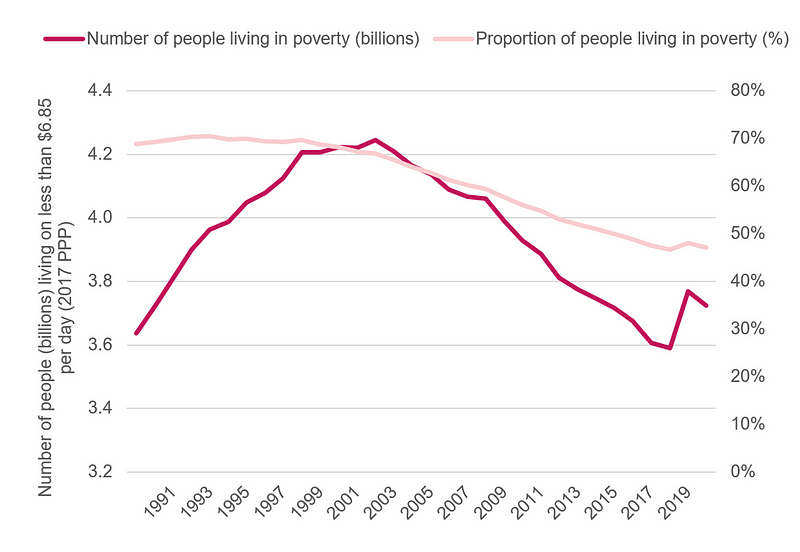
The image shows the number of people living in poverty and the proportion of people living in poverty, according to the World Bank, using the international poverty line of $1.90 per day (2011 PPP)
It shows that although the number of people in poverty has remained largely constant at around 700 million people over the 27 years from 1991 to 2017, the proportion of people living in poverty has steadily decreased from 35% in 1991 to 8.6% in 2017. This means that while the total number of people living in poverty is still high, the percentage of the global population living in poverty has more than halved since 1991.
There are a few possible explanations for this trend. One possibility is that economic growth in developing countries has led to higher incomes for many people, lifting them out of poverty. Another possibility is that there have been improvements in social programs and safety nets that have helped to reduce poverty.
The data represented in the image is from 2017, so it does not take into account the impact of more recent events such as the COVID-19 pandemic. However, it is still a useful indicator of the long-term trends in global poverty.
Overall, the image shows that there has been significant progress in reducing global poverty in recent decades. However, there are still many people living in poverty, and more work needs to be done to eradicate poverty completely.
How Poverty leads to widespread Unemployment?
The relationship between poverty and widespread unemployment is complex and multifaceted. It’s not simply a case of one causing the other, but rather a vicious cycle where both factors reinforce each other, creating a difficult situation for individuals and economies as a whole. Here’s a breakdown of how poverty feeds into unemployment:
Limited access to education and skills:
- Education: Poverty often restricts access to quality education. This can be due to a lack of affordable schools, the need for children to work instead of attending school, or cultural barriers. With inadequate education, individuals acquire fewer skills and knowledge, making them less competitive in the job market.
- Skills: Even individuals who manage to get some education might lack the specific skills required for available jobs. Rapid technological advancements and changing market demands require continuous skill development, which becomes difficult for those unable to access relevant training due to financial constraints.
Reduced demand for goods and services:
- Low purchasing power: People living in poverty have limited disposable income, leading to reduced demand for goods and services. This hinders business growth and discourages new job creation, as companies face diminishing demand for their products.
- Informal economy: Many individuals trapped in poverty turn to the informal economy for survival, either through small-scale entrepreneurship or casual labor. While contributing to some level of employment, these jobs are often characterized by low wages, lack of benefits, and instability, hindering overall economic development and formal job creation.
Health and nutritional deficiencies:
- Poor health: Malnutrition and inadequate healthcare common in poverty lead to poor physical and mental health, reducing work capacity and productivity. This can lead to absenteeism, low performance, and ultimately, job losses.
- Limited mobility: Health issues and lack of resources can restrict individuals’ ability to reach potential workplaces, further reducing their employability.
Psychological factors:
- Discouragement and hopelessness: The constant struggle for basic needs can lead to feelings of helplessness and demotivation, hindering individuals’ willingness and ability to actively seek or perform well in jobs.
- Social stigma: Poverty can be associated with negative stereotypes and social stigma, which can fuel discrimination in hiring practices and limit employment opportunities.
Policy and structural factors:
- Inadequate social safety nets: Lack of strong social protection systems in some countries leaves individuals vulnerable to falling into poverty and unemployment traps. This lack of support hinders job mobility and risk-taking, discouraging entrepreneurship and innovation.
- Macroeconomic policies: Certain economic policies, such as austerity measures or policies favoring capital over labor, can disproportionately impact low-income individuals and exacerbate unemployment, particularly during economic downturns.
It’s important to note that the specific mechanisms through which poverty leads to unemployment vary depending on the context, including the level of economic development, social and cultural norms, and government policies. However, by understanding these complex interactions, we can develop more effective strategies to address both poverty and unemployment simultaneously.
Some potential solutions include:
- Investing in education and training programs: Providing affordable access to quality education and job-specific skills training can equip individuals with the knowledge and skills needed to participate in the formal economy.
- Strengthening social safety nets: Robust social protection systems can provide temporary support during periods of joblessness and prevent individuals from falling into poverty, thus promoting job mobility and encouraging risk-taking.
- Promoting pro-poor economic policies: Implementing policies that prioritize job creation, fair wages, and social protections can create a more inclusive economy that benefits all levels of society.
- Addressing discrimination: Tackling social stigma and discriminatory practices in the workplace can increase access to jobs for individuals from disadvantaged backgrounds.
- Investing in healthcare and nutrition: Improving access to affordable healthcare and ensuring adequate nutrition can contribute to better physical and mental health, leading to a more productive workforce.
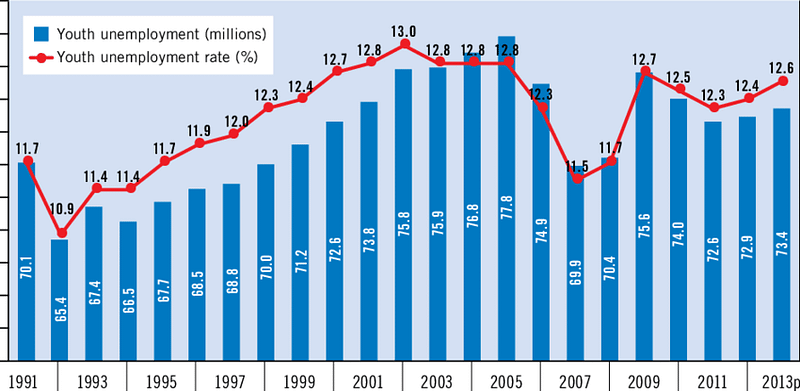
The above bar graph shows that youth unemployment rate —
- Youth unemployment (millions):
- The number of unemployed young people in the United States reached a peak of 13.0 million in 2009, during the Great Recession.
- Since then, the number of unemployed young people has declined steadily, reaching 7.0 million in 2011.
- The lowest number of unemployed young people during the period shown was 6.5 million in 1997.
- Youth unemployment rate (%):
- The youth unemployment rate peaked at 16.1% in 1992.
- The rate then declined steadily until 2007, when it began to rise again.
- The youth unemployment rate reached a new high of 16.2% in 2009.
- Since then, the rate has declined again, reaching 11.3% in 2011.
The data also shows some general trends in youth unemployment in the United States:
- Youth unemployment is more volatile than overall unemployment. This is because young people are more likely to enter and leave the workforce, and they are also more likely to be laid off during economic downturns.
- The youth unemployment rate has been higher than the overall unemployment rate for most of the period shown. This is because young people often lack the experience and skills that are required for many jobs.
How Education and Development in Infrastructure reduce the poverty and unemployment?
ducation and improvement in infrastructural development are two powerful tools that can work together to significantly reduce poverty and unemployment. They tackle these issues in interconnected ways, creating a positive cycle of development. Here’s a detailed breakdown of how they play their roles:
Education:
- Enhances skills and employability: Quality education equips individuals with the knowledge, skills, and problem-solving abilities needed to secure better jobs in formal sectors. This includes both technical and soft skills, preparing individuals for the demands of the modern workforce.
- Boosts productivity and innovation: A skilled workforce contributes to higher productivity in businesses and industries, leading to economic growth and job creation. Additionally, education fosters innovation and entrepreneurship, further driving economic diversification and employment opportunities.
- Reduces informal sector dependence: By equipping individuals with skills and qualifications, education encourages them to transition from low-paying informal jobs to formal employment with better wages, benefits, and job security.
- Empowers women and marginalized groups: Providing equal access to education empowers women and marginalized groups, who often face higher unemployment rates, to participate more fully in the economy and break the cycle of poverty.
- Improves health and wellbeing: Education promotes better health awareness and hygiene practices, leading to improved health outcomes and reduced absenteeism from work. This ultimately contributes to a more productive workforce and a decline in poverty.
Infrastructure development:
- Connects people to markets and opportunities: Improved infrastructure like roads, bridges, and communication networks connect rural and remote areas to urban centers, markets, and essential services. This facilitates the movement of goods and people, opening up new economic opportunities and access to jobs.
- Boosts economic activity: Investments in infrastructure like irrigation systems, power grids, and transportation networks stimulate economic activity by lowering transportation costs, attracting investments, and facilitating efficient supply chains. This leads to job creation in various sectors like construction, maintenance, and related industries.
- Promotes rural development: Improved infrastructure in rural areas facilitates access to agricultural inputs and markets, enhancing agricultural productivity and income for farmers. This reduces rural poverty and encourages migration towards more productive sectors.
- Supports education and healthcare: Improved infrastructure like schools and healthcare facilities in remote areas makes education and healthcare services more accessible, contributing to improved health outcomes and educational attainment, which further reduce poverty.
- Promotes gender equality: Improved infrastructure like sanitation facilities and safe transportation options can empower women by enhancing their mobility, safety, and participation in economic activities, leading to reduced poverty.
Synergy and Interconnectedness:
The impact of education and infrastructure development is maximized when they are implemented in a coordinated manner. Education equips individuals to take advantage of the opportunities created by improved infrastructure, while infrastructure development helps make education and healthcare services more accessible, further enhancing the impact of education. This synergy creates a virtuous cycle of development, leading to poverty reduction and increased employment opportunities.
Challenges and considerations:
- Targeted investments: It’s crucial to ensure that investments in education and infrastructure are targeted towards the most vulnerable communities and sectors where poverty and unemployment are most prevalent.
- Quality and inclusivity: Education systems need to be accessible and provide quality education for all, including marginalized groups and women. Similarly, infrastructure development should be inclusive and benefit all communities, not just urban elites.
- Sustainability: Investments in education and infrastructure should be sustainable and consider long-term maintenance and management.
- Policy and governance: Effective policies and good governance are necessary to ensure efficient allocation of resources, combat corruption, and promote transparency in project implementation.
What is the Multidimensional Poverty Measure?
- An index that measures the percentage of households in a country deprived along three dimensions –monetary poverty, education, and basic infrastructure services — to capture a more complete picture of poverty
- A means to capture the complexity of poverty that considers dimensions of well-being beyond just monetary poverty.
The Multidimensional Poverty Measure (MPM) seeks to understand poverty beyond monetary deprivations (which remain the focal point of the World Bank’s monitoring of global poverty) by including access to education and basic infrastructure along with the monetary headcount ratio at the $2.15 international poverty line.
The World Bank’s measure takes inspiration and guidance from other prominent global multidimensional measures, particularly the Multidimensional Poverty Index (MPI) developed by the United Nations Development Programme (UNDP) and Oxford University, but includes monetary poverty less than $2.15 per day, the international poverty line at 2017 PPP (Purchasing Power Parity), as one of the dimensions. Under this broader definition of poverty, many more people come into view as poor.
While monetary poverty is strongly correlated with deprivations in other domains, this correlation is far from perfect. The Poverty and Shared Prosperity 2022 report (World Bank, 2022) shows that almost 4 out of 10 multidimensionally poor individuals (39 percent) are not captured by monetary poverty, as they are deprived in nonmonetary dimensions alone. A country’s MPM is at least as high as or higher than monetary poverty, reflecting the additional role of nonmonetary dimensions to poverty and their importance to general well-being. Deprivations in nonmonetary dimensions like access to schooling and basic infrastructure, compound poverty and perpetuate cycles of inequality. Securing higher living standards for a population becomes more challenging when poverty in all its forms is considered, but it can provide policymakers with a roadmap for and a means of monitoring improvements in welfare.
The November 2023 update presents the 6th edition of the World Bank’s Multidimensional Poverty Measure (MPM). The latest data provides estimates for 121 economies in the GMD circa 2018, revising estimates published in April 2023. The global and regional MPM headcount remains unchanged from the previous edition, however the share of population experiencing deprivations by dimension has changed slightly, reflecting updates to underlying survey data in some countries.
The above file contains the data on multidimensional poverty index for the year 2023.
Methodology and Usage
The data for the MPM is derived from harmonized surveys in the World Bank’s Global Monitoring Database. The latest estimates for the world are available for circa 2018, using household survey data collected within a three-year window between 2015 to 2021.
The MPM is composed of six indicators: consumption or income, educational attainment, educational enrollment, drinking water, sanitation, and electricity. These are mapped into three dimensions of well-being: monetary, education, and basic infrastructure services.
The three MPM dimensions are weighted equally, and within each dimension each indicator is also weighted equally. Individuals are considered multidimensionally deprived if they fall short of the threshold in at least one dimension or in a combination of indicators equivalent in weight to a full dimension. (See Table1). In other words, households will be considered poor if they are deprived in indicators whose weight adds up to 1/3 or more. Because the monetary dimension is measured using only one indicator, anyone who is income poor is automatically also poor under the multidimensional poverty measure.
Table 1. Multidimensional Poverty Measure Dimensions, Weights, and Parameters
| Dimension | Parameter | Weight |
|---|---|---|
| Monetary | Daily consumption or income is less than $ 2.15 per person. | 1/3 |
| Education | At least one school-age child up to the age of grade 8 is not enrolled in school. | 1/6 |
| No adult in the household (age of grade 9 or above) has completed primary education. | 1/6 | |
| Access to basic infrastructure | The household lacks access to limited-standard drinking water. | 1/9 |
| The household lacks access to limited-standard sanitation. | 1/9 | |
| The household has no access to electricity. | 1/9 |
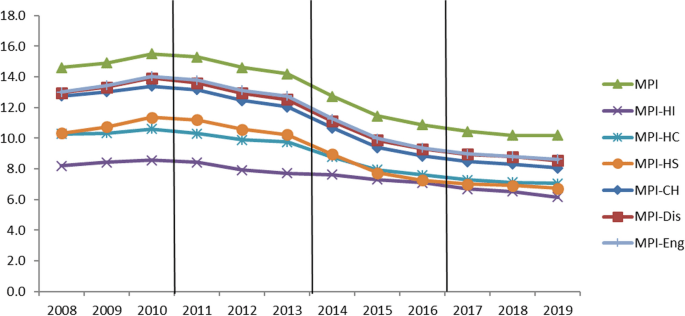
a line graph that shows the Multidimensional Poverty Index (MPI) of Vietnam from 2008 to 2019. The MPI is a measure of poverty that takes into account ten different dimensions of deprivation, including health, education, and living standards. Each dimension is weighted based on its importance to the population, and the MPI is calculated as the average of the weighted deprivations across all dimensions.
The line graph shows that the MPI in Vietnam has decreased steadily over the past decade. In 2008, the MPI was 0.277, which means that 27.7% of the population was living in multidimensional poverty. By 2019, the MPI had decreased to 0.124, which means that 12.4% of the population was living in multidimensional poverty. This is a significant reduction in poverty, and it represents a major achievement for Vietnam.
There are a few possible explanations for the decrease in the MPI in Vietnam. One possibility is that economic growth has led to higher incomes for many people, lifting them out of poverty. Another possibility is that there have been improvements in social programs and safety nets that have helped to reduce poverty. Additionally, Vietnam has also made significant investments in education and healthcare, which has likely contributed to the decrease in poverty.
The MPI is a more comprehensive measure of poverty than traditional income-based measures, as it takes into account the many different dimensions of deprivation that people can experience. As a result, the decrease in the MPI in Vietnam is a positive sign that the country is making progress in reducing poverty and improving the lives of its citizens.
Multidimensional Poverty: A Web of Challenges, a Spectrum of Solutions
Multidimensional poverty is not just about a lack of income. It’s a complex web of interconnected deprivations, encompassing inadequate education, healthcare, nutrition, sanitation, housing, social exclusion, and lack of empowerment. Tackling this multifaceted issue requires a multi-pronged approach that addresses these deprivations simultaneously. Here’s a deeper look at some effective solutions:
Investing in Education and Skills Development:
- Early Childhood Education: Ensuring quality early childhood education lays the foundation for cognitive development, school readiness, and future success. Programs like India’s Integrated Child Development Services (ICDS) provide critical nutrition, healthcare, and early learning opportunities.
- Integrated Child Development Services (ICDS) program in India
- Equitable Access to Quality Education: Universal access to primary and secondary education is crucial, along with addressing gender disparities and providing education in marginalized communities. Programs like Bangladesh’s “Free and Compulsory Education for All” initiative have made significant strides in enrollment.
- Skills Training and Vocational Education: Equipping individuals with relevant skills for in-demand jobs is essential. Vocational training programs and apprenticeships can bridge the gap between education and employability, as exemplified by Kenya’s Uwezo Fund, which supports youth entrepreneurship and skills development.
- Kenya’s Uwezo Fund
Promoting Health and Well-being:
- Universal Healthcare: Ensuring access to affordable and quality healthcare is vital for preventing illness, promoting healthy living, and reducing poverty’s health burden. Initiatives like Thailand’s Universal Coverage Scheme provide a model for expanding healthcare access.
- Thailand’s Universal Coverage Scheme
- Nutrition and Food Security: Combating malnutrition and ensuring access to nutritious food are crucial for physical and cognitive development. Programs like Brazil’s Bolsa Família, which transfers conditional cash grants to families, have improved food security and health outcomes.
- Brazil’s Bolsa Família program.
- Sanitation and Hygiene: Access to clean water, sanitation facilities, and hygiene education are essential for preventing preventable diseases and improving overall health. Programs like India’s Swachh Bharat Abhiyan (Clean India Mission) have made significant progress in sanitation access.
- India’s Swachh Bharat Abhiyan (Clean India Mission)
Empowering Vulnerable Groups:
- Social Protection Programs: Providing social safety nets like unemployment benefits, disability pensions, and child allowances can protect vulnerable groups from falling into poverty and promote social inclusion. Examples include South Africa’s SASSA grant program and Chile’s Solidario program.
- South Africa’s SASSA grant program
- Microfinance and Financial Inclusion: Access to microloans and financial services can empower individuals, particularly women, to start small businesses, generate income, and escape poverty. Programs like Bangladesh’s Grameen Bank have pioneered microfinance initiatives.
- Gender Equality and Women’s Empowerment: Addressing gender discrimination and promoting women’s education, economic participation, and decision-making is crucial for poverty reduction. Initiatives like Rwanda’s Gender Monitoring Office and UN Women’s programs advocate for gender equality.
Sustainable Livelihoods and Economic Development:
- Promoting Rural Development: Investing in rural infrastructure, irrigation systems, and agricultural technology can boost agricultural productivity, create jobs, and improve livelihoods in rural communities. Initiatives like Ethiopia’s Productive Safety Net Program (PSNP) exemplify this approach.
- Ethiopia’s Productive Safety Net Program (PSNP)
- Supporting Small and Medium Enterprises (SMEs): Fostering the growth of SMEs through access to finance, skills development, and market opportunities can create jobs and drive economic growth in developing countries. Examples include initiatives like Indonesia’s Kredit Usaha Rakyat (KUR) program for micro, small, and medium enterprises.
- Indonesia’s Kredit Usaha Rakyat (KUR) program
- Environmental Sustainability: Integrating environmental sustainability into poverty reduction strategies is crucial for long-term success. Programs like Nepal’s Community Based Forest Management (CBFM) initiative promote sustainable resource management and poverty reduction.
- Nepal’s Community Based Forest Management (CBFM) initiative
Combating Social Exclusion and Discrimination:
- Promoting Social Inclusion: Addressing discrimination based on caste, ethnicity, religion, or any other factor is essential for ensuring equal opportunities and reducing poverty. Initiatives like India’s Scheduled Tribes and Other Backward Classes (ST & OBC) welfare programs work towards social inclusion.
Conclusion — Multidimensional poverty demands our attention, not just for its statistical magnitude, but for the human stories it represents. By understanding its multifaceted nature, we can tailor our response, investing in education, healthcare, social safety nets, and sustainable livelihoods. This is not just an economic imperative, but a moral obligation. Let us commit to tackling poverty in all its dimensions, remembering that within each life touched by deprivation lies the potential for prosperity, dignity, and human flourishing.
Thanks.
 Pratik Ghansham Salvi Assistant Professor of Economics | Banking & Finance | IMF Finance & Development Contributor
Leave a comment