The Role of Fixed Proportion Production Function in Developing Economies and Cheap Labour: An Unexpected Asset for Developed Economies
The distinction between developed and developing economies empirically suggests that while developed countries are mostly capital abundant (Physical and Human Capital) and labor scarce and on the other hand, developing and underdeveloped countries are labor abundant and capital scarce. This distinction enables us to study different parameters of economic analysis and draw the conclusions from it.
In this article I am explaining why in underdeveloped and developing countries disguised unemployment occurred? And why some developed countries set up their units in labor abundant countries even though they have capital abundant factor?
For this analysis I am using fixed proportion production function with constant, increasing and decreasing returns to scale. Readers note that I am using this production function for analyzing the phenomenon of disguised unemployment and capital-labor intensities in the production processes.
In the realm of economics, the interplay between developing and developed economies often presents intriguing paradoxes. The article, “Disguised Unemployment in Developing Economies: A Consequence of Fixed Proportion Production Function and an Asset for Developed Economies,” delves into one such paradox.
The phenomenon of disguised unemployment, prevalent in developing economies, is a consequence of the fixed proportion production function. This form of unemployment, often overlooked, is not characterized by a lack of work, but rather by an excess of labor that does not contribute to production. It is a manifestation of the inefficiencies and structural issues inherent in the economies of developing nations. On the other hand, developed economies, characterized by high labor costs and advanced technological infrastructure, are constantly in search of cost-effective labor. This is where the disguised unemployment in developing economies transforms into an asset for developed economies. The surplus labor, considered a liability in its native economy, becomes a valuable resource when viewed through the lens of a developed economy. This article aims to explore this complex relationship, shedding light on the economic structures that perpetuate these conditions and examining the implications for global economic dynamics. By understanding these intricacies, we can work towards more equitable economic systems that benefit all parties involved.
Introduction to Disguised Unemployment —
Disguised unemployment is a form of unemployment where the labor that is employed in a job is not fully utilized for the production of goods and services. Such employment does not contribute to the output of an economy and is thus akin to a form of unemployment. It is usually witnessed in developing economies and especially in labor-intensive economies.
Definition and Concept —
Disguised unemployment exists when part of the labor force is either left without work or is working in a redundant manner such that worker productivity is essentially zero1. It is unemployment that does not affect aggregate output1. An economy demonstrates disguised unemployment when productivity is low and too many workers are filling too few jobs1. It can refer to any part of the population that is not employed at full capacity.
Causes of Disguised Unemployment —
Disguised unemployment can be attributed to various factors, both structural and cyclical. Here are some of the major causes:
- Population Growth: The supply of labor surpasses the available job opportunities, leading to higher unemployment rates.
- Lack of Skill Development: There is often a mismatch between the skills possessed by the workforce and the skills demanded by the industries, resulting in high unemployment rates, particularly among the youth.
- Slow Industrial Growth: Limited investment in industries can lead to fewer job opportunities, exacerbating the existing situation4.
- Low Capital-to-Labor Ratio: This is one of the crucial reasons for high disguised unemployment levels in developing countries.
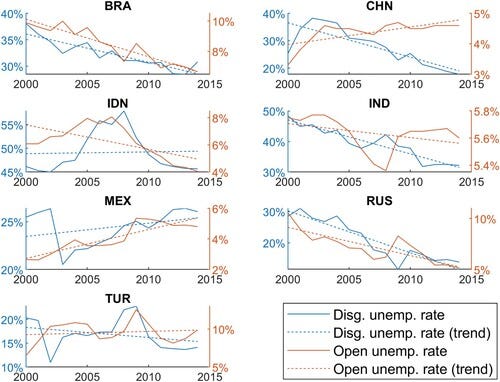
A line graphs, each representing data on unemployment rates from the year 2000 to 2015 for different countries: Brazil (BRA), China (CHN), Indonesia (IDN), India (IND), Mexico (MEX), and Russia (RUS).
Each graph plots two types of unemployment rates:
- The Discouraged Unemployment Rate, represented by a solid line.
- The Open Unemployment Rate, represented by a dashed line.
The y-axis of each graph represents the percentage of unemployed individuals, which varies from 0% to as high as 55% depending on the country’s data. The x-axis represents the years from 2000 to 2015.
Here’s a brief explanation of each graph:
- Brazil (BRA): The graph shows the trends in both Discouraged and Open Unemployment Rates from 2000 to 2015. The rates vary between 0% and 30%.
- China (CHN): The unemployment rates in China are shown, varying between 3% and 40%.
- Indonesia (IDN): This graph presents the unemployment rates in Indonesia, which range from 4% to 55%.
- India (IND): The unemployment rates in India are depicted, ranging from 2% to 50%.
- Mexico (MEX): The graph shows the unemployment rates in Mexico, varying between 2% and 45%.
- Russia (RUS): This graph presents the unemployment rates in Russia, which range from 2% to 30%.
The dotted lines in each graph represent the trend lines for both types of unemployment rates, providing a visual representation of the overall direction of the data.
This data provides valuable insights into the unemployment trends in these countries over a 15-year period, highlighting the differences in open and discouraged unemployment rates. It’s a useful resource for economists and policymakers studying labor market dynamics.
Prevalence in Developing Economies —
Disguised unemployment is prevalent in developing economies due to increased labor force. Such workers tend to engage in unskilled, labor-intensive jobs. This decreases the productivity of the economy and increases the burden on a limited number of resources3. Disguised unemployment exists frequently in developing countries whose large populations create a surplus in the labor force1. It can be characterized by low productivity and frequently accompanies informal labor markets and agricultural labor markets, which can absorb substantial quantities of labor1.
Disguised unemployment is a significant issue, especially in developing economies. It is crucial to address this problem through various measures such as population control, skill development programs, and encouraging industrial growth to ensure the full utilization of the labor force and enhance economic productivity.
Fixed Proportion Production Function and Disguised Unemployment in Developing Economies
Understanding the Fixed Proportion Production Function (FPF):
The fixed proportion production function (FPF) is a theoretical model in economics that describes a production process where factors of production, typically labor and capital, must be combined in fixed, unchangeable ratios to produce a certain output. In simpler terms, imagine making cookies; if you need 1 cup of flour for every 2 eggs, adding more flour without adjusting the eggs won’t result in double the cookies. This fixed ratio is the core attribute of an FPF.
Fixed Proportion Production Function —
Q = min (αK, βL), Where α,β> 0
Characteristics of an FPF:
- Production Isoquants: Output levels are represented by isoquants, curves depicting all combinations of labor and capital that yield the same output. These isoquants are parallel straight lines, implying increasing one factor while keeping the other constant won’t change output, reinforcing the fixed ratio requirement.
- Returns to Scale: FPFs exhibit constant returns to scale. Doubling both labor and capital will double output but maintain the fixed proportion within the production process.
- Limited Substitution: Substitution between labor and capital is impossible. If you need 3 workers to operate a specific machine, adding more workers without another machine won’t increase output.
In the above formulation of this production function — Q = min (αK, βL), Where α,β> 0, the operator “min” implies that output Q is determined by the smaller of the two values in the bracket. If αK<βL then output Q=αK which would mean that capital acts as binding constraint in the production process; the increase in the use of labor would not raise output that is marginal product of labor will be zero. If due to some reasons additional labor has to be employed in this case this additional labor will be disguised. This type of situation prevails in developing countries where factors like capital and land are binding constraint on the growth of production and employment of labor. Since abundant labor is available, the output is determined by the given stock of capital and land. However, due to the lack of employment opportunities in family enterprises in agriculture with limited land and capital equipment more family labor than actually required for agricultural work is to be engaged for the production activity. Therefore, in these economies the additional workers are disguisedly unemployed.
On the other hand, if αK>βL, then labor acts as a binding constraint on the expansion in output and the additional capital is redundant. This situation encountered in the developed economies where labor is scarce and capital abundant. That is why some developed countries set up some production units in China and India by bringing their additional capital equipment and machines in these countries to increase their output by using cheap and surplus labor.
FPF and Disguised Unemployment in Developing Economies:
Developing economies often feature sectors characterized by FPFs, particularly in agriculture and subsistence farming. This model becomes relevant to understanding a unique phenomenon — disguised unemployment.
What is Disguised Unemployment?

Disguised unemployment refers to a situation where workers appear to be employed but contribute minimally or insignificantly to total output. In the context of an FPF, consider a farm where a fixed amount of land requires a specific number of workers to cultivate it efficiently. Adding more workers beyond this optimal level won’t increase output, essentially rendering them redundant or underemployed.
How FPF Contributes to Disguised Unemployment:
- Limited Substitution: FPFs restrict the ability to substitute capital for labor. In developing economies, capital scarcity might necessitate employing more labor than what’s truly needed, leading to disguised unemployment.
- Constant Returns to Scale: Due to constant returns, increasing output might not require proportional increases in labor. This can lead to situations where additional workers aren’t needed unless production significantly expands, leaving existing workers underutilized.
- Low Capital Intensity: Sectors with FPFs tend to be less capital-intensive, relying more on labor. This can lead to a surplus of labor relative to available productive opportunities, contributing to disguised unemployment.
Implications of Disguised Unemployment:
The presence of disguised unemployment can have significant consequences:
- Low Productivity: Underutilized workers contribute less to overall output, hindering economic growth and development.
- Poverty: Disguised unemployment can trap individuals in low-wage, unproductive jobs, perpetuating poverty.
- Social Issues: It can lead to social unrest and migration as individuals seek better opportunities elsewhere.
Addressing Disguised Unemployment:
- Capital Investment: Increased investment in capital-intensive technologies and infrastructure can create new productive jobs and absorb underutilized labor.
- Skill Development: Providing workers with skills relevant to emerging sectors can make them more employable and productive.
- Entrepreneurship Promotion: Encouraging entrepreneurship and small business development can generate new employment opportunities outside traditional FPF-based sectors.
The Looming Shadow: Analyzing the Economic and Social Impact of Disguised Unemployment on Developing Economies —
Disguised unemployment, a seemingly paradoxical phenomenon where individuals appear employed but contribute minimally to output, casts a long shadow over developing economies. Its impact permeates both the economic and social fabric, hindering progress and jeopardizing well-being. Let’s delve deeper into these detrimental effects.
Economic Impacts:
- Hampers Productivity and Growth: With workers underutilized, potential output remains unrealized. This stagnates economic growth, limiting the generation of wealth and resources necessary for poverty reduction and development.
- Depresses Wages and Standards of Living: Overabundant labor in FPF-dominated sectors creates a buyer’s market, driving down wages and perpetuating low living standards. This further restricts disposable income and limits investments in education and healthcare, creating a vicious cycle of poverty.
- Inefficient Resource Allocation: Disguised unemployment misallocates resources, directing labor towards unproductive activities. This creates a drain on resources that could be invested in more productive sectors, further hindering economic development.
- Fiscal and Policy Challenges: Measuring and addressing disguised unemployment presents a challenge for policymakers. Official unemployment statistics often underestimate its prevalence, making it difficult to design effective policy interventions.
Social Impacts:
- Frustration and Social Unrest: Underutilized workers face diminished opportunities and lack of professional fulfillment, leading to frustration and resentment. This can fuel social unrest and political instability, jeopardizing the political and social fabric of developing economies.
- Erosion of Human Capital: The lack of productive work and skill development hinders human capital development. This traps individuals in a cycle of underemployment, limiting their future potential and contribution to the economy.
- Gender Inequality: Disguised unemployment often disproportionately affects women, particularly in informal sectors with FPF characteristics. This exacerbates gender inequality and hinders women’s economic and social empowerment.
- Increased Vulnerability to Shocks: Underemployed individuals lack stability and are more vulnerable to economic shocks like recessions or natural disasters. This further deepens poverty and creates social safety net challenges.
Addressing the Challenge:
Tackling disguised unemployment requires a multi-pronged approach:
- Investment in Capital and Technology: Encouraging investments in capital-intensive technologies and infrastructure can create new job opportunities and absorb underutilized labor.
- Skill Development: Providing workers with relevant skills through training programs can equip them for jobs in emerging sectors and increase their employability.
- Promoting Diversification: Supporting the development of non-FPF sectors, such as services and manufacturing, can offer alternative employment opportunities and reduce dependence on agriculture and subsistence farming.
- Social Safety Nets: Strengthening social safety nets can provide support to underemployed individuals and their families, making them less vulnerable to economic shocks.
Exploring the Demand for Cheap Labour in Developed Economies-
While developed economies generally enjoy high wages and living standards, a less visible, yet persistent facet is the demand for cheap labor. This seemingly contradictory phenomenon warrants closer examination, revealing the complex interplay of economic forces and global dynamics that fuel it.
Factors Contributing to the Demand for Cheap Labour:
- Cost Competition: Globalized markets foster intense competition, putting pressure on businesses to keep production costs low. Cheap labour allows developed economies to undercut competitors in price-sensitive sectors like manufacturing, agriculture, and service industries.
- Automation and Offshoring: Automation replaces some unskilled jobs, but often creates new ones requiring specialized skills not readily available or too expensive in the domestic workforce. Companies then offshore these jobs to regions with abundant cheap labour, further pushing domestic wages down.
- Labor Market Segmentation: Certain sectors, like cleaning, caregiving, and construction, often face challenges attracting domestic workers due to low wages, lack of benefits, or perceived social stigma. This creates a reliance on migrant workers or undocumented immigrants willing to accept these jobs for cheap.
- Policy and Regulatory Gaps: Uneven enforcement of labor laws and regulations in certain industries or for specific worker groups (e.g., migrant workers) creates loopholes for employers to exploit. This allows them to pay lower wages, bypass benefits, and maintain unsafe working conditions.
- Consumer Preferences: The pursuit of lower prices by consumers in developed economies fuels the demand for cheap labour. This creates a vicious cycle where businesses prioritize cost reduction over fair labour practices, perpetuating the dependence on cheap labour.
Impacts of Cheap Labour:
The presence of cheap labour in developed economies has both positive and negative consequences:
Positive Impacts:
- Lower consumer prices: Consumers in developed economies can benefit from lower prices on goods and services due to cheap labour used in their production.
- Job creation: Some sectors in developed economies rely on cheap labour to create jobs that might otherwise disappear due to automation or offshoring.
Negative Impacts:
- Wage depression: The influx of cheap labour can depress wages for domestic workers in similar occupations, particularly low-skilled jobs.
- Exploitation and unfair working conditions: Cheap labour is often associated with exploitative practices like low wages, long hours, poor working conditions, and lack of social protections.
- Social tensions and political instability: Concerns about unfair competition and job losses due to cheap labour can lead to social tensions and political backlash against immigration or globalization.
Finding a Balance:
Addressing the demand for cheap labour requires a multi-pronged approach:
- Strengthening labour laws and regulations: Ensuring the consistent enforcement of fair labour practices for all workers, regardless of immigration status, is crucial to prevent exploitation and protect domestic workers.
- Investing in skill development: Fostering programs that equip domestic workers with the skills needed for jobs in higher-paying sectors can reduce dependence on cheap labour and improve overall competitiveness.
- Promoting ethical consumerism: Raising awareness about the negative impacts of cheap labour and encouraging consumers to prioritize ethical goods and services can shift market pressure towards fairer practices.
- Global cooperation: Addressing the complex issues surrounding cheap labour requires international cooperation on setting and enforcing minimum labour standards, regulating migration flows, and promoting fair trade practices.
The demand for cheap labour in developed economies is a complex issue with multifaceted causes and consequences. While it offers some economic benefits, it also raises concerns about exploitation, unfair competition, and social tensions. Striking a balance between economic competitiveness and ethical labor practices requires concerted efforts from businesses, governments, and consumers to promote a more just and sustainable global economy.
Disguised Unemployment as an Asset for Developed Economies —
While portraying disguised unemployment as an outright “asset” is problematic due to its negative impacts on developing economies, it’s true that developed economies looking for cheap labor can perceive it as an advantage in certain ways. However, it’s crucial to critically analyze this viewpoint and acknowledge the ethical and economic complexities involved.
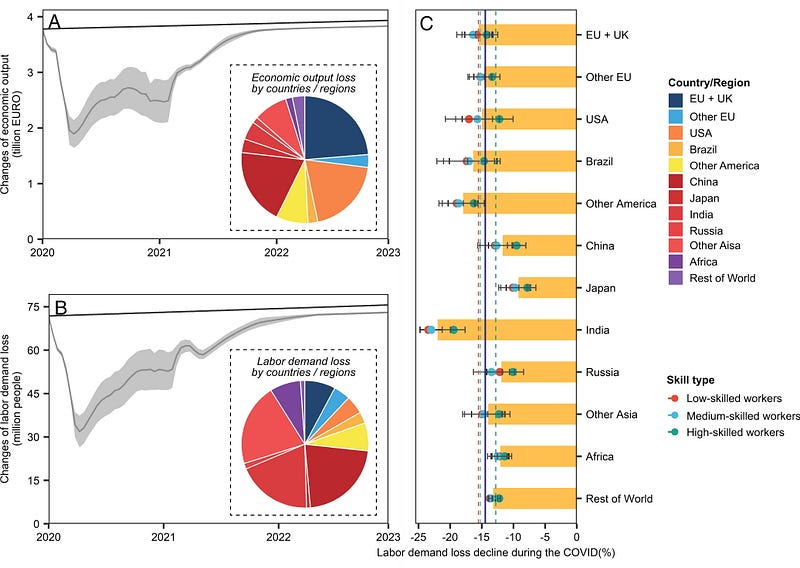
The image contains three graphs that represent the economic and labor impacts of the COVID-19 pandemic across various countries and regions. Here’s a detailed explanation:
- Graph A — Economic Output Loss by Countries/Regions (2020–2023): This line graph shows a significant drop in economic output around 2021, with a shaded area indicating uncertainty or variability. An inset pie chart breaks down the economic losses by country/region.
- Graph B — Labor Demand Loss by Countries/Regions (2020–2023): Similar to Graph A, this line graph shows a decline in labor demand around the year 2021, with a shaded area for uncertainty. An inset pie chart provides details on labor demand losses per country/region.
- Graph C — Labor Demand Loss Decline During the COVID (%): This bar graph compares labor demand loss decline during the COVID-19 pandemic across different countries and regions. It’s categorized by country/region and skill type (low-skilled workers, medium-skilled workers, high-skilled workers). Error bars indicate variability.
Potential Advantages for Developed Economies:
- Lower Production Costs: The abundance of underutilized labor in developing economies can attract businesses from developed countries seeking to reduce production costs. This can lower consumer prices for goods and services in developed economies, potentially boosting their competitive edge in the global market.
- Access to a Larger Labor Pool: Developed economies facing labor shortages, particularly in unskilled or less desirable jobs, can benefit from the availability of workers willing to accept lower wages and less favorable working conditions. This can help fill critical positions and contribute to their economic growth.
- Investment Opportunities: Developed economies might see potential for investments in developing economies with disguised unemployment by offering capital and technology in exchange for access to cheap labor. This can create new job opportunities in related sectors like infrastructure development or support services.
Challenges and Ethical Concerns:
- Exploitation and Unfair Labor Practices: The reliance on cheap labor from developing economies raises concerns about worker exploitation. Lower wages, longer hours, unsafe working conditions, and lack of social protections are often associated with disguised unemployment. Developed economies must ensure their businesses operate ethically and adhere to fair labor standards abroad.
- Negative Impact on Developing Economies: While developed economies might reap some benefits, cheap labor can exacerbate poverty and inequality in developing economies. It can hinder human capital development, suppress domestic wages, and discourage local investment in productivity-enhancing technologies.
- Short-Term Gains vs. Long-Term Sustainability: Relying solely on cheap labor can create a “race to the bottom” in terms of wages and working conditions, ultimately hindering global sustainability and economic stability. Developed economies should focus on fostering long-term partnerships with developing economies that promote fair trade practices and mutual development.
Alternative Approaches:
Instead of simply exploiting the presence of disguised unemployment, developed economies can adopt responsible strategies that benefit both parties:
- Skill Development and Technology Transfer: Investing in skill development programs and knowledge transfer in developing economies can equip their workforce with the skills needed for higher-paying jobs, reducing their reliance on cheap labor.
- Promoting Ethical Sourcing and Fair Trade Practices: Encouraging businesses to adopt ethical sourcing practices and adhere to fair trade standards can ensure that workers in developing economies receive fair wages and enjoy decent working conditions.
- Supporting Sustainable Development: Assisting developing economies in diversifying their economies, strengthening social safety nets, and improving infrastructure can address the root causes of disguised unemployment and promote long-term sustainable development.
While disguised unemployment in developing economies may appear attractive to developed economies seeking cheap labor, it’s essential to recognize the ethical and economic pitfalls associated with this approach. Instead of exploiting vulnerable workers, developed economies should pursue strategies that promote fair trade, skill development, and sustainable development in partner countries. This approach can create a win-win situation where both developed and developing economies benefit from a more equitable and prosperous global economy.
Case Studies: Disguised Unemployment and Cheap Labor —
Developing Economies:
1. India: India struggles with disguised unemployment, particularly in its vast agricultural sector. Millions of individuals are technically employed but contribute minimally to overall output due to factors like fragmented landholdings, outdated farming practices, and underemployment during off-seasons. This surplus of cheap labor makes India attractive to global companies seeking to outsource manufacturing and service jobs, leading to concerns about exploitation and wage depression in certain sectors.
2. South Africa: The informal sector in South Africa, characterized by low wages and precarious working conditions, absorbs a significant portion of the unemployed workforce. This readily available pool of cheap labor attracts foreign investments in labor-intensive industries like garment manufacturing and agriculture. However, it also perpetuates poverty and income inequality, limiting South Africa’s long-term economic growth potential.
Developed Economies:
3. United States: In the US, concerns about job displacement due to cheap labor often focus on immigration, particularly in blue-collar and service sectors. The influx of undocumented workers willing to accept lower wages can impact domestic workers in similar jobs, raising tensions and fueling calls for stricter border control. However, some argue that cheap labor also fills critical positions that might otherwise go unfilled, contributing to specific sectors’ economic viability.
4. Germany: Germany’s aging population and low birth rate raise concerns about future labor shortages. To address this, the country has liberalized immigration policies and actively sought skilled workers from developing economies. This strategy recognizes the need for skilled labor while aiming to ensure fair treatment and integration of foreign workers into the German workforce.
Analysis:
These case studies showcase the multifaceted nature of disguised unemployment and its connection to cheap labor. While developed economies might enjoy some short-term benefits like lower prices and access to a larger labor pool, it’s crucial to acknowledge the ethical and economic drawbacks associated with exploiting cheap labor. To achieve long-term sustainability and address the root causes of disguised unemployment, both developed and developing economies need to:
- Focus on skill development and knowledge transfer: Equipping workers in developing economies with relevant skills empowers them to transition to higher-paying jobs and reduces their reliance on cheap labor.
- Promote fair trade practices and ethical sourcing: Developed economies should hold their businesses accountable for ensuring decent working conditions and fair wages for workers in developing countries.
- Support sustainable development initiatives: Addressing poverty, inequality, and limited economic opportunities in developing economies plays a key role in tackling disguised unemployment at its core.
Policy Implications: Tackling Disguised Unemployment and Cheap Labor —
The presence of disguised unemployment in developing economies and its perceived attractiveness for developed economies seeking cheap labor present a complex policy challenge. Addressing this issue requires multifaceted approaches from both sides, aiming to promote fair labor practices, sustainable development, and economic opportunity for all.
Policy Implications for Developing Economies:
- Investing in Human Capital: Prioritize education and skill development programs to equip the workforce with skills needed for higher-paying jobs in diverse sectors beyond traditional FPF-dominated areas.
- Enhancing Land Use and Agricultural Efficiency: Implement land reforms, provide access to technology and training for farmers, and encourage diversification of agricultural production to increase productivity and reduce underemployment.
- Promoting Social Safety Nets: Establish strong social safety nets to support vulnerable individuals and families impacted by economic shocks or changes in labor market demands.
- Strengthening Labor Laws and Regulations: Ensure effective enforcement of labor laws to protect workers from exploitation, including those in informal sectors and undocumented immigrants.
- Fostering Entrepreneurship and Small Business Development: Encourage entrepreneurship and micro-enterprise initiatives to create additional employment opportunities and reduce reliance on wage labor in FPF-dominated sectors.
Policy Implications for Developed Economies:
- Promoting Ethical Sourcing and Supply Chains: Encourage responsible sourcing practices and enforce fair trade agreements to ensure decent working conditions and wages for workers in developing countries.
- Investing in Skill Development and Technology Transfer: Assist developing economies in their skill development efforts and knowledge transfer initiatives to promote a more skilled and productive workforce.
- Supporting Sustainable Development Goals: Align trade policies and development assistance with the UN Sustainable Development Goals to address the root causes of poverty and inequality that contribute to disguised unemployment.
- Addressing Domestic Labor Market Challenges: Invest in training and skills development programs for domestic workers to fill critical skill gaps and avoid relying solely on cheap labor from abroad.
- Rethinking Consumer Choices: Encourage responsible consumerism by raising awareness about the ethical implications of cheap labor and promoting support for businesses committed to fair practices.
Potential Strategies:
- South-South Cooperation: Promote collaboration between developing economies to share best practices in tackling disguised unemployment, skill development, and economic diversification.
- Multilateral Trade Agreements: Advocate for international trade agreements that prioritize fair labor standards and worker rights to prevent downward pressure on wages and working conditions.
- Global Tax Initiatives: Implement coordinated global tax measures to create a level playing field for businesses and discourage exploitation of cheap labor in developing countries.
- Public-Private Partnerships: Facilitate partnerships between governments, businesses, and NGOs to develop and implement effective solutions for addressing disguised unemployment and promoting decent work standards globally.
Disguised unemployment and the demand for cheap labor are complex issues with far-reaching economic and social consequences. Addressing these challenges requires a long-term, multi-pronged approach that recognizes the interdependence of developed and developing economies. By prioritizing ethical practices, sustainable development, and skill development, both sides can contribute to building a more equitable and prosperous future for all.
Conclusion — In conclusion, the intricate interplay between disguised unemployment in developing economies and the demand for cheap labour in developed economies is a testament to the complex dynamics of global economics. The phenomenon of disguised unemployment, a byproduct of the fixed proportion production function, is not merely a challenge for developing economies but also an unexpected asset for developed economies.
However, this relationship underscores the need for more equitable economic policies and practices. While developed economies benefit from the availability of cheap labour, it is crucial to ensure that this does not perpetuate the cycle of poverty and unemployment in developing nations.
Moreover, the fixed proportion production function, which contributes to disguised unemployment, calls for structural reforms and investment in human capital in developing economies. This would not only alleviate disguised unemployment but also enhance the productivity and living standards in these economies.
Ultimately, the goal should be to transform the narrative from ‘disguised unemployment as an asset’ to ‘empowered and productive workforce as an asset.’ This shift would pave the way for sustainable and inclusive growth in both developing and developed economies, fostering a global economy that thrives on mutual growth and respect rather than disparities.
Thanks.
 Pratik Ghansham Salvi Assistant Professor of Economics | Banking & Finance | IMF Finance & Development Contributor
Leave a comment