In South Asia India emergeed as the new economic superpower due to its economic prgress and place in the international trade domain. If we analyses carefully then we will find that India is focusing on its infrastructure, space technology, finance and banking, service sector, etc. Which actually a positive sign for the Indian Economy to grow faster in South Asia.
According to the recent International Monetary Fund (IMF) study Indian Economy is growing this fiscal year at a rate of 6.5%. Moreover India’s Ministry of Statistics and Programe Implementation estimated that Indian Economy is growing at a rate of 7.3%.Apart from that Indian Government is bilaterally as well as multilateraly engaged in various tarde negotiations with western countries such as QUAD-USA, Japan, Autralia, and Canada, European Union, France, Germany, etc. This is the sign of India’s rise as a economic superpower in the world.
However, despite India is achiveing phenomenal growth in economic sphere there are certain socio-economic indicators where India is lagged behind other developing countries. For example its performance in Global Hunger Index, Multidimensioanl Poverty Index, Malnutrition, Unemplaoyment, etc is worsed. Therefore India needs to works on these indicators for betterment of its people.
In this article I will be discussing only focusing on GDP and growth in trade is not sufficent for the development perspective. The countries need to include its people’s happiness along with improvement in socio-economic indicators is the most integral part for the inclusive and sustainable devlepment.
For reders I am using data sources from diffrent institutions and government websites for better understanding of all these aspects. Moreover, I also use diagrams and charts whenever necessary. So, lets try to understand all this concepts in a detailed way.
Economic Growth vs. Development: Beyond the Numbers
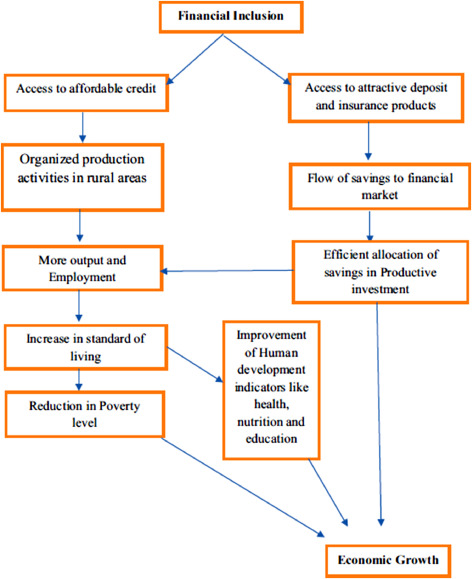
While often used interchangeably, economic growth and overall development are distinct concepts with crucial differences. Understanding them is vital when gauging a nation’s true progress.
Economic growth refers to the quantitative expansion of an economy, typically measured by increases in GDP (Gross Domestic Product). It signifies a rise in the production of goods and services, potentially leading to higher incomes and increased national wealth. Think of it as the size of the economic pie increasing.
On the other hand, overall development extends beyond mere numbers, encompassing qualitative improvements in the lives of citizens. It considers factors like:
- Standard of living: Access to education, healthcare, sanitation, and housing.
- Poverty reduction: Lifting individuals and families out of financial hardship.
- Equality and inclusion: Ensuring opportunities for all, regardless of background.
- Environmental sustainability: Preserving resources for future generations.
- Happiness and well-being: Going beyond material wealth to assess quality of life.
Therefore, while economic growth can contribute to development, it’s not a guarantee. Solely relying on GDP as a progress indicator has limitations:
- Inequality: Growth may only benefit certain segments, leaving others behind.
- Unsustainable practices: Resource depletion and environmental degradation can occur.
- Subjective well-being: Happiness, social cohesion, and other vital aspects remain unmeasured.
While economic growth can be a tool, it’s crucial to recognize its limitations. True progress necessitates a multidimensional approach that prioritizes not just the size of the economic pie, but also equitable distribution and overall well-being for all citizens.
India’s Economic Landscape: Beyond the GDP Glimmer
India’s economic journey has been one of impressive growth. In recent years, it has been among the fastest-growing economies globally, boasting:
- GDP growth: Estimated at 6.9% in 2022 and projected to be between 6.3% and 7.2% in 2023-24.
- Increased foreign exchange reserves: Nearly doubled to US$568 billion.
- Narrowing current account deficit: Reduced to 1.9% of GDP in 2023.
These numbers paint a picture of a thriving economy. However, looking beyond the GDP reveals a more nuanced picture:
- Inflation: Remains a concern, hovering around 5% and impacting essential goods.
- Unemployment: While decreasing, still stands at around 8%, with significant underemployment.
- Poverty: Though declining, millions still live below the poverty line.
- Malnutrition: A persistent issue, particularly among children.
- Inequality: The wealth gap remains significant, with benefits of growth skewed towards higher income earners.
Therefore, while acknowledging India’s economic growth, it’s crucial to avoid the “GDP trap”. True progress necessitates considering:
- Human development indicators: Education, healthcare, access to basic necessities.
- Equality and inclusion: Ensuring benefits of growth reach all segments of society.
- Environmental sustainability: Balancing economic growth with responsible resource management.
- Happiness and well-being: Recognizing the importance of subjective measures of progress.
India’s economic potential is undeniable. However, achieving meaningful and inclusive development requires going beyond mere numbers and focusing on holistic progress that improves the lives of all citizens. This means investing in:
- Social programs: Education, healthcare, and poverty alleviation initiatives.
- Infrastructure: Upgrading physical and social infrastructure to create equitable opportunities.
- Sustainable practices: Promoting clean energy and resource-efficient development.
- Social welfare: Supporting vulnerable groups and ensuring everyone benefits from growth.
Only by considering these factors can India achieve true development that reflects not just economic prosperity, but also overall well-being for its citizens.
India’s Performance in Key Socio-Economic Indicators –
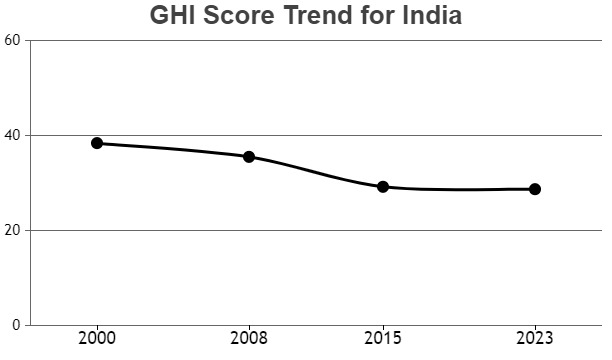
Global Hunger Index – According to the 2023 Global Hunger Index (GHI), India ranks 111th out of 125 countries. India’s GHI score is 28.7 on a 100-point scale, with 0 being the best score and 100 being the worst. This indicates a “serious” level of hunger for the country.
The GHI score is a composite index that reflects the severity of hunger across the globe. It is calculated based on four key indicators:
- Undernourishment: The proportion of the population that is unable to consume enough dietary energy to meet their basic needs.
- Child stunting: The proportion of children under five who are short for their age.
- Child wasting: The proportion of children under five who are thin for their height.
- Mortality: The under-five mortality rate.
A higher GHI score indicates a more severe hunger situation.
The graph shows that India’s GHI score has been declining over time, from 44.3 in 2000 to 26.5 in 2023. This indicates that hunger has been decreasing in India over the past two decades. However, India’s GHI score is still considered to be “serious,” according to the GHI classification system.
Here are some additional details that can be seen in the graph:
- The rate of decline in India’s GHI score has slowed down in recent years.
- The GHI score is still higher in some parts of India than in others.
Overall, the graph shows that India has made progress in reducing hunger, but there is still more work to be done.
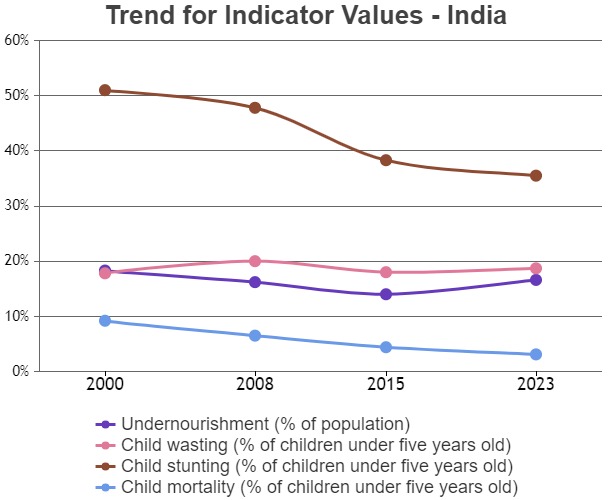
It is a graph showing the trend for indicator values in India. The x-axis shows time, ranging from 2000 to 2023. The y-axis shows the percentage of the population. The graph displays four lines, each representing a different indicator:
- Undernourishment (% of population): This line starts at around 42% in 2000 and has steadily declined to about 14% in 2023.
- Child wasting (% of children under five years old): This line is similar to the undernourishment line, starting at around 48% in 2000 and decreasing to around 17% in 2023.
- Child stunting (% of children under five years old): This line shows a similar trend, starting at around 54% in 2000 and falling to around 33% in 2023.
- Child mortality (% of children under five years old): This line exhibits the most significant decline, starting at around 6% in 2000 and dropping to about 2% in 2023.
Overall, the graph suggests that India has made significant progress in reducing undernourishment, child wasting, child stunting, and child mortality over the past two decades. However, it is important to note that these values still represent a considerable number of people, especially children.
Global Happiness Index – The World Happiness Report is released every year on March 20 which also marks the celebration of International Day of Happiness. It ranks countries on the basis of the level of happiness.
The report typically awards rankings to 150 nations based on a number of variables, including
- Real social support,
- GDP per capita,
- Freedom of choice in one’s life,
- Healthy life expectancy,
- Perceptions of corruption and
- Generosity.
World Happiness Report 2023
- Finland has topped the chart and is the happiest country in the world while Denmark and Iceland hold second and third positions respectively.
- Afghanistan has secured the last position in the chart since 2020 due to the humanitarian crisis it has been facing since the Taliban took over the administration.
- In the 2023 edition, India has improved its ranking to 126th position out of 137 countries in comparison to the 135th position in the 2022 report.
- But, if we compare our neighbouring countries in South Asia, India still ranks below countries such as Nepal, Bhutan, Pakistan, Sri Lanka, China and Bangladesh.
- India only ranked better than Afghanistan which was placed at 137, the bottom position.
- Despite being the fastest economy India has secured a very low rank in the index, even Russia and Ukraine, despite being at war for more than one year, ranked better than India at 70th and 92nd in terms of happiness. So it raises doubts about the credibility of the report and the method of evaluation.
Country Rankings by Life Evaluations in 2020-2022 are as under (World Happiness Report 2023 List):
| Top 10 Countries on World Happiness Index | |
| Rank | Country |
| 1 | Finland |
| 2 | Denmark |
| 3 | Iceland |
| 4 | Israel |
| 5 | Netherlands |
| 6 | Sweden |
| 7 | Norway |
| 8 | Switzerland |
| 9 | Luxembourg |
| 10 | New Zealand |
Performance of Countries
- Top Performers:
- Three countries from the Scandinavian region were awarded the top three spots in the World Happiness Report.
- Finland has been named the world’s happiest country six times in a row, followed by Denmark, Iceland, Israel, and the Netherlands.
- While the United States managed to secure the 15th spot among western nations, Britain came in at 19th and France at 21st.
- Worst Performers:
- Only Afghanistan under the Taliban performed worse than India among the South Asian countries.
- Afghanistan came at 137th rank, which was preceded by Lebanon, Sierra Leone, Zimbabwe, and Democratic Republic of Congo, respectively.
- Nepal (78), Bangladesh (118), Pakistan (108) and Sri Lanka (112) managed to get better ranks in the list than India.
- India’s Performance:
- India moved up three ranks from 139th in the 2021 report to 136th in the 2022 edition and in the 2023 edition it reached the 126 spot.
- According to the Happiness Report, India was one of the nations where people’s assessments of their quality of life declined by more than one full point on a scale of 0 to 10 over the previous ten years.
- Numerous factors contribute to the persistent unhappiness of the nation, including
- Rapid urbanization and congestion in cities
- Declining incomes and unemployment
- Unfavourable perceptions about corruption in the country
- Rising costs of healthcare
- Women’s safety
- Environmental pollution
- Poor mental well-being
India’s Rank in the World Happiness Report is still worsed as compared to the 2021 data.
The Press Freedom Index – Global media watchdog Reporters Without Borders (RSF), which publishes a yearly report on press freedom in countries across the world, had last year ranked India at 150 in a survey of 180 countries.
“The indices of press freedom have worsened in several countries, including India, according to the latest RSF report,” the joint statement said.
“For developing democracies in the Global South where deep pockets of inequities exist, the media’s role cannot be understated. Likewise the constraints on press freedom due to hostile working conditions like contractorization have to also be challenged. Insecure working conditions can never contribute to a free press,” it added
India
The violence against journalists, the politically partisan media and the concentration of media ownership all demonstrate that press freedom is in crisis in “the world’s largest democracy”
Media landscape
The Indian media landscape is like India itself – huge and densely populated – and has more than 100,000 newspapers (including 36,000 weeklies) and 380 TV news channels. But the abundance of media outlets conceals tendencies toward the concentration of ownership, with only a handful of sprawling media companies at the national level, including the Times Group, HT Media Ltd, The Hindu Group and Network18. Four dailies share three quarters of the readership in Hindi, the country’s leading language. The concentration is even more marked at the regional level for local language publications such as Kolkata’s Bengali-language Anandabazar Patrika, the Mumbai-based daily Lokmat, published in Marathi, and Malayala Manorama, distributed in southern India. This concentration of ownership in the print media can also be observed in the TV sector with major TV networks such as NDTV. The state-owned All India Radio (AIR) network owns all news radio stations.
Political context
Originally a product of the anti-colonial movement, the Indian press used to be seen as fairly progressive but things changed radically in the mid-2010s, when Narendra Modi became prime minister and engineered a spectacular rapprochement between his party, the BJP, and the big families dominating the media. The prime example is undoubtedly the Reliance Industries group led by Mukesh Ambani, now a personal friend of Modi’s, who owns more than 70 media outlets that are followed by at least 800 million Indians. Similarly, the takeover of the NDTV channel at the end of 2022 by tycoon Gautam Adani, who is also very close to Narendra Modi, signalled the end of pluralism in the mainstream media. Very early on, Modi took a critical stance vis-à-vis journalists, seeing them as “intermediaries” polluting the direct relationship between himself and his supporters. Indian journalists who are too critical of the government are subjected to all-out harassment and attack campaigns by Modi devotees known as bhakts.
Legal framework
Indian law is protective in theory but charges of defamation, sedition, contempt of court and endangering national security are increasingly used against journalists critical of the government, who are branded as “anti-national.” Under the guise of combatting Covid-19, the government and its supporters have waged a guerrilla war of lawsuits against media outlets whose coverage of the pandemic contradicted official statements. Journalists who try to cover anti-government strikes and protests are often arrested and sometimes detained arbitrarily. These repeated violations undermine media self-regulatory bodies, such as the Press Council of India (PCI) and the Electronic Media Monitoring Centre (EMMC).
Economic context
The Indian press is a colossus with feet of clay. Despite often huge stock market valuations, media outlets largely depend on advertising contracts with local and regional governments. In the absence of an airtight border between business and editorial policy, media executives often see the latter as just a variable to be adjusted according to business needs. At the national level, the central government has seen that it can exploit this to impose its own narrative, and is now spending more than 1.8 billion rupees (20.4 million euros) a year on ads in the print and online media alone. Recent years have also seen the rise of “Godi media” (a play on Modi’s name and lapdogs) – media outlets such as Times Now and Republic TV that mix populism and pro-BJP propaganda. The old Indian model of a pluralist press is therefore being seriously challenged by a combination of harassment and influence.
Sociocultural context
The enormous diversity of Indian society is barely reflected in the mainstream media. For the most part, only Hindu men from upper castes hold senior positions in journalism or are media executives – a bias that is reflected in media content. For example, fewer than 15% of the participants in major evening talk shows are women. At the height of the Covid-19 crisis, some TV hosts blamed the Muslim minority for the spread of the virus. The media landscape is nonetheless also rich in alternative examples such as Khabar Lahariya, a media outlet composed solely of female journalists from rural areas and from ethnic or religious minorities.
Safety
With an average of three or four journalists killed in connection with their work every year, India is one of the world’s most dangerous countries for the media. Journalists are exposed to all kinds of physical violence including police violence, ambushes by political activists, and deadly reprisals by criminal groups or corrupt local officials. Supporters of Hindutva, the ideology that spawned the Hindu far right, wage all-out online attacks on any views that conflict with their thinking. Terrifying coordinated campaigns of hatred and calls for murder are conducted on social media, campaigns that are often even more violent when they target women journalists, whose personal data may be posted online as an additional incitement to violence. The situation is also still very worrisome in Kashmir, where reporters are often harassed by police and paramilitaries, with some being subjected to so-called “provisional” detention for several years.
Multidimensional Poverty Index –
About the Global Multidimensional Poverty Index (MPI)
- This report presents a compact update on the state of multidimensional poverty in the world.
- It compiles data from 110 developing countries covering 6.1 billion people, accounting for 92 percent of the population in developing countries.
- It tells an important and persistent story about how prevalent poverty is in the world and provides insights into the lives of poor people, their deprivations and how intense their poverty is—to inform and accelerate efforts to end poverty in all its forms.
- MPI is published annually by the UN Development Programme (UNDP) and the Oxford Poverty and Human Development Initiative.
Significance of India’s success:
- Some of these gains may have the current government’s social development schemes to thank.
- Rapid economic expansion has been criticized for not benefiting the poor, but these estimates suggest that fast growth is indeed improving the lives of those who are the worst off.
- While there are signs of the pandemic having set poverty reduction back, we don’t have adequate data to draw conclusions. Still, India’s direct poverty-relief efforts mustn’t slacken even as we pursue output growth.
Challenges for India
- Levels of nutrition:
- While poverty levels have not worsened, levels of under-nutrition are still very high.
- There is no marked acceleration in rate of improvement between NFHS-3 and NFHS-4 and NFHS-4 and NFHS-5.
- And the MPI mainly captures the pre-COVID situation because 71% of the NFHS-5 interviews were pre-COVID.
- Focussing on existing vulnerable population:
- India still has more than 230 million people who are poor.
- According to the MDI report, one should take the population “vulnerable” to multidimensional poverty seriously.
- The UNDP defines, “Vulnerability — the share of people who are not poor but have deprivations in 20–33.3 percent of all weighted indicators — can be much higher.” India has some 18.7 per cent population under this category.
To be sure India is achiving certainly good postion however more work needs to be done by the Indian Government.
Happiness Beyond the Numbers: GNH and the Value of Wellbeing
For decades, economic growth, measured by GDP, has been the primary yardstick for national progress. However, this single metric often fails to capture the true well-being of a nation’s citizens. This is where concepts like Gross National Happiness (GNH) and other happiness indices emerge, offering alternative measures of societal success.
GNH, pioneered by Bhutan, goes beyond the material sphere, incorporating nine domains crucial to human flourishing:
- Psychological well-being: Mental health and contentment.
- Health: Physical and mental health access.
- Time use: Balance between work, leisure, and family.
- Standard of living: Access to basic necessities and resources.
- Community: Sense of belonging and social support.
- Good governance: Effective and just leadership.
- Ecology: Environmental sustainability and preservation.
- Culture: Preservation and celebration of cultural heritage.
Similar indices like the World Happiness Report and the Happy Planet Index use multi-dimensional approaches to assess national well-being, considering factors like life satisfaction, social support, trust, and income equality.
Why is happiness relevant?
Focusing solely on GDP can have detrimental consequences:
- Ignoring inequality: Growth may benefit select groups, leaving others behind, creating widespread discontent.
- Unsustainable practices: Unchecked growth can deplete resources and harm the environment, impacting future generations’ well-being.
- Neglecting subjective experiences: Economic prosperity doesn’t guarantee individual happiness or social cohesion.
By measuring happiness and well-being:
- Policymakers gain a broader perspective: They can design policies that promote not just economic growth, but also individual and societal flourishing.
- We prioritize holistic development: Resources are directed towards improving healthcare, education, social support, and environmental sustainability.
- We empower individuals and communities: When happiness is valued, individuals have more agency to pursue fulfilling lives, and communities have a stronger sense of shared purpose.
However, measuring happiness comes with challenges:
- Subjectivity: Defining and measuring happiness can be complex and vary across cultures.
- Data collection: Accurate and reliable data collection across diverse populations is crucial.
- Policy integration: Translating happiness data into effective policies requires innovative approaches.
Despite these challenges, the growing focus on happiness indices signifies a crucial shift in how we measure progress. By considering both economic and well-being indicators, we can build a future where prosperity extends beyond mere numbers and embraces the genuine happiness of all citizens.
Inclusive Growth and Income Distribution
Economic growth is often celebrated as a key driver of national progress. However, its true value lies not just in the overall expansion of the economic pie, but also in how equitably its benefits are distributed. This is where the concept of inclusive growth comes in, emphasizing the importance of spreading economic prosperity to all segments of society.
Why Income Distribution Matters:
- Social stability: Stark income inequality breeds discontent and fuels social unrest, hindering overall development.
- Human capital development: Investing in education, healthcare, and skills training for all, regardless of income, creates a more skilled and productive workforce, further benefiting the economy.
- Sustainability: Inclusive growth fosters wider participation in the economy, leading to more responsible resource management and environmentally sustainable practices.
- Individual well-being: When economic gains reach everyone, living standards improve, fostering individual happiness and societal well-being.
Concerns about Income Inequality:
- Widening gap: In many countries, the rich are getting richer, while the poor struggle to keep up, creating a widening income gap.
- Limited opportunities: Unequal access to education, healthcare, and social support traps individuals and communities in poverty, hindering their ability to climb the economic ladder.
- Reduced demand: When wealth concentrates in the hands of a few, overall demand for goods and services weakens, potentially slowing economic growth.
Strategies for Inclusive Growth:
- Progressive taxation: Redistributing wealth through fair tax systems can fund social programs and infrastructure development that benefit everyone.
- Social safety nets: Providing a safety net for the vulnerable, such as unemployment benefits and healthcare access, mitigates the negative impacts of economic downturns.
- Investment in human capital: Investing in education, skills training, and healthcare for all creates equal opportunities for participation in the economy.
- Minimum wage policies: Ensuring a living wage for all workers promotes economic security and strengthens consumer demand.
- Supporting small businesses: Fostering small and medium-sized enterprises creates job opportunities and diversifies the economy.
By prioritizing inclusive growth, we can build a more equitable, stable, and sustainable future for all. This requires not just focusing on economic expansion, but also ensuring that its benefits are shared widely, allowing everyone to participate in and enjoy the fruits of progress.
It’s important to remember that achieving inclusive growth is a complex and ongoing process. There’s no one-size-fits-all solution, and different countries need to tailor their strategies based on their specific context and challenges. However, by recognizing the importance of income distribution and implementing effective policies, we can move towards a world where economic prosperity truly benefits all.
Evaluating Policies for Holistic Development: Success Stories and Challenges
Governments around the world have implemented diverse policies and initiatives aimed at achieving holistic development, combining economic growth with improvements in social and environmental well-being. While challenges remain, some strategies have shown remarkable success:
Successful Cases:
- India’s National Rural Employment Guarantee Scheme (NREGA): Providing guaranteed wage employment in rural areas, NREGA reduced poverty, boosted rural infrastructure, and empowered women through increased participation.
- Rwanda’s Vision 2020: Focusing on health, education, and technology, Rwanda achieved significant economic growth alongside improvements in life expectancy, literacy rates, and gender equality.
- Costa Rica’s Ecotourism Model: Balancing tourism with environmental protection, Costa Rica fostered economic growth while preserving biodiversity and promoting sustainable practices.
- Bhutan’s Gross National Happiness (GNH) Framework: Incorporating well-being indicators into policymaking, Bhutan prioritized holistic development over solely economic metrics.
Key Takeaways from Success Stories:
- Multi-pronged approach: Successful initiatives address multiple dimensions of development, including economic, social, and environmental aspects.
- Community engagement: Empowering communities and fostering citizen participation leads to more effective and sustainable solutions.
- Long-term vision: Holistic development is a long-term process requiring sustained commitment and policy consistency.
- Data-driven decision making: Monitoring and evaluating progress using relevant indicators helps in adapting and refining strategies.
Challenges and Considerations:
- Resource constraints: Governments often face limited resources to implement comprehensive development programs.
- Corruption and governance issues: Inefficient administration and corruption can hinder effective implementation of policies.
- Balancing competing interests: Addressing economic, social, and environmental goals simultaneously can be challenging, requiring trade-offs and negotiation.
- Measuring progress: Developing and using appropriate metrics to assess holistic development remains an ongoing challenge.
Achieving holistic development requires a shift from a GDP-centric approach towards policies that prioritize well-being and inclusivity. While challenges remain, the success stories showcased demonstrate the potential for positive change. By learning from these experiences, implementing multi-pronged strategies, and addressing resource constraints and governance issues, we can move towards a future where both economic growth and societal well-being flourish for all.
Education and Healthcare: Cornerstones of Sustainable Development
While economic growth plays a crucial role in development, its true sustainability hinges on investing in human capital through quality education and accessible healthcare. These are not just social services, but powerful tools for empowering individuals, fostering inclusive societies, and ensuring long-term progress.
Education’s Transformative Power:
Empowering individuals: Education equips individuals with the knowledge, skills, and critical thinking abilities needed to participate effectively in the economy, create opportunities for themselves and their families, and make informed decisions about their lives.
Promoting equality: By providing equal access to quality education, we can break down cycles of poverty and inequality, ensuring that everyone has the chance to reach their full potential.
Driving innovation and resilience: A well-educated population fosters innovation, adaptability, and the ability to solve complex problems, contributing to a more resilient and sustainable future.
Promoting environmental awareness: Education plays a critical role in raising awareness about environmental issues and empowering individuals to make responsible choices, contributing to a sustainable future.
Healthcare’s Essential Role:
Healthy workforce: A healthy population translates to a more productive workforce, with fewer lost days due to illness and greater capacity to contribute to the economy.
Reduced poverty: Access to healthcare reduces the financial burden of illness on individuals and families, helping them escape poverty and improve their overall well-being.
Demographic dividends: Investing in healthcare leads to healthier and longer lives, potentially creating a demographic dividend where a productive workforce supports a smaller dependent population.
Breaking intergenerational cycles: By addressing health challenges, we can prevent their transmission across generations, leading to a healthier and more productive future population.
Long-Term Benefits of Investing in Human Capital:
Sustainable economic growth: A healthy and educated population drives innovation, productivity, and entrepreneurship, contributing to sustained economic growth.
Reduced social inequalities: Education and healthcare empower individuals and foster social mobility, leading to more equitable societies.
Improved governance: Educated citizens are more likely to participate in civic life and hold their leaders accountable, leading to better governance and improved service delivery.
Peaceful and stable societies: When individuals have opportunities to improve their lives and access essential services, it contributes to greater social stability and peaceful coexistence.
Challenges and Considerations:
Resource constraints: Governments often face limited resources for investing in education and healthcare, requiring efficient allocation and targeted strategies.
Quality and accessibility: Ensuring equitable access to quality education and healthcare for all, regardless of socioeconomic background, remains a challenge.
Data and monitoring: Reliable data and effective monitoring systems are crucial for assessing progress and adapting strategies in education and healthcare.
Investing in education and healthcare is not just a moral imperative, but a strategic investment in a nation’s future. By empowering individuals, fostering inclusive societies, and driving sustainable development, these investments reap long-term benefits for generations to come. By prioritizing human capital development, we can build a future where economic prosperity goes hand-in-hand with individual and societal well-being.
Conclusion –
In conclusion, the pursuit of economic development in India necessitates a paradigm shift from the narrow confines of GDP-centric growth to a more inclusive and holistic approach. While economic growth remains a crucial aspect of progress, it is imperative to recognize the inherent limitations of this singular metric in capturing the overall well-being of a nation. As we navigate the complexities of development, the incorporation of happiness indices and a comprehensive set of socio-economic indicators emerges as indispensable tools in our assessment of the economies.
India stands at a critical juncture where the pursuit of a more equitable and sustainable future requires a recalibration of priorities. By acknowledging the multifaceted nature of development, encompassing not only financial prosperity but also the eradication of poverty, reduction of unemployment, and improvement in healthcare and education, we pave the way for a more resilient and thriving society.
Government policies and initiatives must evolve to embrace this broader perspective, ensuring that economic gains translate into tangible improvements in the lives of all citizens. In doing so, India can foster inclusive growth, address income disparities, and build a foundation where the pursuit of happiness is not a mere aspiration but an achievable reality for every individual.
Ultimately, the success of India’s economic development lies not solely in the numeric growth figures but in the positive transformation of the social fabric. It is a call to action for policymakers, businesses, and citizens alike to collaborate in sculpting a future where the prosperity of the nation is measured not just in economic terms but in the contentment and well-being of its people. As India charts its course towards development, let it be a journey that encompasses the richness of human experience, ensuring that no one is left behind on the path to progress.
Thanks.
 Pratik Ghansham Salvi Assistant Professor of Economics | Banking & Finance | IMF Finance & Development Contributor
Leave a comment