The Dynamic Firm in a Static World: How Nicholas Kaldor’s Pathbreaking Work Explains the Rise of Monopolies and Oligopolies?
The analysis of market structure is important because it gives us true picture of how price and output is determined. Basically there are two types of market forms — Perfect Competition and Imperfect Competition. Where Perfect Competition is the most idealistic form of competition which is rarely found in the real world. On the other hand, imperfect com petion is divided between — Monopoly, Monopolistic, Oligopoly, Duopoly, etc. And this classification is based on degree of imperfectivness in the market.
In a world seemingly obsessed with innovation and disruption, the dominance of large, established firms can be perplexing. This article, titled “The Dynamic Firm in a Static World: How Nicholas Kaldor’s Pathbreaking Work Explains the Rise of Monopolies and Oligopolies,” delves into the ideas of Nicholas Kaldor, a pioneering economist, to shed light on this very paradox. Kaldor’s concept of the “dynamic firm” offers a compelling explanation for the rise of monopolies and oligopolies, even in seemingly static environments. By examining the interplay between technological advancements, strategic decision-making, and market dynamics, this article explores how Kaldor’s work provides a fresh perspective on the persistence of market power in the hands of a select few.
In this article I will discuss Nicholas Kalador pathbreaking analysis of incompatibility of equilibrium under perfect competition in the long run. However, it is important to note that it is undeniable that in the short run analysis equlibrium is always attained with stability. Apart from that I will discuss short-run and long-run static eqilibrium under perfect competition.
Nicholas Kaldor’s Critique of Perfect Competition: —
Understanding Perfect Competition:
Perfect competition is a theoretical framework in economics that depicts an idealized market structure characterized by:
- A large number of buyers and sellers: No single entity has significant control over market prices.
- Homogeneous products: Goods or services are identical and perfectly substitutable.
- Free entry and exit: Barriers to entry and exit from the market are non-existent, allowing firms to freely adjust their production based on changing market conditions.
- Perfect information: All market participants possess complete and accurate information about prices, products, and available alternatives.
Kaldor’s Critique: Challenging the Static Equilibrium:
Nicholas Kaldor, a renowned economist, challenged the relevance of perfect competition in explaining real-world market dynamics. His critique focused primarily on the concept of static equilibrium inherent in the model.
Static Equilibrium: This concept states that in a perfectly competitive market, firms will eventually reach a state of equilibrium where:
- Price equals marginal cost (P = MC): This ensures firms earn zero economic profit, eliminating incentives for entry or exit.
- Supply and demand are perfectly balanced: There is no excess supply or demand, and the market remains stable.
Kaldor’s argument:
Kaldor argued that this static equilibrium is unrealistic and incompatible with the true nature of firms. He emphasized the following points:
- Firms are inherently dynamic: They constantly seek technological advancements, develop new products, and strive for growth and profit maximization. This dynamic behavior disrupts the static equilibrium envisioned in perfect competition.
- Static equilibrium stifles innovation: The constant pressure to minimize costs and achieve zero economic profit in perfect competition discourages firms from investing in research and development, hindering innovation and long-term growth.
- Real-world markets are often dynamic and evolving: Technological advancements, changing consumer preferences, and strategic decision-making by firms continuously reshape market landscapes, making the static equilibrium of perfect competition irrelevant in explaining real-world phenomena.
Kaldor’s critique highlights limitations of perfect competition as a model for understanding the behavior of firms and the dynamics of real-world markets. His focus on the dynamic nature of firms and their pursuit of growth and innovation laid the foundation for further research into imperfect competition and market power.
The Role of Long-Run Static Equilibrium: —
Long-Run Static Equilibrium Defined:
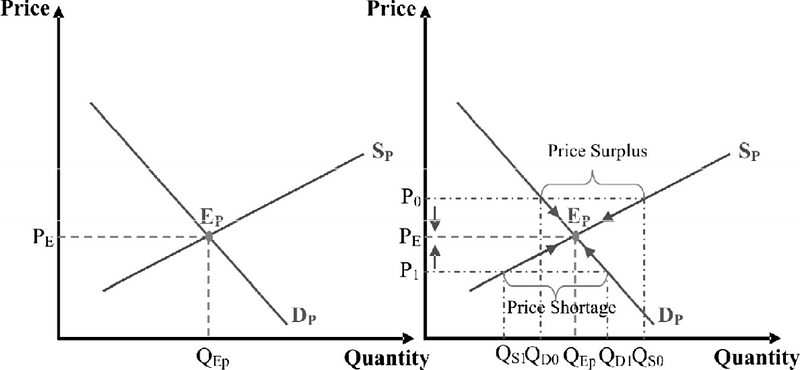
Long-run static equilibrium is a theoretical state in economics where, over an extended period, the following conditions hold true:
- Market supply and demand are perfectly balanced: There is no excess supply or demand, and the market price remains constant.
- Firms operate at minimum average total cost (ATC): They have achieved the most efficient production level, minimizing costs per unit of output.
- No economic profits are earned: Price equals average total cost (P = ATC), leaving no incentive for new firms to enter the market.
This state is considered “static” because it represents a stagnant scenario with no further changes in market conditions or firm behavior.
Long-Run Static Equilibrium and Perfect Competition:
Perfect competition, as discussed previously, is a market structure characterized by numerous firms, homogeneous products, and free entry and exit. In theory, perfectly competitive markets are expected to reach a long-run static equilibrium. With no single firm able to influence the market price, they compete fiercely, driving prices down to the minimum average cost. This eliminates economic profits, preventing new entrants and ensuring the existing firms operate at the efficient long-run equilibrium.
Kaldor’s Challenge:
Kaldor argued that achieving a long-run static equilibrium is impossible for several reasons:
- Firms are inherently dynamic: They constantly innovate, develop new technologies, and pursue growth strategies. This constant pursuit of improvement disrupts the static equilibrium assumption.
- Innovation creates disequilibrium: When a firm introduces a new product or technology, it disrupts the existing market landscape. This temporary period of disequilibrium creates opportunities for the innovative firm to gain a temporary advantage, potentially leading to a dominant position.
- Strategic behavior: Firms may engage in strategic actions like advertising, product differentiation, or mergers and acquisitions to gain a competitive edge. These actions further disrupt the static equilibrium and can lead to market power concentration.
Kaldor’s critique highlights how the dynamic nature of firms and their constant pursuit of growth and innovation prevent markets from achieving a true long-run static equilibrium. This creates opportunities for firms to exploit these dynamic changes and gain a competitive advantage, potentially leading to the emergence of monopolies or oligopolies.
Kaldor’s Path to Monopolies and Oligopolies: Nicholas Kaldor argued that the inherent dynamism of firms, coupled with the limitations of perfect competition, paves the way for the emergence of monopolies and oligopolies. Here’s how he explained this phenomenon:
Gaining an Advantage:
Kaldor emphasized that dynamic firms actively seek to gain an edge over their competitors by:
- Technological innovation: Developing new technologies or production methods can lead to cost advantages or allow firms to offer superior products, temporarily increasing market share and creating a competitive advantage.
- Economies of scale: As firms grow larger, they may benefit from economies of scale, allowing them to produce goods at a lower cost per unit compared to smaller competitors. This cost advantage can further strengthen their market position and create barriers to entry for new firms.
- Product differentiation: Introducing products with unique features or qualities can create a niche market and shield firms from direct competition. This allows them to command higher prices and potentially earn economic profits.
Exploiting Disequilibrium:
Kaldor argued that the dynamic nature of firms constantly disrupts the static equilibrium envisioned in perfect competition. This creates windows of opportunity for dynamic firms to exploit:
- When a firm introduces an innovation, it temporarily disrupts the market equilibrium, creating a period of disequilibrium. The innovative firm can leverage this period to gain a temporary advantage and potentially capture a significant market share.
- This temporary advantage can translate into long-term dominance if the firm can effectively defend its position through further innovation, cost advantages, or brand loyalty.
The Natural Outcome?
Kaldor’s analysis suggests that monopolies and oligopolies may not be aberrations but rather a natural outcome of dynamic firms operating in a world that deviates from the assumptions of perfect competition. The constant pursuit of growth, innovation, and strategic advantage by firms can lead to market power concentration, resulting in the emergence of dominant players in certain industries.
However, it’s important to note that Kaldor’s arguments do not imply complete market failure. While they highlight the potential for monopolies and oligopolies to emerge, they also acknowledge the role of government interventions and regulations in preventing excessive market power concentration and promoting fair competition.
Kaldor’s work provides a valuable perspective on understanding market dynamics and the factors that contribute to the rise of monopolies and oligopolies. His critique of perfect competition emphasizes the need to consider the dynamic and strategic behavior of firms when analyzing real-world market structures.
The Relevance of Kaldor’s Work Today: Despite being formulated decades ago, Nicholas Kaldor’s critique of perfect competition and his analysis of dynamic firms remain highly relevant in understanding contemporary market structures.
Understanding Dominant Tech Companies:
Kaldor’s framework sheds light on the rise of dominant tech companies like Google, Amazon, and Facebook. These companies:
- Continuously innovate: They invest heavily in research and development, constantly pushing the boundaries of technology and creating new products and services. This innovation often disrupts existing markets, creating temporary disequilibria that these companies can exploit to gain market share.
- Benefit from economies of scale: As their user base grows, these companies enjoy economies of scale, allowing them to offer services at lower costs and potentially squeezing out smaller competitors.
- Employ product differentiation: They leverage their platforms and user data to create differentiated experiences and build strong brand loyalty, further solidifying their market positions.
These strategies, analyzed through Kaldor’s lens, highlight how dynamic firms in today’s information age can achieve and maintain dominance, potentially leading to concerns about reduced competition and innovation in the long run.
Competition Policy and Antitrust Regulations:
Kaldor’s work suggests that competition policy and antitrust regulations need to adapt to the realities of dynamic markets. Some potential implications include:
- Focus on dynamic aspects: Competition authorities should not only look at static market share but also consider the innovative potential and strategic behavior of firms.
- Prevent anti-competitive practices: Regulations need to address practices like predatory pricing, mergers that stifle competition, or self-preferencing on platforms, which can hinder the growth of potential competitors.
- Promote innovation: Policies could encourage open innovation ecosystems and ensure access to data and resources for smaller players to foster healthy competition and prevent dominant firms from stifling technological advancements.
By acknowledging the dynamic nature of firms and the limitations of perfect competition, Kaldor’s work provides a valuable framework for policymakers and regulators to navigate complex market landscapes and ensure fair competition in the digital age.
It’s important to note that Kaldor’s work is not without its critics. Some argue that his framework overemphasizes the role of firms and underestimates the importance of external factors like consumer behavior, government policies, and social trends in shaping market structures. However, his core insights offer valuable perspectives for understanding contemporary market dynamics and their implications for competition, innovation, and policy frameworks.
Criticisms and Alternative Perspectives:
While Kaldor’s work offers valuable insights, it has also faced criticism:
- Overemphasis on firms: Some argue Kaldor overemphasizes the role of firms in shaping market structures, neglecting the influence of external factors like consumer preferences, government regulations, and broader economic trends.
- Underestimation of competition: Critics argue that Kaldor’s framework might underestimate the resilience of competition and the ability of new entrants to disrupt established firms, even in the face of temporary advantages.
Alternative perspectives on market structures include:
- Evolutionary economics: This approach emphasizes the dynamic nature of markets and the constant adaptation of firms to survive and grow. It highlights how established firms may not always maintain their dominance due to unforeseen disruptions and changes in the technological or economic landscape.
- Behavioral economics: This approach focuses on the psychological and cognitive biases of consumers and their impact on market dynamics. It suggests that even in imperfectly competitive markets, consumer behavior can influence market outcomes and prevent complete dominance by a single firm.
Real-World Examples:
- The rise of Amazon: Kaldor’s framework helps explain Amazon’s dominance in e-commerce. Constant innovation (e.g., AWS cloud computing), economies of scale, and product differentiation (Prime membership) have allowed them to gain a significant market share. However, the recent emergence of competitors like Shopify highlights the dynamic nature of the market and the potential for disruption.
- Smartphone market: Apple and Samsung account for a significant portion of the smartphone market. Their continuous advancements in design, technology, and brand loyalty align with Kaldor’s ideas, though competition from other companies like Xiaomi shows alternative perspectives in play.
Conclusion — Nicholas Kaldor’s critique of perfect competition and his emphasis on the dynamic nature of firms offer a compelling explanation for the rise of monopolies and oligopolies in seemingly static environments. By recognizing the relentless pursuit of growth, innovation, and strategic advantage by firms, Kaldor’s framework provides valuable insights for understanding contemporary market structures and the dominance of large corporations in the digital age. While his work is not without its critics, Kaldor’s core ideas remain highly relevant for policymakers and regulators seeking to foster fair competition, promote technological advancements, and ensure a healthy balance between dynamic firms and a competitive market landscape. As the business world continues to evolve, Kaldor’s pathbreaking work serves as a reminder that a static perspective is insufficient for understanding the dynamic forces that shape our markets.
Thanks.
 Pratik Ghansham Salvi Assistant Professor of Economics | Banking & Finance | IMF Finance & Development Contributor
Leave a comment