The economic theory of perfect competition has long been a cornerstone of analysis in partial equilibrium frameworks. This approach isolates a single market or good, assuming perfect information, price-taking behavior by firms, and constant returns to scale. However, within this framework, a fundamental tension arises when considering the concept of declining returns. This article explores this tension through the lens of Sraffa’s critique, highlighting the limitations of partial equilibrium analysis in capturing the complexities introduced by declining returns
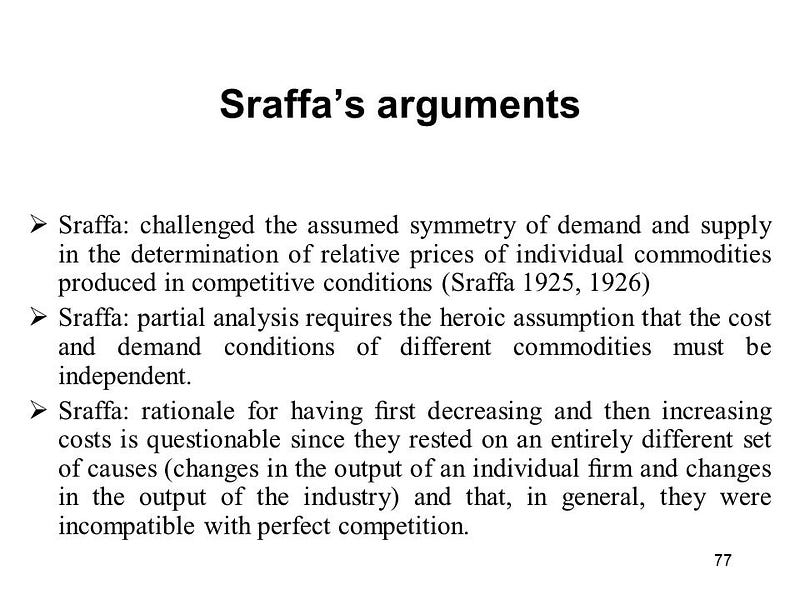
The economic theory of perfect competition has long been a cornerstone of analysis in partial equilibrium frameworks. This approach isolates a single market or good, assuming perfect information, price-taking behavior by firms, and constant returns to scale. However, within this framework, a fundamental tension arises when considering the concept of declining returns. This article explores this tension through the lens of Sraffa’s critique, highlighting the limitations of partial equilibrium analysis in capturing the complexities introduced by declining returns.
The Sraffian perspective emphasizes the importance of physical production processes and the role of embodied technical knowledge. In this framework, the notion of constant returns to scale becomes incompatible with the real-world scenario of finite resources and limitations on freely replicating production techniques. This article delves into these Sraffian insights, demonstrating how declining returns challenge the core assumptions of perfect competition within partial equilibrium analysis.
By examining the Sraffian critique, we gain a deeper understanding of the constraints inherent in partial equilibrium models. This analysis paves the way for exploring alternative theoretical frameworks that can better account for the complexities of production under declining returns.
Declining Returns and Partial Equilibrium: Understanding Production and Market Dynamics —
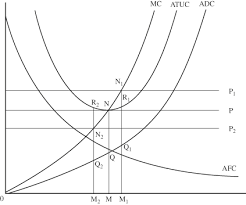
1. Declining Returns (Increasing Marginal Cost):
Imagine a bakery trying to increase its production of bread. Initially, adding more labor and ingredients might lead to a proportional increase in bread output. This is a scenario of constant returns.
However, as production continues to rise, the bakery might face limitations:
- Limited Resources: There might not be enough oven space to bake all the dough simultaneously, or skilled workers to handle a massive dough batch.
- Coordination Challenges: Managing a larger workforce and ingredient quantities becomes more complex, leading to inefficiencies and potential waste.
These limitations lead to declining returns. Each additional unit of output (bread) becomes more expensive to produce compared to the previous unit. This translates to increasing marginal cost. The marginal cost represents the additional cost incurred to produce one more unit of output.
2. Partial Equilibrium Analysis: A Simplified Lens
Economics often analyzes complex market interactions. Partial equilibrium analysis is a tool that focuses on a single market while assuming all other markets remain constant. This simplifies the analysis by isolating the cause-and-effect relationship within a specific market.
Here’s how this works:
- Imagine a market for apples. A partial equilibrium analysis would focus on the factors influencing the price and quantity of apples, like consumer demand and apple production costs.
- It would assume that prices of other fruits (oranges, bananas), wages for apple pickers, and overall economic conditions remain unchanged.
Why is Partial Equilibrium Useful?
- Teaching Tool: It provides a clear starting point to understand basic economic principles like supply and demand.
- Market Predictions: It can provide reasonable predictions for a specific market’s behavior (apple prices) under certain conditions (increased demand for apples).
Limitations of Partial Equilibrium:
- Interconnected Markets: In reality, markets are interconnected. A change in the apple market might affect the demand for oranges as substitutes. Partial equilibrium might miss these interdependencies.
- Long-Run Analysis: It may not capture long-term adjustments. For example, a sustained increase in apple prices might incentivize more farmers to enter the market, eventually affecting supply and price in the long run.
Combining Declining Returns and Partial Equilibrium:
Partial equilibrium analysis is often used to analyze how declining returns affect a specific market. For instance, if an industry experiences declining returns due to resource limitations, the partial equilibrium framework can help predict how this might lead to increased production costs and potentially higher prices within that specific market.
A declining return highlight the challenges of increasing production, while partial equilibrium analysis provides a simplified framework for understanding market dynamics. Understanding both concepts helps in comprehending production limitations and market responses in a complex economic system.
The Tension Between Declining Returns and Partial Equilibrium in Perfect Competition — While both declining returns and partial equilibrium analysis are valuable tools in economics, they can create tension when applied to perfectly competitive markets. Let’s delve deeper into this:
1. Declining Returns and the Shortcomings of Partial Equilibrium:
- Perfect Competition Assumption: One of the key assumptions of perfect competition is constant returns to scale. This means that when all inputs in production are increased proportionally, the output increases proportionally as well. There are no diminishing returns.
- Declining Returns Challenge: However, reality often involves declining returns. As a firm in a perfectly competitive market increases production, it might encounter resource limitations or coordination challenges, leading to increasing marginal costs.
- Partial Equilibrium’s Blind Spot: Partial equilibrium analysis, by assuming constant prices in other markets, overlooks these increasing costs. It might predict a continuous increase in output for a perfectly competitive firm as the price rises, neglecting the limitations of declining returns.
2. The Contradiction of Constant Returns and Declining Returns:
The core issue lies in the opposing assumptions:
- Perfect Competition: Constant returns to scale imply that firms can easily replicate their production process without encountering inefficiencies or limitations.
- Declining Returns: Reality suggests that as production increases, limitations arise, making it progressively more difficult and expensive to produce each additional unit.
3. Declining Returns and Price Determination in a Flawed Equilibrium:
Within a partial equilibrium framework for a perfectly competitive market:
- Initial Price Increase: An increase in demand might initially lead to a higher equilibrium price.
- Declining Returns Bite: Firms might try to increase production to meet the demand. However, declining returns would cause their marginal costs to rise.
- Unsustainable Equilibrium: The initially determined price might not be sustainable in the long run. Firms facing increasing marginal costs might be unwilling to produce at the initially predicted quantity.
- Market Adjustment: This could lead to a shortage in the market, causing further price adjustments.
In essence, partial equilibrium analysis, when applied to perfectly competitive markets with declining returns, might create a flawed picture of price determination. The predicted equilibrium might not be achievable due to the limitations of increasing costs.
Beyond the Flawed Equilibrium:
Economic models often consider long-run adjustments to account for declining returns. In the long run, higher prices might incentivize new firms to enter the market or existing firms to find ways to overcome limitations (e.g., technological advancements). This increased competition could eventually lead to a new equilibrium price that reflects the true cost of production with declining returns.
The tension between declining returns and perfect competition in partial equilibrium analysis highlights the limitations of simplified models. While partial equilibrium offers a starting point for understanding market dynamics, it’s crucial to consider real-world limitations like declining returns to get a more accurate picture of how markets function in the long run.
Sraffa’s Critique: Challenging the Perfect World of Partial Equilibrium —

1. Piero Sraffa: A Pioneer in Economic Theory
Piero Sraffa was a prominent Italian economist known for his contributions to economic theory, particularly his critique of neoclassical economic theory and his revival of classical economics. His book, “Production of Commodities by Means of Commodities,” challenged the dominant economic models of his time.
2. Sraffa’s Focus on Physical Production:
Sraffa argued that economic theory should pay closer attention to the physical realities of production processes. He emphasized the role of:
- Embodied Technical Knowledge: The skills and knowledge workers bring to the production process, which are not easily replicated.
- Real Inputs: The specific types and quantities of raw materials, labor, and machinery required for production.
3. Sraffa vs. Constant Returns:
The concept of constant returns to scale, a cornerstone of perfect competition in partial equilibrium models, assumes that output increases proportionally with input increases. Sraffa challenged this by highlighting:
- Physical Limitations: Production processes often face limitations on the amount of output achievable from a given set of inputs. This contradicts the idea of infinitely scalable production.
- Embodied Knowledge Constraints: The ability to replicate production efficiently depends on the availability of skilled workers and the transferability of embodied technical knowledge, which might be limited.
4. Sraffa and the Scarcity of Resources:
Sraffa’s emphasis on physical production processes shines a light on the scarcity of resources. He argued that:
- Real-World Limitations: Partial equilibrium models often overlook real-world limitations in resource availability, labor skills, and technological knowledge.
- Perfect Competition Unrealistic: The idealized world of perfect competition, with infinite scalability and perfect substitutability of factors of production, doesn’t reflect the limitations imposed by physical production processes.
Impact of Sraffa’s Critique:
Sraffa’s critique led to a reevaluation of economic models. Economists began to consider:
- The importance of physical production processes in determining prices and output.
- The limitations of perfect competition as a universal model.
- The role of scarcity and embodied technical knowledge in economic analysis.
Sraffa’s critique challenged the assumptions of constant returns and the idealized world of perfect competition within partial equilibrium models. His emphasis on physical production processes and real-world limitations opened doors for a more nuanced understanding of how economic systems function.
Sraffian Critique: Exposing the Flaws of Partial Equilibrium with Declining Returns — Piero Sraffa’s critique of neoclassical economics, particularly his focus on physical production processes, exposes the limitations of partial equilibrium analysis when applied to markets with declining returns. Here’s a breakdown of the implications:
1. Limitations of Partial Equilibrium:
- Ignoring Interconnectedness: Partial equilibrium, by assuming constant prices in other markets, fails to capture the interconnectedness of production processes in an economy with declining returns.
- Misleading Price Predictions: When declining returns set in, increasing production costs might not be reflected in the initially predicted equilibrium price within the partial equilibrium framework. This can lead to misleading predictions about market behavior.
2. Consequences of Ignoring Declining Returns:
- Unsustainable Equilibrium: The predicted equilibrium price in a partial equilibrium model with declining returns might not be sustainable in the long run. Firms facing increasing marginal costs might be unwilling to produce at the predicted quantity, leading to shortages and price adjustments.
- Inefficient Resource Allocation: Ignoring declining returns can lead to inefficient resource allocation. Firms might continue to expand production even when the marginal cost of production is high, leading to wasted resources.
3. Alternative Approaches:
Several theoretical approaches address some of the limitations highlighted by Sraffa:
- General Equilibrium Models: These models consider the entire economic system and the interactions between all markets. This allows for a more comprehensive analysis of how declining returns in one sector might affect prices and production in other sectors.
- Agent-Based Models: These models simulate the behavior of individual firms and consumers within an economy. This can provide insights into how declining returns might emerge at the micro level and affect market dynamics.
- Evolutionary Economics: This approach emphasizes the long-run adjustments in an economy. It can capture how firms might adapt to declining returns by developing new technologies or finding alternative production methods.
However, it’s important to note that:
- General equilibrium models can be complex and computationally expensive.
- Agent-based models are data intensive and may not always provide generalizable results.
- Evolutionary models are often long run in their focus and may not be suited for short-term analysis.
Sraffa’s critique reminds us of the limitations of simplified models. While partial equilibrium analysis offers a basic framework, it’s crucial to consider the complexities introduced by declining returns and explore alternative approaches that better capture these real-world limitations. Choosing the most suitable approach depends on the specific research question and the level of detail required.
Conclusion — The concept of declining returns, championed by Piero Sraffa, exposes the limitations of partial equilibrium analysis in understanding market dynamics. While partial equilibrium offers a simplified framework, it can create misleading predictions when applied to markets with declining returns. Sraffa’s emphasis on physical production processes and embodied technical knowledge compels us to consider the real-world limitations that constrain perfect competition and its idealized constant returns.
By acknowledging these limitations, we can move towards more comprehensive theoretical approaches, such as general equilibrium models, that better capture the interconnectedness of markets and the challenges posed by declining returns. Ultimately, Sraffa’s critique encourages us to view economic systems with a discerning eye, recognizing the complexities that underlie market behavior and the importance of considering real-world constraints for a more nuanced understanding of how our economies function.
Thanks.
 Pratik Ghansham Salvi Assistant Professor of Economics | Banking & Finance | IMF Finance & Development Contributor
Leave a comment