The business world thrives on dynamism, with new ventures constantly emerging and established players adapting to stay relevant. Yet, beneath the surface of this churn lies a curious phenomenon: the zombie firm. Unlike their terrifying namesakes, these companies aren’t flesh-eating monstrosities, but rather businesses that persist in a state of perpetual decline.
These seemingly functional entities are plagued by chronic losses, barely generating enough revenue to cover their expenses. Operating in a financial purgatory, they neither flourish nor truly die. But why, in a world driven by profit, do these zombie firms cling to existence? This article delves deep into the perplexing world of zombie firms, exploring the various factors that keep them afloat despite mounting losses. We’ll examine the potential benefits some see in these struggling businesses, from strategic investments for future growth to the impact on jobs and entire industries. Additionally, we’ll explore the potential drawbacks of zombie firms, including their drain on resources and their ability to stifle innovation within the larger economy. By understanding the motivations and consequences of zombie firms, we can gain valuable insights into the health and adaptability of the business landscape as a whole.
Zombie Firms: The Walking Dead of the Business World — Imagine a company that stumbles on like a shambling corpse, barely clinging to life. This is the apt imagery behind the term zombie firm. These are businesses that are highly indebted and struggle to generate enough profit to cover their basic expenses, let alone pay off their debts.
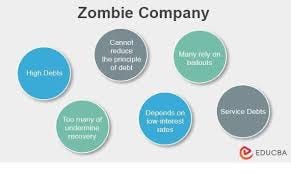
Here’s a deeper dive into what defines a zombie firm:
- Chronic Losses: Unlike healthy companies that experience occasional setbacks, zombie firms are often plagued by consecutive years of losses. Their core business model might be fundamentally flawed, or they could be struggling in a declining industry.
- Debt Treadmill: Zombie firms are burdened by a heavy debt load. They can only manage to scrape by enough cash flow to cover the interest payments on their debts, but not the actual principal amount. This creates a vicious cycle, where they’re constantly running on a treadmill of debt, with no hope of getting ahead.
- Stagnant Growth: These companies exhibit low productivity and stagnant growth. They lack the resources to invest in innovation, new technologies, or employee training. This stagnation further hinders their ability to compete and generate profits.
Refinancing Reliance: Since zombie firms can’t pay down their debts, they become heavily reliant on refinancing their loans. This means convincing creditors to extend the life of their debt or secure new loans simply to stay afloat. However, this is a precarious situation. Any economic downturn or rise in interest rates could make refinancing difficult, pushing them towards collapse.
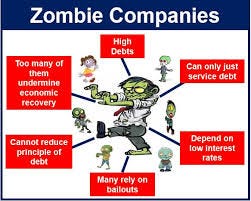
In essence, zombie firms are like the walking dead of the business world. They drain resources, stifle innovation, and impede overall economic growth.
Why Do Zombie Firms Persist? A Look at the Lifeline Mechanisms — Despite their lack of profitability and sluggish performance, zombie firms often manage to cling to life. Here’s a breakdown of the key factors that contribute to their persistence:
- Government Support: In some cases, governments might prop up zombie firms through various measures:
- Loan guarantees: This reduces the risk for lenders, making it easier for zombie firms to secure loans and stay afloat.
- Subsidies: Direct financial aid from the government can help zombie firms meet operational costs and keep them operational.
- Bailouts: In extreme cases, governments might resort to bailouts, particularly for companies deemed strategically important or to prevent mass job losses. These measures, while aimed at mitigating social and economic disruption, can hinder market efficiency and allow inefficient firms to continue operating.
- Low Interest Rates: When interest rates are low, it becomes easier for zombie firms to manage their debt burden. They can use a larger portion of their cash flow to cover interest payments, postponing the day of reckoning. However, this is a double-edged sword. When interest rates inevitably rise, it can push these already fragile firms over the edge.
- Intangible Assets: Even struggling firms might possess valuable intangible assets that provide a lifeline. These could include:
- Brand Recognition: A well-established brand name can still hold value, attracting customers even if the company itself is struggling.
- Skilled Workforce: An experienced and talented workforce can be an asset, especially in niche industries. This expertise could be attractive to potential buyers or act as a foundation for a turnaround strategy.
- Intellectual Property: Patents, trademarks, or proprietary technology can hold significant value, even for an underperforming company. This intellectual property could be attractive to a competitor looking to expand its offerings.
- Debt Overhang: The fear of bankruptcy can be a perverse incentive for keeping zombie firms afloat. Here’s why:
- Large Debt Repayments: Zombie firms often have a mountain of debt. If the company declares bankruptcy, creditors might demand immediate repayment of the entire principal amount. This can be devastating for the owners and employees, creating a disincentive to pursue closure.
- Complex Ownership Structures: Some companies have convoluted ownership structures with multiple stakeholders. Reaching a consensus on closure or restructuring can be a cumbersome process, further delaying the inevitable. This complexity can act as a shield, allowing zombie firms to linger in a state of suspended animation.
These factors, along with others, create a situation where zombie firms persist, despite their negative impact on the overall economy. Understanding these reasons is crucial for policymakers and economic actors to devise strategies to encourage efficient resource allocation and foster a more vibrant business landscape.
The Two Sides of the Coin: Zombie Firms and their Economic Impact — The existence of zombie firms presents a complex dilemma for policymakers and the economy at large. While they might offer some potential benefits, their drawbacks are significant and far-reaching. Let’s delve deeper into both sides of the coin:
Benefits:
- Preserving Jobs: In the short term, zombie firms can act as a buffer against unemployment. By keeping their doors open, they provide a source of income and livelihood for employees. However, this benefit is often temporary. Without addressing underlying problems, these jobs may eventually disappear as the company continues to struggle.
- Maintaining Competition: In certain industries, a minimal level ofcompetition is necessary to prevent monopolies. Zombie firms, despite their limitations, can contribute to this by keeping established players on the market. However, the quality of competition offered by a struggling firm is debatable. They might not be able to invest in innovation or offer competitive prices, ultimately hindering overall market dynamism.
- Turnaround Potential: In some cases, zombie firms might have the potential for a turnaround. With a change in leadership, restructuring, or a shift in market conditions, they could become viable businesses again. However, this is a gamble, and the resources used to prop up a struggling firm could be better allocated to support promising startups or growing companies.
Drawbacks:
- Resource Drain: Zombie firms are resource guzzlers. They soak up credit that could be available to more productive firms, hindering overall economic growth. Banks might be hesitant to lend to new ventures or innovative companies if they are already burdened with risky loans to struggling firms.
- Innovation Stifling: These companies are unlikely to invest in research and development (R&D) or new technologies. Their focus is simply on survival, leaving innovation to take a backseat. This can stifle overall economic progress and make the economy less competitive in the global marketplace.
- Capital Misallocation: The presence of zombie firms distorts the allocation of capital. Resources are channeled towards keeping failing companies afloat, rather than being directed towards more productive sectors with higher growth potential. This misallocation hinders long-term economic growth and prosperity.
While zombie firms might offer some temporary benefits, their overall impact on the economy is negative. They drain resources, stifle innovation, and distort capital allocation. Addressing this issue requires a multi-pronged approach, including fostering a business environment that encourages innovation and facilitates efficient market exits for failing firms.
Potential Solutions for the Zombie Firm Problem — The persistence of zombie firms demands a multi-faceted approach. Here’s a look at some potential solutions that leverage both policy changes and market forces, along with restructuring possibilities:
Policy Changes:
- Targeted Support Programs: Revise government support programs to prioritize promising startups and sectors with high growth potential. This ensures resources aren’t wasted on propping up failing firms.
- Stricter Loan Requirements: Implement stricter lending standards for banks and other financial institutions. This discourages risky loans to already struggling businesses, promoting financial prudence.
- Bankruptcy Reform: Streamline bankruptcy procedures to facilitate smoother exits for zombie firms. This reduces the burden on the economy and allows resources to be reallocated more efficiently.
Market Forces:
- Rising Interest Rates: Higher interest rates can make it more expensive for zombie firms to service their debt burden. This could force them to restructure, seek mergers, or ultimately exit the market, making way for more productive firms.
- Increased Competition: A dynamic and competitive market environment encourages innovation and efficiency. Increased competition can expose the weaknesses of zombie firms, pressuring them to improve or face closure.
Restructuring:
- Debt Forgiveness: In some cases, partial debt forgiveness might incentivize restructuring and a turnaround for viable zombie firms. This approach requires careful assessment to ensure it doesn’t reward mismanagement.
- Mergers and Acquisitions: Encourage mergers and acquisitions involving zombie firms. Healthy companies can acquire assets, talent, or market share from struggling firms, leading to consolidation and a more efficient market.
Zombie Firms: The Walking Dead of the Business World — Zombie firms, companies with high debt burdens and stagnant growth, pose a significant challenge to economic health. Their continued existence drains resources, hinders innovation, and distorts capital allocation. This article delves into the complexities surrounding zombie firms, exploring potential solutions, real-world examples, and international perspectives.
The Problem and Its Impact
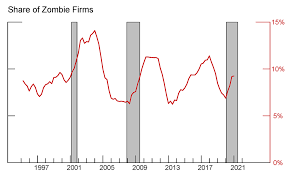
Research by the International Monetary Fund (IMF) in 2023 ([IMF Working Paper WP/23/125]) highlights the rise of zombie firms globally. The share of listed and private non-financial zombie firms has been increasing, particularly since the Great Recession and the COVID-19 pandemic. This trend is concerning as it suggests a growing number of unproductive firms are siphoning resources away from more dynamic businesses.
A 2022 study by the Harvard Business Review ([Harvard Business Review, Can Zombie Firms Survive Rising Interest Rates?]) points out the negative impact of zombie firms on non-zombie firms in the same industry. The presence of zombies can lead to persistently lower financial performance for healthy businesses, hindering overall economic growth.
Potential Solutions
Addressing the zombie firm issue requires a multi-pronged approach:
- Policy Changes: Governments can adjust support programs to target promising startups and industries with high growth potential. Additionally, stricter loan requirements for banks can discourage risky lending practices. Streamlining bankruptcy procedures can facilitate smoother exits for failing firms, allowing for a more efficient reallocation of resources.
- Market Forces: Rising interest rates can force zombie firms to restructure, seek mergers, or exit the market altogether, paving the way for more productive businesses. Increased competition can also expose the weaknesses of zombie firms, pressuring them to innovate or face closure.
- Restructuring: In some cases, carefully considered debt forgiveness or Zombie Firms: The Walking Dead of the Business Worldmergers and acquisitions involving zombie firms might lead to viable businesses. However, such measures require thorough evaluation to avoid rewarding mismanagement.
Real-World Examples
Across various industries, we can find examples of companies exhibiting zombie firm characteristics:
- Retail: Department stores in developed economies often struggle with declining foot traffic and rising online competition. Some may fall into the zombie trap, barely covering debt payments with shrinking profits.
- Steel Industry: Companies in this sector might be burdened with legacy debt and struggle to compete with lower-cost producers in emerging markets. This can lead to a situation where they’re just limping along, unable to invest in modernization.
International Perspectives
The issue of zombie firms is not limited to any one country. The IMF study mentioned earlier ([IMF Working Paper WP/23/125]) found a higher prevalence of zombie firms in countries with:
- Looser macroprudential stances (regulations governing risks in the financial system)
- Weaker insolvency frameworks (processes for dealing with bankruptcies)
- Lower GDP growth
- Lower interest rates
This suggests that a combination of factors contributes to the persistence of zombie firms, and solutions may require international cooperation and harmonization of regulations.
A Balanced View
While the negative impacts of zombie firms are significant, it’s important to acknowledge a few potential benefits:
- Job Preservation: In the short term, zombie firms can act as a buffer against unemployment, providing a source of income for employees.
- Turnaround Potential: A small number of zombie firms might have the potential for a turnaround with a change in leadership or market conditions. However, this is not guaranteed, and the resources used to support such firms could be better allocated elsewhere.
Conclusion — Zombie firms, companies that persist despite chronic losses, represent a significant challenge to economic health. Their existence drains resources, hinders innovation, and distorts capital allocation. However, addressing this issue requires a nuanced approach.
While policy changes like stricter loan requirements and bankruptcy reform can promote financial prudence and smoother exits, we must also acknowledge the potential benefits of zombie firms. In some cases, they can act as a temporary buffer against unemployment or hold potential for a turnaround.
The key lies in striking a balance. By fostering a dynamic and competitive business environment that encourages innovation and facilitates efficient exits for failing firms, policymakers and economic actors can create a landscape where healthy businesses can thrive. Understanding the international dimensions of the zombie firm phenomenon and acknowledging the potential benefits, while limited, are crucial for developing effective solutions that promote long-term economic growth.
The future of the business landscape hinges on our ability to address the challenge of zombie firms. Through a combination of targeted policies, market forces, and strategic restructuring, we can pave the way for a more vibrant and resilient economy.
Thanks.
 Pratik Ghansham Salvi Assistant Professor of Economics | Banking & Finance | IMF Finance & Development Contributor
Leave a comment