
The concpet of price discrimination is possible only in the case of imperfect competition more specifically it depends upon the degree of imperfection in the market. For example, pure monopoly is most imperfect form of market structure where perfect competition has no imperfection at all and hence it is cosidered as the most idealstic form of market structure. However, in the real dynamic world these two market tructures is rarely found instead in between them there are various other market structures such as monoplistic competition, oligopolistic competition, duopoly market structures, etc.
In this article I will be discussing the phenomenon of price discrimination with regard to monopolistic competition and how this can be equitable and fair from the point of view of resource allocation and distributive efficiency. But before that I will expalain certain aspects of perfect competition because under it resource allocation is Pareto Optimal or maximum social welfare can be achived.
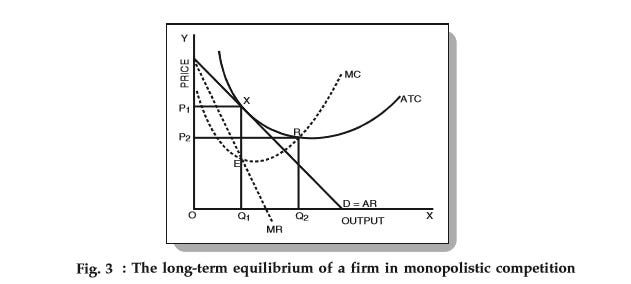
Monopolistic competition, characterized by numerous firms offering similar but differentiated products, presents a unique environment for price discrimination. While not monopolies, these firms possess some control over pricing due to product variation. The question arises: can price discrimination in this context achieve both efficiency, maximizing total surplus for producers and consumers, and equity, ensuring fair treatment for all buyers?
This article explores this very question. We will examine the different forms of price discrimination and their potential impact on efficiency in monopolistic competition. We will then analyze the concept of equity and how price discrimination might create disparities among consumers. Finally, we will weigh the trade-offs between efficiency and equity, considering potential justifications for price discrimination within the framework of monopolistic competition.
Price Discrimination: Charging What Customers Will Bear — Price discrimination is a pricing strategy where a company charges different prices for the same good or service to different customers. This contrasts with uniform pricing, where everyone pays the same price. Companies engage in price discrimination to maximize profits by charging high prices to customers willing to pay more and lower prices to those who are more price-sensitive.
There are three main degrees of price discrimination, each with varying levels of difficulty to implement:
1. First-Degree Price Discrimination (Perfect Price Discrimination):
This is the most challenging form to achieve. Here, the company charges each customer the absolute maximum price they are willing to pay, essentially extracting all their consumer surplus. Imagine a salesperson at a fancy flea market who negotiates a unique price with every customer based on their perceived interest and budget.
Monopolistic Competition Example: A high-end car dealership might use personalized pricing for luxury cars. They may negotiate different prices with each customer depending on their perceived budget and willingness to pay.
2. Second-Degree Price Discrimination (Quantity Discrimination):
This strategy offers different prices based on the quantity purchased. Companies achieve this through discounts for bulk purchases or tiered pricing plans.
Monopolistic Competition Example: A movie theater might offer cheaper tickets for matinee shows or discounted ticket bundles for multiple movies. Phone companies often have tiered data plans where customers pay more for higher data allowances.
3. Third-Degree Price Discrimination (Group Pricing):
This is the most common form of price discrimination. Here, the company charges different prices to different customer groups based on factors like age, location, income, or occupation.
Monopolistic Competition Example: A gym might offer discounted memberships for students or seniors. A clothing store might have different pricing for their children’s and adult clothing lines. Amusement parks often have cheaper tickets for children or special discounts for local residents.
Conditions for Price Discrimination:
It’s important to note that price discrimination isn’t always feasible. Here are some key requirements for it to work effectively:
- Market Power: The company must have some degree of market power, like a monopoly or operate in a monopolistically competitive market.
- Segmented Market: The market needs to be divided into distinct groups with different price elasticities of demand (how much demand changes with price).
- Limited Resale: The company needs to prevent customers from buying at a lower price and reselling at a higher price (arbitrage).
Impact and Considerations:
Price discrimination can be a successful strategy for companies to increase profits, but it can also raise concerns:
- Reduced Consumer Surplus: Consumers in some groups may end up paying more than under uniform pricing.
- Fairness Concerns: Some may view it as unfair that similar customers pay different prices.
- Legality: Price discrimination can be illegal in some cases, particularly when based on certain factors like race or ethnicity.
Understanding price discrimination is crucial for both businesses and consumers. Businesses can leverage it to reach different customer segments and maximize profits, while consumers should be aware of potential price variations and shop around for the best deals.
Efficiency in Monopolistic Competition with Price Discrimination — Monopolistic competition, with its close substitutes and product differentiation, presents an interesting case for price discrimination and its impact on efficiency.
Perfect Price Discrimination and Allocative Efficiency
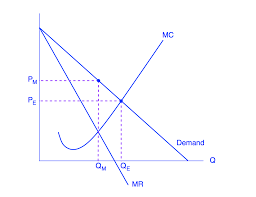
Imagine a scenario where a monopolistically competitive firm achieves perfect price discrimination. This means they charge each customer the exact maximum price they’re willing to pay for each unit of the product.
Under perfect price discrimination, the firm would be extracting all consumer surplus. However, this surprisingly leads to allocative efficiency, the ideal production level where marginal cost (MC) equals marginal benefit (MB).
- Since the firm charges each customer their maximum willingness to pay, each unit sold generates the same additional benefit for the consumer (marginal benefit) as it costs the firm to produce (marginal cost).
- There’s no incentive for the firm to produce more or less. Producing more would mean selling units to customers who value them less than the cost of production, resulting in a loss. Similarly, producing less would leave willing customers unsatisfied, representing a missed opportunity for profit.
- In essence, the firm acts like a perfectly competitive firm, producing at the point where MC = MB, even though it enjoys some degree of market power due to product differentiation.
Limitations of Perfect Price Discrimination —
Unfortunately, perfect price discrimination is a theoretical ideal rarely achievable in the real world. Here’s why:
- Information Asymmetry: Companies rarely have complete information about each customer’s willingness to pay. Obtaining such detailed information can be expensive and intrusive.
- Cost of Implementation: Tailoring prices to individual customers can be administratively complex and costly.
- Resale and Arbitrage: If customers in a lower-priced group can resell to those in a higher-priced group (arbitrage), the entire price discrimination strategy falls apart.
Imperfect Price Discrimination and Efficiency —
In reality, firms practice imperfect price discrimination, relying on techniques like second and third-degree discrimination. While less efficient than perfect discrimination, the impact on efficiency compared to uniform pricing is a complex issue:
- Potential for Increased Efficiency: Imperfect price discrimination can nudge production closer to the MC = MB level by allowing firms to charge higher prices to customers with less elastic demand (less sensitive to price changes). This allows them to recoup some of the lost consumer surplus and potentially increase output compared to uniform pricing.
- Deadweight Loss: However, imperfect discrimination is rarely perfect. Companies might misclassify customers or overcharge some groups, leading to a deadweight loss — a situation where some potential trades are not made because the price is too high for some consumers.
- Administrative Costs: Implementing imperfect price discrimination also involves administrative costs, which can reduce overall efficiency.
The net effect of imperfect price discrimination on efficiency in monopolistic competition is ambiguous. It depends on the specific market dynamics, the degree of price differentiation, and the effectiveness of the implemented strategy. In some cases, it might lead to a small improvement compared to uniform pricing, but it can also lead to inefficiencies if not implemented carefully.
Price discrimination in monopolistic competition can be a double-edged sword. While perfect discrimination theoretically achieves allocative efficiency, it’s unrealistic. Imperfect discrimination has the potential to improve efficiency over uniform pricing but can also lead to deadweight losses and reduced overall welfare. Understanding the trade-offs and limitations is crucial for both firms considering such strategies and policymakers concerned about market efficiency.
Equity Considerations in Price Discrimination — Equity, in the context of pricing, refers to the fairness and impartiality of a pricing strategy. Price discrimination, while potentially beneficial for businesses, can raise concerns about equity and fairness. Let’s delve deeper into these considerations.
Fairness and Price Discrimination —
Price discrimination can create a sense of unfairness for several reasons:
- Unequal Treatment: Charging different prices to different customers for the same good can be seen as unfair, especially if the price difference isn’t based on a legitimate cost justification.
- Exploitation: Companies with significant market power might exploit certain customer segments by charging them higher prices, particularly if those customers have limited choices or inelastic demand (less sensitive to price changes).
- Income Disparities: Price discrimination can exacerbate income disparities. For instance, student discounts for essential goods like medicine or education can be helpful, but they might also leave lower-income individuals who don’t qualify for such discounts at a disadvantage.
Here’s a breakdown of how different consumer segments might be affected:
- High-Income Consumers: They might benefit from lower prices through bulk discounts or loyalty programs
- Low-Income Consumers: They might face higher prices for smaller quantities or essential goods they can’t afford in bulk.
- Students and Seniors: They might receive special discounts, but this can exclude others who might also need those goods but don’t qualify for the specific category.
Ethical Concerns:
Charging different prices based on factors beyond a consumer’s willingness to pay raises ethical concerns. For example:
- Geographic Discrimination: Charging higher prices in areas with lower average income can exploit residents with fewer options.
- Age Discrimination: Charging higher prices to seniors for essential goods they rely on can be seen as unfair.
- Discriminatory Pricing: Charging different prices based on race, ethnicity, or gender is not only unfair but also illegal in many jurisdictions.
These practices can create a sense that the company is taking advantage of vulnerable populations or using irrelevant criteria to determine price.
Balancing Efficiency and Equity:
The challenge lies in finding a balance between efficiency (maximizing production at the optimal level) and equity (ensuring fair treatment for all consumers). While price discrimination can potentially increase efficiency for companies, it can come at the cost of reduced equity.
Price discrimination in monopolistic competition raises complex equity concerns. Companies need to consider the potential impact on different consumer segments and avoid exploiting vulnerable populations. Finding a pricing strategy that balances efficiency with fairness is crucial for businesses to operate ethically and responsibly.
Trade-offs and Justifications in Price Discrimination — Price discrimination in monopolistic competition presents a classic trade-off between efficiency and equity. Let’s explore the potential gains and losses, justifications for its use, and potential regulatory approaches.
Balancing the Scales: Efficiency vs. Equity
Efficiency Gains:
- Increased Production: Imperfect price discrimination can allow firms to charge higher prices to customers with less elastic demand, potentially leading to increased output compared to uniform pricing. This can benefit society as a whole by producing more goods.
- Improved Cost Recovery: Price discrimination can help firms recoup fixed costs by charging higher prices to those who are willing to pay more. This can lead to lower prices for some consumers and potentially make the good or service more accessible.
Equity Losses:
- Reduced Consumer Surplus: Consumers in some segments might pay more than they would under uniform pricing. This reduces consumer surplus, the difference between what a consumer is willing to pay and the actual price they pay.
- Income Disparity: Price discrimination can exacerbate income disparities, as wealthier consumers might benefit from discounts while lower-income consumers face higher prices.
- Exploitation: Companies with market power might exploit certain customer segments with limited choices or inelastic demand.
Finding the Middle Ground:
The optimal pricing strategy depends on the specific market and the potential impact on both efficiency and equity. In some cases, the efficiency gains might outweigh the equity losses. However, it’s crucial to consider the ethical implications and avoid practices that exploit vulnerable populations.
Justifications for Price Discrimination in Monopolistic Competition —
- Reaching Underserved Markets: Price discrimination can be used to reach underserved markets by offering lower prices to attract new customer segments. For example, student discounts can make educational resources more accessible.
- Covering Fixed Costs: Offering discounts for larger quantities or bulk purchases can help firms cover fixed costs associated with production and distribution. This allows them to offer lower prices for smaller quantities, potentially benefiting a wider range of consumers.
- Product Differentiation: Monopolistic competition relies on product differentiation. Price discrimination can be a tool to reflect the perceived value of different versions of the product. For example, a movie theater might charge a premium for premium seating or advanced ticket purchases.
The key is to ensure that the justification is legitimate and the price discrimination doesn’t lead to significant exploitation of any consumer segment.
Mitigating Negative Equity Impacts —
Policymakers can consider regulations or policies to address the negative equity impacts of price discrimination:
- Price Transparency: Requiring companies to be transparent about their pricing practices can empower consumers to shop around and make informed decisions.
- Regulation of Discriminatory Factors: Banning price discrimination based on factors like race, ethnicity, or gender protects vulnerable populations from exploitation.
- Focus on Efficiency Gains: Encouraging forms of price discrimination that demonstrably lead to increased efficiency and potentially lower overall prices for some consumers, such as quantity discounts.
These measures can help ensure that price discrimination in monopolistic competition doesn’t come at the excessive cost of fairness and consumer welfare.
Price discrimination in monopolistic competition is a complex issue with both potential benefits and drawbacks. Weighing the efficiency gains against the equity losses and considering justifications for its use is crucial. Regulations and policies that promote transparency and focus on efficiency gains can help mitigate the negative impacts and ensure a fairer marketplace. Ultimately, the goal is to strike a balance that allows businesses to operate profitably while ensuring fair treatment for all consumers.
Conclusion — The question of whether a divided market under price discrimination can be both efficient and equitable in monopolistic competition remains a complex one. While perfect price discrimination theoretically achieves allocative efficiency, its real-world implementation is impractical. Imperfect price discrimination, while more prevalent, can create trade-offs between efficiency and equity.
Consumers with lower willingness to pay might face higher prices, raising concerns about fairness. However, price discrimination can also allow firms to cater to diverse needs, potentially expanding market reach and benefiting underserved segments.
The key lies in striking a balance. Regulations or industry practices that mitigate the negative aspects of price discrimination on equity, while allowing firms some flexibility in pricing strategies, could be a possible solution.
Ultimately, the debate on price discrimination in monopolistic competition highlights the ongoing tension between maximizing economic efficiency and ensuring fair treatment for all consumers. Further research is needed to explore how this balance can be achieved in different market settings, fostering innovation and consumer welfare without compromising on equity.
Thanks.
 Pratik Ghansham Salvi Assistant Professor of Economics | Banking & Finance | IMF Finance & Development Contributor
Leave a comment