From globalisation all economies are integrated to one another in extensive ways. Whether we talked about developing economies or developed due to integration of world economic system. Therefore, when one country experiences economic boom other countries also benefiting from this economic boom and exa ding their trade and economic growth. On the other hand if one of countries facing recessionary condition it spread to other economies and negatively affecting the financial markets and global trade.
We already experienced this type of conditions during 2008 global financial crisis and many others like Asian Financial crisis, etc.
Capital flight, the rapid outflow of capital from a country, has emerged as a significant challenge for many developing economies. This phenomenon, often triggered by economic instability, political uncertainty, or unfavorable investment climates, has far-reaching implications for a nation’s financial system, foreign direct investment (FDI), and overall economic growth and development.
When capital flees a country, it can lead to a decline in domestic investment, currency devaluation, and increased borrowing costs. These adverse effects can hinder economic growth, exacerbate poverty, and undermine efforts to improve living standards. Additionally, capital flight can discourage foreign investors, as it signals economic instability and political risk.
This article delves into the intricate relationship between capital flight, FDI, and economic development. It will explore the mechanisms through which capital flight can deter FDI, analyze the impact of capital flight on economic growth, and discuss potential policy measures to mitigate its adverse effects. By understanding the complexities of this issue, policymakers and international organizations can develop effective strategies to promote sustainable economic development in developing economies.
What is the Capital Flight and why it is important for development perspective?
Capital flight refers to the rapid outflow of capital from a country, often driven by concerns about economic or political instability. This can take various forms, including —
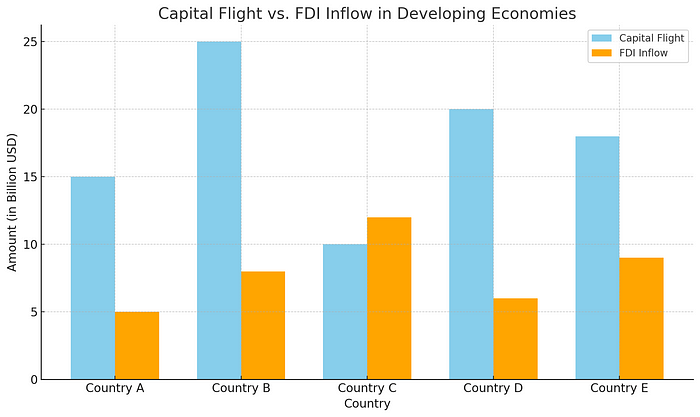
- Illicit Flows: These involve the movement of funds across borders without the knowledge or consent of authorities. They are often facilitated through complex financial instruments, tax havens, and money laundering schemes.
- Tax Evasion: Individuals and corporations may seek to avoid paying taxes by transferring assets to foreign jurisdictions with lower tax rates or more lenient regulations.
- Trade Mispricing: This occurs when goods or services are intentionally undervalued or overvalued in international trade transactions to transfer funds out of the country.
What are the causes of capital flight?
- Political Instability: Political unrest, coups, or changes in government can create uncertainty and erode investor confidence.
- Economic Uncertainty: Economic downturns, high inflation, or currency devaluation can lead to fears of asset depreciation and loss of purchasing power.
- Corruption: Corruption and weak governance can undermine the rule of law and discourage investment.
- Weak Regulatory Frameworks: Lax financial regulations and ineffective enforcement can facilitate illicit financial flows.
- Capital Controls: Ironically, strict capital controls can sometimes exacerbate capital flight as individuals and businesses seek to circumvent restrictions.
What is the impact of Capital Flight on Economy?
Capital flight can have severe consequences for a country’s economy —
- Reduced Investment: It can deter foreign investment and reduce domestic savings, hindering economic growth.
- Currency Depreciation: It can lead to currency devaluation, making imports more expensive and fueling inflation.
- Debt Accumulation: Governments may resort to borrowing to finance deficits, increasing the country’s debt burden.
- Reduced Tax Revenue: Tax evasion and trade mispricing can erode the government’s revenue base, limiting its ability to provide public services.
- Social and Political Unrest: Economic hardship caused by capital flight can lead to social unrest and political instability.
How to address Capital Flight issue in Developing countries?
To mitigate capital flight, governments can implement various strategies —
- Strengthening Institutions: Improving governance, reducing corruption, and enhancing the rule of law can create a more stable and attractive investment environment.
- Implementing Sound Economic Policies: Maintaining macroeconomic stability, controlling inflation, and promoting sustainable growth can boost investor confidence.
- Enhancing Financial Regulation: Strengthening financial regulations and improving tax administration can reduce opportunities for illicit financial flows.
- International Cooperation: Collaborating with other countries to share information and coordinate efforts to combat tax evasion and money laundering can be effective.
- Promoting Transparency and Accountability: Increasing transparency in financial transactions and holding individuals and corporations accountable for their actions can deter capital flight.
By addressing the underlying causes of capital flight and implementing effective policies, countries can protect their economies and promote sustainable development.
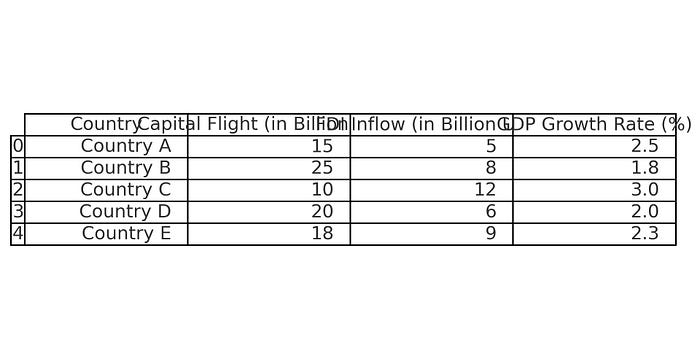
The Impact of Capital Flight on FDI — Capital flight, the rapid outflow of capital from a country, has a significant negative impact on foreign direct investment (FDI). It creates a less attractive investment climate, erodes investor confidence, and weakens financial markets.
Deterrent Effect:
- Signal of Economic Instability: Capital flight often serves as a red flag for potential investors. It signals underlying economic problems, such as political instability, corruption, or poor economic management. This perception of risk deters foreign investors from committing capital to the country.
- Uncertainty and Risk: Capital flight creates uncertainty about the future economic environment. Investors are hesitant to invest in countries with high levels of uncertainty, as it increases the risk of losing their investment.
Reduced Investor Confidence:
- Eroded Trust: Capital flight can erode investor confidence in a country’s economic policies and institutions. When domestic investors lose faith in the economy and withdraw their funds, it sends a negative signal to foreign investors.
- Fear of Expropriation: In some cases, capital flight can be a symptom of a deteriorating investment climate, including increased risk of expropriation or discriminatory policies against foreign investors. This fear further discourages FDI
Weakened Financial Markets:
- Reduced Liquidity: Capital flight can lead to a significant reduction in liquidity in domestic financial markets. This can make it difficult for businesses to access financing, hindering economic growth and investment.
- Increased Volatility: The sudden outflow of capital can increase market volatility, making it harder for investors to predict future returns and increasing the risk of losses.
- Potential Financial Crises: In severe cases, capital flight can trigger a financial crisis, leading to bank runs, currency devaluation, and economic recession. This can have a devastating impact on FDI, as investors may avoid countries perceived to be at risk of financial instability.
Capital flight has a detrimental impact on FDI by creating a less attractive investment climate, eroding investor confidence, and weakening financial markets. To attract FDI, countries must address the underlying causes of capital flight, such as political instability, corruption, and poor economic policies. By implementing sound economic policies, strengthening institutions, and improving the investment climate, countries can mitigate the negative effects of capital flight and encourage foreign investment.
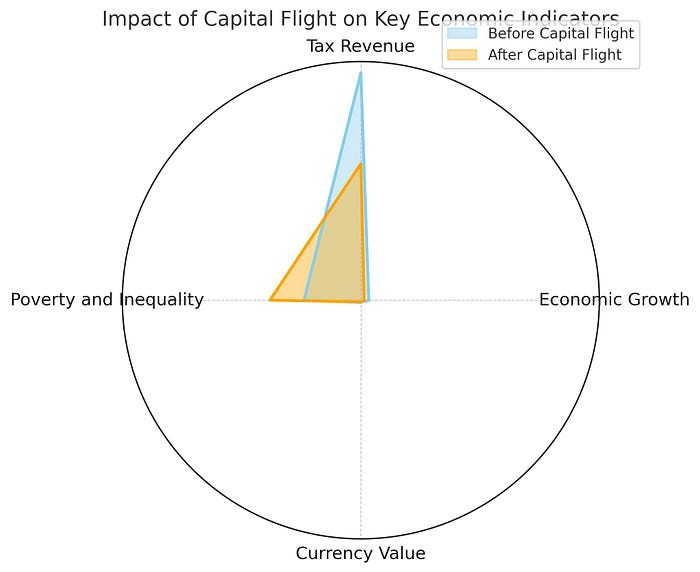
The Impact of Capital Flight on Economic Growth and Development — Capital flight, the rapid outflow of capital from a country, has a profound negative impact on economic growth and development. It can lead to a range of adverse consequences, including slower economic growth, reduced tax revenue, increased poverty and inequality, and currency depreciation.
Slower Economic Growth:
- Reduced Investment: Capital flight diminishes the pool of domestic savings available for investment. This can lead to a decline in investment in productive sectors such as manufacturing, infrastructure, and technology, which are crucial for long-term economic growth.
- Decreased Consumption: When capital leaves a country, it can lead to a contraction in domestic demand. This can reduce consumption and investment, further slowing down economic growth.
Reduced Tax Revenue:
- Tax Evasion: Capital flight often involves tax evasion, as individuals and corporations seek to avoid paying taxes by transferring assets to tax havens. This reduces government revenue, limiting its ability to fund public services, infrastructure, and social programs.
- Reduced Economic Activity: Reduced investment and consumption due to capital flight can lead to a decline in economic activity, further eroding the tax base.
Increased Poverty and Inequality:
- Reduced Social Spending: Decreased tax revenue can force governments to cut back on social spending, such as education, healthcare, and social safety nets. This can disproportionately affect the poor and vulnerable, exacerbating poverty and inequality.
- Reduced Job Opportunities: Capital flight can lead to job losses, particularly in sectors that rely on foreign investment. This can increase unemployment and poverty rates.
Currency Depreciation:
- Loss of Foreign Exchange Reserves: Capital flight can deplete a country’s foreign exchange reserves, making it more difficult to stabilize the currency.
- Increased Import Costs: Currency depreciation can lead to higher import prices, increasing the cost of living and fueling inflation. This can further erode economic stability and reduce the purchasing power of consumers.
To mitigate the negative impacts of capital flight, countries must implement sound economic policies, strengthen institutions, and improve the investment climate. By addressing the underlying causes of capital flight, such as political instability, corruption, and weak governance, countries can attract foreign investment, promote economic growth, and reduce poverty and inequality.
Mitigating the Impact of Capital Flight — Capital flight, a significant challenge for many developing countries, can be mitigated through a combination of domestic and international efforts. Here are some key strategies:
Strengthening Institutions —
- Good Governance: A strong, transparent, and accountable government is essential to deter capital flight. It fosters trust among investors and reduces the perceived risk of political instability and expropriation.
- Rule of Law: A robust legal framework that protects property rights and enforces contracts can enhance investor confidence and discourage illicit financial flows.
- Transparency and Accountability: Promoting transparency in government operations, particularly in the areas of public finance and procurement, can reduce corruption and improve governance.
Improving Economic Policies —
- Sound Macroeconomic Policies: Implementing sound fiscal and monetary policies can create a stable macroeconomic environment, which is attractive to foreign investors.
- Investment-Friendly Climate: Governments can create a conducive business environment by reducing bureaucratic hurdles, simplifying regulations, and providing incentives for investment.
- Sustainable Economic Growth: Pursuing sustainable economic growth strategies can enhance a country’s long-term prospects and attract foreign investment.
International Cooperation —
- Global Tax Cooperation: International cooperation is crucial to address tax evasion and avoidance. Countries can work together to share information, implement common standards, and close loopholes in tax laws.
- Combating Illicit Financial Flows: International efforts to combat money laundering and terrorist financing can help reduce illicit financial flows and capital flight.
- Strengthening International Institutions: Strengthening international institutions like the IMF and World Bank can provide financial support and technical assistance to countries affected by capital flight.
Enhancing Financial Market Regulation —
- Effective Supervision: Strong regulatory oversight of financial institutions can help prevent financial crises and reduce the risk of capital flight.
- Transparency and Disclosure: Enforcing strict transparency and disclosure requirements for financial institutions can improve market integrity and deter illicit financial activities.
- Anti-Money Laundering and Counter-Terrorism Financing Measures: Implementing robust AML/CTF measures can help prevent the misuse of the financial system for illicit purposes.
By implementing these measures, countries can reduce the incidence and impact of capital flight, thereby promoting sustainable economic development and improving the lives of their citizens.
Conclusion — Capital flight, the rapid outflow of capital from a country, poses a significant threat to the economic development of developing nations. By undermining investor confidence, weakening financial markets, and reducing government revenue, it can stifle growth, exacerbate poverty, and hinder progress towards sustainable development goals. To mitigate the adverse effects of capital flight, developing countries must adopt a multi-faceted approach. This includes strengthening institutions, implementing sound economic policies, fostering international cooperation, and enhancing financial market regulation. By addressing the underlying causes of capital flight, such as political instability, corruption, and weak governance, these countries can create a more attractive investment climate and attract much-needed foreign direct investment.
In conclusion, capital flight is a complex issue with far-reaching consequences. By taking decisive action to address the root causes and implement effective policies, developing countries can safeguard their economic future and build resilient, prosperous economies.
Thanks.
 Pratik Ghansham Salvi Assistant Professor of Economics | Banking & Finance | IMF Finance & Development Contributor
Leave a comment