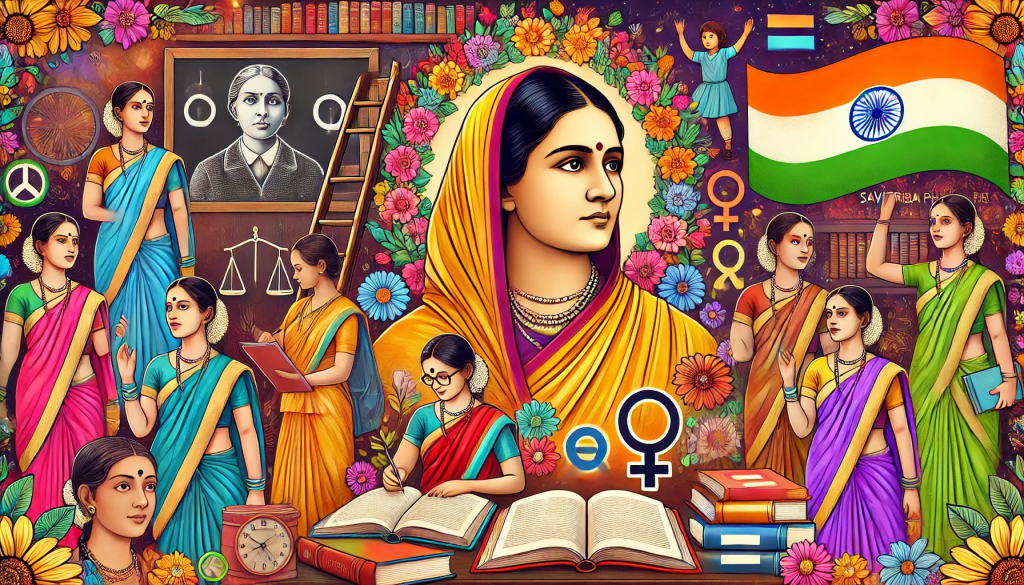
Today is the birth anniversary of Savitribai Phule who was the reformer, teacher (First Female) in India. Her work in women’s education is notable because in the 19th century women in India does not have the basic right of education due to orthodox society custom and norms. The varna system existed in India, at that time, excluded the certain basic human rights to shudra and all women’s in society. It is important to note that the role of Mahatma Phule the husband of savitribai phule is important. He first educated her wife saitribai and then opened the first girl school in India at Pune (Bhidewada) in 1848. Mahatma Phule along with savitribai Phule made revolution and promote women’s empowerment in Indian society. And this enables the women in India to get education along with marginalized section in India.
19th century India witnessed a deeply entrenched social order characterized by rigid caste hierarchies and the severe suppression of women. Education, particularly for women, was deemed a radical and subversive concept, vehemently opposed by conservative forces within society. Against this backdrop emerged Savitribai Phule, an extraordinary figure who dedicated her life to challenging these deeply ingrained prejudices. Alongside her husband, Jyotirao Phule, Savitribai embarked on a revolutionary mission to provide education to women from all social strata, including those from marginalized and oppressed castes.
19th century India witnessed a deeply entrenched social order characterized by rigid caste hierarchies and the severe suppression of women. Education, particularly for women, was deemed a radical and subversive concept, vehemently opposed by conservative forces within society. Against this backdrop emerged Savitribai Phule, an extraordinary figure who dedicated her life to challenging these deeply ingrained prejudices. Alongside her husband, Jyotirao Phule, Savitribai embarked on a revolutionary mission to provide education to women from all social strata, including those from marginalized and oppressed castes.
This article delves into the multifaceted contributions of Savitribai Phule to women’s education in India. It examines her pioneering efforts in establishing schools for girls, the innovative pedagogical approaches she employed to overcome social resistance and cultural barriers, and the profound impact of her work on challenging traditional gender roles and empowering women. Furthermore, the article analyzes how Savitribai Phule’s activism transcended the realm of education, contributing significantly to broader social reform movements aimed at achieving gender equality and social justice. By critically examining her life and work, this study seeks to understand the enduring relevance of Savitribai Phule’s legacy in contemporary India, where the struggle for women’s empowerment and gender equality continues.
Social and Historical Context: 19th Century India — The Caste System: Structure and Implications
The caste system in 19th-century India was an intricate and deeply entrenched socio-religious framework that dictated virtually every aspect of an individual’s life, including occupation, marriage, and social interactions. Rooted in ancient Hindu texts, the system perpetuated rigid hierarchies that privileged the Brahmins (priestly class) while marginalizing Shudras (laborers) and Dalits (formerly termed “untouchables”). The segregation was not merely symbolic; it was institutionalized through laws, customs, and social practices that enforced endogamy, restricted inter-dining, and denied basic rights to the lower castes.
This systemic oppression was particularly acute in rural areas, where land ownership and economic opportunities were concentrated among the upper castes. Lower-caste communities were relegated to menial and stigmatized occupations, fostering cycles of poverty and exclusion. These practices were deeply resistant to change, as they were both socially accepted and justified through religious orthodoxy.
Patriarchy and the Role of Women —
Patriarchal norms dominated 19th-century Indian society, constraining women’s roles to the domestic sphere. Women were subjected to practices such as child marriage, sati (the self-immolation of widows), and purdah (seclusion from public view). Their access to education was minimal, as prevailing beliefs deemed it unnecessary or even harmful for women. Property rights for women were virtually non-existent, and widows were particularly marginalized, often stripped of their status and dignity.
While upper-caste women faced social restrictions under the guise of “protection,” lower-caste women were doubly burdened by caste and gender-based discrimination. They were often forced into labor-intensive roles and were more vulnerable to exploitation. Patriarchal ideology was pervasive, reinforced through religious texts, customary practices, and even the emerging print culture of the time.
Social Reform Movements: Progressive Yet Limited —
The 19th century witnessed the rise of social reform movements in India, often spearheaded by Western-educated elites and influenced by colonial critique of “traditional” Indian practices. Reformers like Raja Ram Mohan Roy, Jyotirao Phule, and others challenged practices such as sati, child marriage, and caste-based discrimination. Organizations like the Brahmo Samaj and Arya Samaj sought to modernize Indian society by aligning it with ideals of rationality, education, and humanism.
However, the reform movements often reflected the priorities of their predominantly male, upper-caste leadership. Women’s issues, while acknowledged, were framed within a paternalistic paradigm, aiming to “uplift” women without granting them autonomy or agency. Similarly, caste reform was often limited to superficial changes that did not dismantle the underlying hierarchies. Notable exceptions, such as Phule’s efforts to educate lower-caste women and promote social equality, highlight the intersectional challenges faced by reformers who sought to address both caste and gender oppression.
Savitribai Phule’s Life and Work : Early Life and Influences — Savitribai Phule was born in 1831 in Naigaon, Maharashtra, into a Dalit family of modest means. Her early years were shaped by the pervasive discrimination and oppression experienced by lower-caste communities in 19th-century India. This firsthand experience of social inequities profoundly influenced her later activism, fueling her resolve to challenge entrenched hierarchies of caste and gender.
Her husband, Jyotirao Phule, played a pivotal role in shaping her social and political consciousness. Recognizing her intellectual potential, Jyotirao encouraged Savitribai’s education — an extraordinary act in an era when women’s literacy was actively discouraged. Under his guidance, she became literate and imbibed the principles of social equality, rationality, and the transformative power of education. The couple’s partnership was a cornerstone of their shared mission to uplift marginalized communities through education and reform.
Establishing Schools for Girls —
Savitribai Phule’s most significant contribution to social reform was her pioneering work in women’s education. In 1848, she co-founded the first school for girls in Pune, a revolutionary act that challenged the patriarchal and caste-based norms of her time. Her efforts were met with staunch opposition; orthodox segments of society accused her of corrupting traditional values, and she faced verbal abuse and even physical threats while commuting to the school.
The logistical challenges of securing resources, hiring teachers, and convincing families to enroll their daughters were immense. Savitribai adopted innovative strategies to overcome these hurdles. She and Jyotirao personally financed the schools initially and sought allies among progressive thinkers to support their cause. To attract students, she often visited homes to persuade reluctant parents, emphasizing the transformative potential of education for their daughters’ futures.
Savitribai Phule’s work laid the foundation for women’s education in India, challenging centuries of exclusion and marginalization. Her schools became models for progressive education, inspiring subsequent generations of reformers. Beyond education, she was an advocate for widow remarriage, fought against child marriage, and actively supported marginalized communities through initiatives like the establishment of a shelter for destitute women and widows.
Her legacy endures as a symbol of resilience and revolutionary thought. By intertwining the fight against caste and gender oppression with the transformative power of education, Savitribai Phule redefined the contours of social reform in 19th-century India.
Impact of Savitribai Phule’s Work : Empowerment of Women — Savitribai Phule’s pioneering efforts in women’s education were instrumental in breaking down traditional gender roles and challenging societal norms. In a patriarchal society where women’s roles were largely confined to the domestic sphere, her work redefined the possibilities for female agency and self-determination. By providing access to education, Savitribai empowered women to transcend the limitations imposed by centuries of systemic oppression.
Education was not merely a tool for literacy but a transformative medium for cultivating knowledge, skills, and critical consciousness. Savitribai’s inclusion of practical and vocational training in her curriculum equipped women to attain economic independence. This independence challenged the economic dependency that had traditionally reinforced women’s subjugation.
Beyond tangible skills, her schools fostered a sense of self-worth and agency among women, particularly those from marginalized castes. In learning environments designed to be inclusive and egalitarian, women were exposed to ideas of equality and justice, planting the seeds for broader social change.
Social Reform —
Savitribai’s work extended beyond the empowerment of women to contribute meaningfully to broader social reform movements. As an advocate for the rights of Dalits and other marginalized communities, she recognized the intersectionality of caste and gender oppression. Her efforts to educate Dalit girls were a bold repudiation of the caste system, challenging the notion that access to knowledge and progress should be determined by birth.
Her activism inspired subsequent generations of social reformers, including women who became prominent figures in movements for equality and justice. By proving that women could lead transformative social initiatives, Savitribai paved the way for greater inclusion of women in public life and activism.
Her commitment to fighting caste-based discrimination extended to her support for widows and abandoned women. The establishment of a shelter for destitute women exemplified her holistic approach to social reform, addressing both immediate needs and systemic injustices.
The legacy of Savitribai Phule’s work endures as a cornerstone of women’s education and empowerment in India. Her schools were among the first to systematically challenge the exclusion of women from formal education, setting a precedent for the establishment of institutions dedicated to female education in the years that followed.
Her struggles and triumphs remain profoundly relevant in contemporary India. Persistent issues such as gender inequality, caste-based discrimination, and barriers to education for marginalized communities underscore the enduring significance of her vision. Modern movements for women’s rights and social justice continue to draw inspiration from her life and work, making her a timeless symbol of resilience and reform.
Contemporary Relevance of Savitribai Phule’s Ideas and Struggles : Addressing Gender-Based Violence — Savitribai Phule’s life and work resonate powerfully in the contemporary fight against gender-based violence. Her advocacy for women’s education and empowerment directly challenged the patriarchal structures that perpetuate such violence. In today’s context, where incidents of domestic violence, sexual harassment, and gender-based crimes remain alarmingly prevalent, her emphasis on education as a means of fostering autonomy and self-respect for women is particularly relevant.
Modern movements against gender-based violence, such as #MeToo and campaigns for stricter laws and societal accountability, align with Savitribai’s vision of dismantling oppressive norms. Her insistence on creating safe spaces for women in education mirrors the ongoing demand for safer environments in workplaces, public spaces, and institutions.
Combatting Discrimination Against Marginalized Communities — Savitribai Phule’s focus on the intersectionality of caste and gender oppression is a precursor to contemporary discourses on systemic discrimination. Her work with Dalit girls and her commitment to challenging untouchability laid the groundwork for recognizing and addressing the compounded vulnerabilities of marginalized groups.
Today, caste-based discrimination persists in various forms, from manual scavenging to social ostracism and inequitable access to opportunities. Her legacy inspires contemporary efforts to combat these injustices, such as the Dalit rights movement and initiatives for affirmative action in education and employment. Moreover, her approach to inclusivity and resistance to caste hierarchies provides a model for intersectional activism in India and beyond.
Promoting Inclusive Education —
Savitribai Phule’s revolutionary contributions to education underscore the importance of inclusivity in contemporary educational frameworks. The challenges she faced in establishing schools for girls and Dalit children echo the barriers that marginalized communities continue to encounter today, including inadequate access to quality education, financial constraints, and societal prejudices.
Her emphasis on practical skills alongside academic education remains relevant in modern debates about curriculum reform. Efforts to make education more inclusive — through policies that address gender disparity, ensure access for economically disadvantaged students, and support children with disabilities — are directly aligned with her vision. Programs like India’s Right to Education Act and initiatives for gender-sensitive schooling reflect the continuation of her struggle for equitable access to learning.
A Blueprint for Social Change —
Savitribai Phule’s activism offers a blueprint for addressing contemporary issues through grassroots movements, community engagement, and the transformative power of education. Her example highlights the necessity of persistence, courage, and innovative strategies in challenging entrenched norms.
Her life also serves as a reminder of the importance of allyship. Jyotirao Phule’s role in encouraging and supporting her activism underscores the value of collaboration across genders and social groups in effecting meaningful change.
Savitribai Phule’s ideas and struggles resonate deeply in the contemporary world, where issues such as gender-based violence, discrimination, and the need for inclusive education remain pressing. Her work not only provides historical context for these challenges but also inspires actionable solutions rooted in equality, inclusion, and justice. By revisiting and applying her principles, society can continue to address these enduring issues and work towards a more equitable future.
Conclusion — Savitribai Phule’s life and work stand as a testament to the transformative power of education and the unwavering spirit of human resilience. In a society deeply entrenched in patriarchal norms and caste hierarchies, she emerged as a beacon of hope, dedicating her life to challenging the oppressive structures that confined women. Her pioneering efforts in establishing schools for girls, despite facing immense social resistance and cultural barriers, not only provided access to education but also ignited a movement for social reform.
Savitribai Phule’s impact transcended the realm of education. By empowering women with knowledge and skills, she challenged traditional gender roles and fostered a sense of agency and self-worth. Her activism extended beyond the classroom, contributing significantly to broader social reform movements aimed at achieving gender equality and social justice.
While significant progress has been made in women’s education and empowerment in India since Savitribai Phule’s time, challenges persist. Issues such as gender-based violence, discrimination against marginalized communities, and the lack of access to quality education for girls in rural areas continue to hinder progress towards true gender equality.
Savitribai Phule’s legacy serves as a constant reminder of the enduring struggle for women’s rights and social justice. Her unwavering commitment to education and social reform continues to inspire generations of activists and social reformers in India and beyond. Her unwavering commitment to justice reminds us that transformative change is possible through collective action, courage, and an unyielding belief in the power of education.In celebrating Savitribai Phule’s contributions, we honor a pioneer whose vision for equality and empowerment laid the foundation for India’s progress and wmpowerment of women in India.
Thanks.
 Pratik Ghansham Salvi Assistant Professor of Economics | Banking & Finance | IMF Finance & Development Contributor
Leave a comment