The Impact of Exchange Rate Volatility on International Trade Flows : Appreciation and Depreciation of Currency
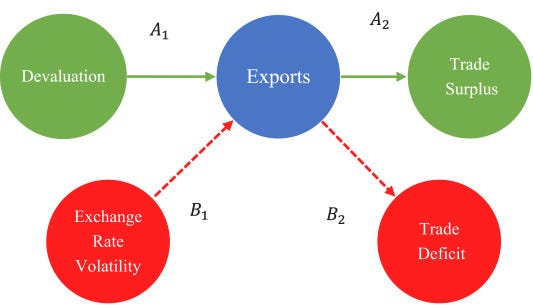
In the interconnected global economy, international trade plays a crucial role in driving economic growth and development. 1 However, this intricate web of global commerce is susceptible to a multitude of factors, with exchange rate volatility emerging as a significant determinant of trade flows. Fluctuations in currency values can significantly impact the competitiveness of exports, the cost of imports, and ultimately, the overall volume of trade between nations.
This article delves into the multifaceted impact of exchange rate volatility on international trade flows, specifically examining the consequences of both currency appreciation and depreciation. We will explore how these exchange rate movements influence key trade variables such as export demand, import demand, and the balance of trade. Furthermore, the analysis will consider the differential impact of exchange rate fluctuations on various sectors and industries, recognizing the heterogeneity of responses across different economic actors. By critically examining the existing literature and analyzing real-world case studies, this article aims to provide a comprehensive understanding of the complex interplay between exchange rate volatility and international trade flows, offering valuable insights for policymakers and businesses operating in the global marketplace.
Theoretical Framework —
A theoretical framework is a structure of concepts, definitions, and propositions that explains phenomena. In economics, it provides a lens through which to analyze and understand economic behavior and relationships. It’s essential for guiding research, formulating hypotheses, and interpreting findings.
Relevant Economic Theories:
- Marshall-Lerner Condition:
- Explanation: This condition states that a currency depreciation will only improve a country’s trade balance if the sum of the price elasticities of demand for imports and exports is greater than one in absolute value.
- In simpler terms: If a country’s currency weakens, making its exports cheaper for foreigners and imports more expensive for domestic consumers, the increase in export revenue must outweigh the increase in import spending for the trade balance to improve.
2) J-Curve Effect:
- Explanation: This describes the short-term and long-term impact of currency depreciation on the trade balance.
- Short-term: Initially, the trade balance may worsen due to existing import contracts and time lags in adjusting production and consumption patterns. This is the “J-curve” — a temporary deterioration before eventual improvement.
- Long-term: Over time, as exporters increase production and consumers shift towards domestic goods, the trade balance typically improves.
3) Pass-through Effect:
- Explanation: This refers to the extent to which changes in exchange rates are transmitted to import and export prices.
- Imperfect pass-through: If pass-through is incomplete, exchange rate changes may not fully translate into changes in import and export prices. This can occur due to factors like:
- Pricing-to-market strategies (firms adjusting prices based on local market conditions)
- Import and export contracts denominated in other currencies
- Market power of firms
How these theories relate:
- The Marshall-Lerner condition provides a crucial criterion for determining whether a currency depreciation will benefit a country’s trade balance.
- The J-curve effect highlights the dynamic nature of this relationship, emphasizing the potential for short-term setbacks before long-term gains.
- The pass-through effect influences the magnitude of price changes and, consequently, the impact of exchange rate fluctuations on trade flows.
By understanding these theories, economists can better analyze the complex relationship between exchange rates, trade balances, and economic growth.
Impact of Currency Appreciation —
Currency appreciation, where a nation’s currency increases in value relative to other currencies, has significant consequences for an economy. Here’s a breakdown of the key impacts:
1. Reduced Export Competitiveness:
- Higher Export Prices: When a currency appreciates, goods and services produced domestically become more expensive for foreign buyers. This price increase erodes the competitiveness of exports in international markets.
- Loss of Market Share: As foreign buyers opt for cheaper alternatives from countries with weaker currencies, domestic exporters may lose market share to competitors. This can lead to decreased export revenues and potential job losses in export-oriented sectors.
2. Increased Import Competitiveness:
- Lower Import Prices: Conversely, imports become cheaper for domestic consumers. This encourages increased consumption of foreign goods, potentially harming domestic producers who face competition from cheaper imports.
- Potential for Job Losses: Domestic industries that compete with imports may experience job losses as consumers shift towards cheaper foreign alternatives.
3. Balance of Trade Implications:
- Worsening Trade Balance: A combination of declining exports and rising imports can lead to a deterioration in the country’s balance of trade. This occurs when the value of imports exceeds the value of exports.
4. Impact on Specific Sectors:
- Manufacturing: Export-oriented manufacturing sectors are particularly vulnerable to currency appreciation. Industries heavily reliant on exports, such as automobiles, electronics, and machinery, may face significant challenges.
- Agriculture: While some agricultural products may benefit from increased export demand due to currency appreciation, others may face increased competition from cheaper imports.
- Tourism: Currency appreciation can make a country more expensive for foreign tourists, potentially reducing tourism revenue. However, it can also encourage domestic tourism as travel within the country becomes relatively more affordable.
It’s important to note:
- The impact of currency appreciation varies significantly across sectors and countries.
- The magnitude of the effects depends on factors such as the extent of currency appreciation, the price elasticity of demand for exports and imports, and the overall economic structure of the country.
- Governments may implement policies to mitigate the negative effects of currency appreciation, such as export subsidies or targeted support for affected industries.
While currency appreciation can offer some benefits, such as lower import prices for consumers, it also poses significant challenges to exporters and domestic producers. Understanding these impacts is crucial for policymakers and businesses to navigate the complexities of international trade and exchange rate fluctuations.
Impact of Currency Depreciation —
Currency depreciation, where a nation’s currency decreases in value relative to other currencies, has a multifaceted impact on an economy:
1. Enhanced Export Competitiveness:
- Lower Export Prices: When a currency depreciates, goods and services produced domestically become cheaper for foreign buyers. This price reduction significantly boosts the competitiveness of exports in international markets.
- Increased Export Revenue & Growth: As exports become more attractive, foreign demand increases, leading to higher export revenue and potentially stimulating economic growth, particularly in export-oriented sectors.
2. Reduced Import Competitiveness:
- Higher Import Prices: Imports become more expensive for domestic consumers due to the depreciated currency. This can lead to:
- Reduced Consumer Purchasing Power: As the cost of imported goods rises, consumers have less disposable income to spend on other goods and services.
- Inflationary Pressures: Increased import costs can contribute to inflationary pressures within the domestic economy.
3. Balance of Trade Implications:
- J-Curve Effect: In the short-term, the trade balance may worsen due to existing import contracts and time lags in adjusting production and consumption patterns. This is the “J-curve” phenomenon.
- Long-Term Improvement: Over the longer term, the increased competitiveness of exports and reduced demand for imports typically lead to an improvement in the country’s trade balance.
4. Impact on Specific Sectors:
- Export-Oriented Sectors: Sectors heavily reliant on exports (e.g., manufacturing, agriculture) generally benefit significantly from currency depreciation.
- Import-Dependent Sectors: Industries that rely heavily on imported raw materials or components may face increased costs and reduced profitability.
- Tourism: Currency depreciation can make a country a more affordable travel destination for foreign tourists, boosting tourism revenue.
Exchange Rate Volatility and its Effects — Exchange rate volatility, or frequent and significant fluctuations in currency values, has several adverse consequences:
- Increased Uncertainty:
- Businesses face difficulty in planning and making investment decisions due to unpredictable changes in exchange rates.
- This uncertainty can hinder economic growth and discourage investment.
- Discouraged International Trade:
- Volatile exchange rates increase the risk associated with international trade.
- Businesses may be less willing to engage in cross-border transactions, potentially harming trade flows.
- Hedging Costs:
- Businesses may incur higher costs to hedge against exchange rate fluctuations, impacting their profitability.
- These hedging costs can reduce the competitiveness of businesses in international markets.
- Impact on Investor Confidence:
- Exchange rate volatility can create uncertainty and erode investor confidence, discouraging both domestic and foreign investment.
Currency depreciation can have both positive and negative effects on an economy. While it can enhance export competitiveness and potentially improve the trade balance, it also poses challenges such as inflation and reduced consumer purchasing power. Exchange rate volatility further complicates the economic landscape, increasing uncertainty and hindering economic growth.
Policy Implications of Exchange Rate Volatility
1. Monetary Policy:
- Central Banks’ Role: Central banks play a crucial role in managing exchange rates and mitigating volatility.
- Interest Rate Adjustments: By adjusting interest rates, central banks can influence capital flows and, consequently, exchange rates. Higher interest rates typically attract foreign investment, increasing demand for the domestic currency and appreciating it.
- Foreign Exchange Interventions: Central banks can intervene in foreign exchange markets by buying or selling their own currency to influence its value.
- Communication Strategies: Clear communication of monetary policy objectives and decisions can help manage market expectations and reduce volatility.
2. Fiscal Policy:
- Government Spending and Taxation: Fiscal policies, such as government spending and taxation, can indirectly impact exchange rates.
- Increased government spending: Can lead to higher interest rates and increased demand for the domestic currency.
- Tax cuts: Can stimulate economic growth and increase demand for imports, potentially weakening the currency.
- Impact on Trade: Fiscal policies can influence trade balances, which in turn affect exchange rates. For example, expansionary fiscal policies can boost domestic demand, leading to increased imports and potentially weakening the currency.
3. Trade Policies:
- Trade Agreements: Trade agreements can help mitigate the negative effects of exchange rate volatility by promoting freer trade and reducing trade barriers.
- Reduced trade barriers: Can increase trade flows and reduce reliance on any single currency.
- Regional trade agreements: Can create more stable trading environments within regions, reducing the impact of exchange rate fluctuations.
- Other Trade Policies: Policies such as export subsidies or import tariffs can be used to offset the effects of currency fluctuations, but they may also lead to trade disputes and retaliation from other countries.
4. Role of International Cooperation:
- International Coordination: International cooperation among countries is essential to address exchange rate issues effectively.
- Global Forums: International forums like the G20 and the International Monetary Fund (IMF) provide platforms for countries to discuss and coordinate exchange rate policies.
- Information Sharing: Sharing information and best practices among countries can help improve understanding of exchange rate dynamics and develop more effective policy responses.
Addressing exchange rate volatility requires a multifaceted approach involving coordinated efforts from monetary authorities, fiscal policymakers, and international institutions. By carefully considering the implications of their policies and engaging in international cooperation, countries can mitigate the negative effects of exchange rate fluctuations and promote stable economic growth.
Conclusion
The dynamic interplay between exchange rates and international trade flows presents a complex challenge for policymakers and businesses alike. As we have seen, exchange rate volatility can significantly impact export competitiveness, import costs, and ultimately, the overall health of a nation’s trade balance. To navigate this intricate landscape, a multifaceted approach encompassing monetary, fiscal, trade, and international cooperation strategies is essential.
Central banks have a critical role to play in managing exchange rates and mitigating volatility. By strategically adjusting interest rates and intervening in foreign exchange markets, they can influence capital flows and stabilize currency values. However, central bank actions must be carefully calibrated to avoid unintended consequences. Clear communication of monetary policy objectives is crucial for managing market expectations and fostering stability.
Fiscal policy also plays an indirect role in shaping exchange rates. Government spending and taxation decisions can influence domestic demand and, consequently, the demand for foreign currency. Policymakers must carefully consider these potential effects when designing fiscal strategies to ensure they do not exacerbate exchange rate volatility.
Trade policies can offer another layer of defense against the negative consequences of exchange rate fluctuations. Trade agreements that promote freer trade and reduce barriers can create a more stable trading environment, lessening the impact of currency movements. Additionally, well-designed trade policies, such as export subsidies or import tariffs, can be used to strategically offset the effects of currency appreciation or depreciation. However, it is crucial to remember that such measures can also lead to trade disputes and retaliation from other countries.
Finally, international cooperation is essential for addressing exchange rate volatility effectively. International forums like the G20 and the IMF provide valuable platforms for countries to discuss and coordinate exchange rate policies. Sharing information and best practices can foster a deeper understanding of exchange rate dynamics and pave the way for the development of more effective collective responses.
In conclusion, by acknowledging the multifaceted nature of exchange rate volatility and implementing a comprehensive strategy that combines monetary, fiscal, trade, and international cooperation measures, countries can create a more stable and predictable trading environment, fostering sustainable economic growth and prosperity.
Thanks.
 Pratik Ghansham Salvi Assistant Professor of Economics | Banking & Finance | IMF Finance & Development Contributor
Leave a comment