The Meaning and Relevance of Equilibrium Analysis in Modern Economics : Partial Equilibrium and General Equilibrium Analysis
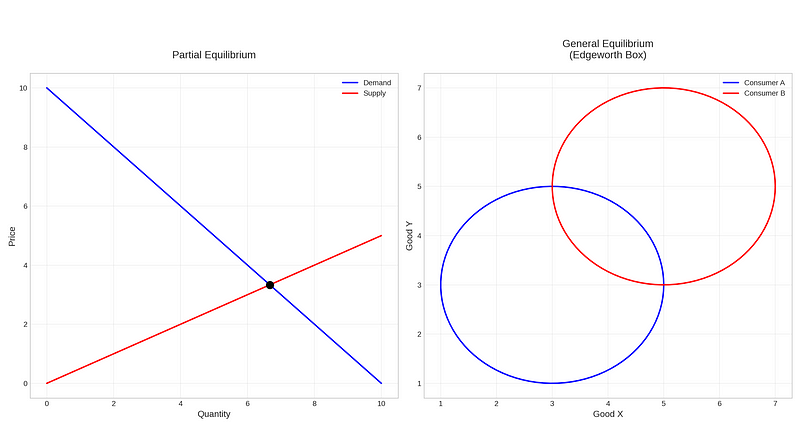
In economic analysis equilibrium, a cornerstone of economic theory, signifies a state of balance or rest where opposing forces are in perfect counterbalance. In the dynamic realm of economics, where countless variables interact, understanding equilibrium is crucial for comprehending market behavior, predicting outcomes, and formulating effective policies. This article delves into the core concepts of equilibrium analysis, focusing on two prominent frameworks: partial equilibrium and general equilibrium.
Partial equilibrium analysis, a more simplified approach, examines the equilibrium within a single market, isolating it from the influence of other markets. By assuming “ceteris paribus” (all other things being equal), it analyzes how changes in supply and demand within that specific market affect price and quantity. While valuable for initial insights and understanding basic market dynamics, partial equilibrium analysis has limitations. It often overlooks the inter-connectedness of markets, potentially leading to inaccurate predictions when market interactions are significant.
In contrast, general equilibrium analysis takes a broader perspective, considering the simultaneous interaction of all markets within an economy. It recognizes that changes in one market can have ripple effects throughout the entire economic system. By analyzing the intricate web of relationships between different markets, general equilibrium analysis provides a more comprehensive and realistic understanding of market behavior.
This article will explore the key concepts of partial and general equilibrium analysis, including their underlying assumptions, methodologies, and applications. We will examine the strengths and weaknesses of each approach and discuss their relevance in contemporary economic research and policy making. By understanding the nuances of these equilibrium concepts, we can gain deeper insights into the complex workings of modern economies and make more informed decisions about economic issues.
Equilibrium in Economics- In economics, equilibrium refers to a state of balance where economic forces acting in opposite directions exactly offset each other. It’s a situation where there’s no inherent tendency for change. In simpler terms, it’s a condition where there are no incentives for buyers or sellers to alter their behavior.
Understanding Equilibrium through Supply and Demand
The concept of equilibrium is most commonly illustrated through the interaction of supply and demand in a market. Supply refers to the total amount of a good or service that producers are willing and able to sell at a given price, while demand refers to the total amount of a good or service that consumers are willing and able to buy at a given price.
- Market Equilibrium: The equilibrium point in a market is the price and quantity at which the quantity of a good or service supplied by producers exactly equals the quantity demanded by consumers. At this point, there’s no excess supply or demand, and the market price is considered stable
- Disequilibrium: If the price is above the equilibrium price, there’s an excess supply (more is being supplied than demanded). This situation creates pressure for the price to fall as producers compete to sell their goods. Conversely, if the price is below the equilibrium price, there’s excess demand (more is demanded than supplied). This situation creates pressure for the price to rise as buyers compete to purchase the limited good.
Importance of Equilibrium Analysis — Equilibrium analysis is a fundamental tool in economics for understanding market behavior and predicting economic outcomes. By analyzing the factors that influence supply and demand, economists can predict how changes in these factors will affect equilibrium prices and quantities. This analysis helps in:
- Understanding Market Trends: Equilibrium analysis helps economists understand how markets react to changes in consumer preferences, production costs, government policies, and other factors. This knowledge can be used to predict market trends and make informed economic decisions.
- Formulating Economic Policies: By understanding how markets reach equilibrium, policymakers can design policies that promote efficient allocation of resources and achieve desired economic outcomes. For instance, if there’s persistent unemployment, policymakers might implement policies to stimulate demand and increase the equilibrium level of output.
- Making Business Decisions: Firms can use equilibrium analysis to understand how changes in their pricing strategies or production costs will affect their sales and profits. This helps them make informed decisions about pricing, production levels, and marketing strategies.
Equilibrium analysis is a cornerstone of economic theory. It provides a framework for understanding how markets function, predicting economic outcomes, and formulating sound economic policies. By understanding the forces that drive supply and demand, economists can gain valuable insights into market behavior and make informed decisions that promote efficient allocation of resources and overall economic well-being.
Partial Equilibrium Analysis — Partial equilibrium analysis is a foundational tool in microeconomics used to study the behavior of a single market in isolation. It assumes “ceteris paribus”, meaning all other factors in the economy are held constant while focusing on changes within a specific market.
The analysis evaluates how shifts in supply or demand influence the equilibrium price and quantity in that market. By isolating one market, it simplifies complex economic interactions, providing clarity and focus.
Important Terms —
- Supply and Demand Curves: Graphical representations showing the relationship between price and quantity supplied or demanded.
- Market Equilibrium Point: The price and quantity at which the supply equals demand.
- Consumer and Producer Surplus: Measures of welfare, indicating benefits to consumers and producers at the equilibrium.
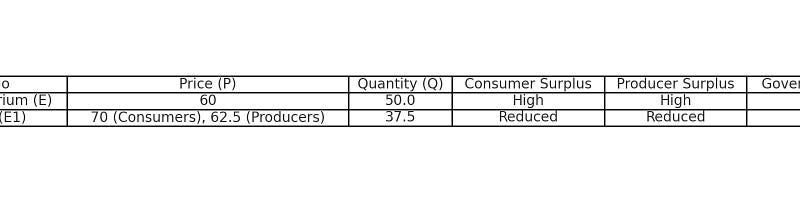
Initial Equilibrium in the Market for Oranges
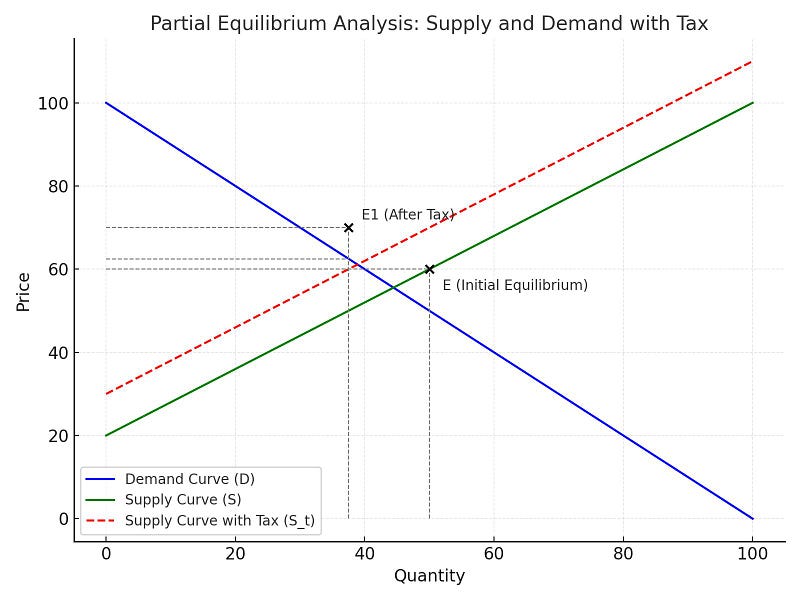
Consider a perfectly competitive market for oranges. The initial equilibrium is characterized by the intersection of the market supply curve (S) and the market demand curve (D) at point E.
- Diagram:
- X-axis: Quantity of oranges (Q)
- Y-axis: Price of oranges (P)
- S: Initial supply curve
- D: Market demand curve
- E: Initial equilibrium point
- Pe: Equilibrium price
- Qe: Equilibrium quantity
Impact of a Tax on Oranges
The imposition of a per-unit tax on oranges shifts the supply curve to the left from S to St. This shift reflects the increased cost of production for sellers due to the tax burden.
- New Equilibrium: The new equilibrium is established at point E1, where the shifted supply curve (St) intersects the original demand curve (D)
- Price Changes:
- Consumer Price (Pc): Consumers now pay a higher price for oranges.
- Producer Price (Pp): Producers receive a lower price for their oranges after accounting for the tax payment.
- Tax Revenue: The difference between the consumer price (Pc) and the producer price (Pp) represents the tax per unit. The government’s tax revenue is equal to the tax per unit multiplied by the new equilibrium quantity (Q1).
- Welfare Effects:
- Consumer Surplus: The area below the demand curve and above the consumer price (Pc) represents consumer surplus. The tax reduces consumer surplus.
- Producer Surplus: The area below the producer price (Pp) and above the supply curve (St) represents producer surplus. The tax also reduces producer surplus.
Important Conclusion —
- The imposition of a tax on oranges creates a wedge between the price paid by consumers and the price received by producers.
- The tax leads to a decrease in both consumer and producer surplus.
- The government gains tax revenue, but this gain comes at the expense of a reduction in overall economic welfare.
Real-World Examples
- Impact of a Tax — Consider a tax imposed on cigarettes. Partial equilibrium analysis examines the direct effects on the cigarette market, ignoring broader impacts on complementary or substitute goods.
- Technological Advancement — The introduction of a new harvesting machine reduces the cost of producing wheat. This shifts the supply curve outward (to the right), decreasing the price of wheat and increasing quantity supplied.
Limitations
- Oversimplification — By focusing on one market, partial equilibrium analysis ignores the complex interdependencies between markets. For instance, a tax on gasoline affects not just fuel prices but also transportation costs, which influence other markets.
- Inaccuracy in Interconnected Markets — In a real-world economy, markets are rarely isolated. Partial equilibrium predictions may fail when spillover effects significantly alter other markets.
General Equilibrium Analysis — General equilibrium analysis examines the simultaneous interaction of all markets within an economy, recognizing the inter connectedness of these markets. It explores how changes in one market influence others, producing ripple effects throughout the economy.
Unlike partial equilibrium analysis, which isolates a single market, general equilibrium analysis provides a comprehensive view of economic systems, making it essential for understanding overall economic efficiency and welfare.
Key Features
- Multiple Markets Interacting Simultaneously — General equilibrium considers the equilibrium conditions of various goods, services, labor, and capital markets simultaneously.
- Interdependence of Prices and Quantities — Prices and quantities in one market depend on conditions in others. For example, a rise in food prices can affect labor costs, which in turn impacts manufacturing and service sectors.
- Focus on Economic Efficiency and Welfare — General equilibrium analysis evaluates how resources are allocated across an economy, aiming to identify conditions that lead to optimal efficiency and welfare.
Key Tools
- Mathematical Models — The Walrasian General Equilibrium Model (named after Léon Walras) is a fundamental framework. It uses equations to represent the equilibrium of supply and demand across all markets simultaneously.
- Computer Simulations — Modern general equilibrium analysis often involves computational techniques, such as Computable General Equilibrium (CGE) models, which simulate complex economic interactions.
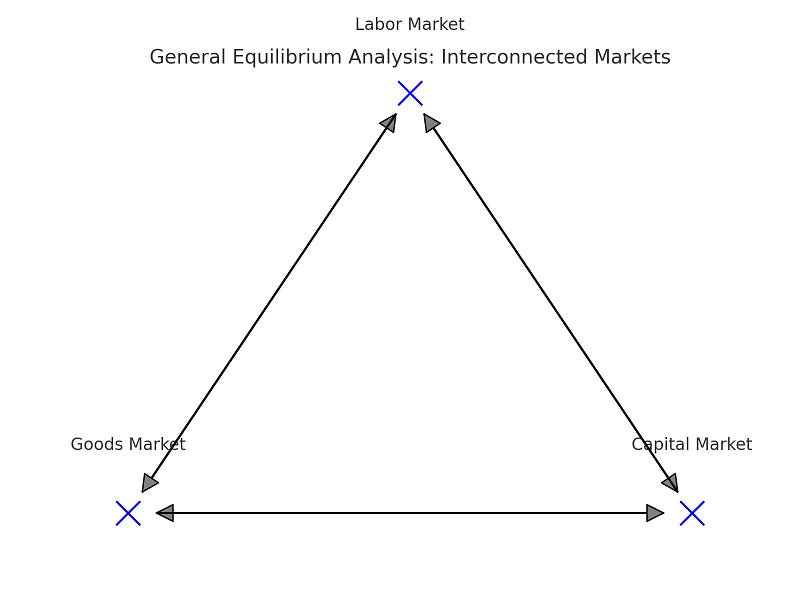
Diagram Example
A diagram illustrating general equilibrium can depict multiple interconnected markets:
- Goods Market: Determines the prices and quantities of goods.
- Labor Market: Determines wages and employment levels.
- Capital Market: Determines interest rates and investment levels.
Examples
- Trade Agreements — A new trade agreement reduces tariffs. General equilibrium analysis evaluates how this impacts domestic production, international trade, wages, and consumer welfare across all sectors.
- Monetary Policy Changes — A central bank increases interest rates. This affects borrowing, investment, and spending in various markets, with cascading effects throughout the economy.
Importance of General Equilibrium Analysis
- Policy Evaluation — Helps governments and institutions assess the wide-reaching effects of policies, such as taxation, subsidies, or regulations, on the economy as a whole.
- Understanding Economic Crises — Provides insights into how shocks, like financial crises or supply chain disruptions, propagate across interconnected markets.
- Promoting Economic Efficiency — Identifies conditions under which resources are allocated efficiently, ensuring maximum welfare and growth.
Limitations
- Complexity and Data Requirements — General equilibrium models require vast amounts of data and computational resources. Simplifying assumptions may not always align with real-world dynamics.
- Static Nature of Some Models — Traditional models may fail to capture dynamic changes over time, such as technological progress or shifting consumer preferences.
Partial vs. General Equilibrium Analysis — Partial equilibrium isolates a single market and analyzes its behavior, assuming other markets remain constant. This simplification makes it easier to understand the basic forces of supply and demand. And on the other hand, General equilibrium considers the interconnectedness of all markets in the economy. It provides a more holistic view but is significantly more complex to model and analyze.
https://docs.google.com/spreadsheets/d/1ctybelEg0q6Z52nXpMg4NFn2ip0MEVv-AgzuX8kFIPs/edit?gid=2117146873#gid=2117146873
This data give you detailed understanding of the general equilibrium and partial equilibrium analysis.
Equilibrium analysis remains highly relevant in modern economics due to its ability to:
1. Inform Policymaking:
- Taxation: Equilibrium analysis helps policymakers understand the impact of taxes on market prices, consumer surplus, and producer surplus. This information is crucial for designing tax policies that are efficient and equitable. For example, analyzing the impact of a tax on gasoline on consumer behavior and the potential for shifting consumption patterns can inform policy decisions.
- Trade: Equilibrium analysis is essential for evaluating the potential impacts of trade policies such as tariffs and quotas. It helps policymakers understand how trade liberalization or protectionist measures affect domestic prices, production, and consumption.
- Regulation: Equilibrium analysis can be used to assess the impact of regulations on market outcomes. For example, analyzing the impact of environmental regulations on the costs of production and the supply of goods can help policymakers design effective and efficient regulations.
- Economic Stabilization: Equilibrium analysis provides insights into how changes in aggregate demand and supply affect overall economic activity. This information is crucial for policymakers to develop and implement policies to stabilize the economy, such as monetary and fiscal policies.
2. Guide Business Decision-Making:
- Market Dynamics: By understanding the factors that influence market equilibrium, businesses can make informed decisions about production, pricing, and investment. For example, analyzing the price elasticity of demand can help businesses determine the optimal pricing strategy to maximize profits.
- Competitive Landscape: Equilibrium analysis helps businesses assess the competitive landscape and identify potential market opportunities. By understanding the behavior of competitors and the dynamics of the market, businesses can develop strategies to gain a competitive advantage.
3. Advance Economic Research:
- Theory Development: Equilibrium analysis serves as a foundation for developing and testing economic theories and models. It helps economists understand the underlying mechanisms that drive economic behavior and predict the consequences of different economic shocks.
- Economic Fluctuations: Equilibrium analysis is crucial for understanding the causes and consequences of economic fluctuations, such as recessions and booms. By analyzing how shocks to different markets can propagate through the economy, economists can develop models to predict and mitigate the impact of these fluctuations.
4. Enhance Understanding of Market Functioning:
- Real-World Applications: Equilibrium analysis provides a framework for understanding how markets function in the real world. By analyzing real-world data and comparing it to theoretical models, economists can gain insights into the strengths and weaknesses of market mechanisms and identify areas for potential improvement.
Equilibrium analysis remains a vital tool for policymakers, businesses, and researchers in modern economics. By providing a framework for understanding market behavior and predicting the consequences of economic shocks, equilibrium analysis helps to inform decision-making, improve economic policy, and advance our understanding of how economies function.
Conclusion — In conclusion, equilibrium analysis remains a cornerstone of modern economics, providing a framework for understanding how markets function and how economic forces interact. While partial equilibrium analysis offers a simplified yet valuable starting point for understanding individual markets, it often falls short in capturing the interconnectedness of the real world. General equilibrium analysis, with its focus on the interplay of all markets, provides a more comprehensive and realistic picture, albeit with increased complexity.
Both approaches have significant implications for economic policymaking. By understanding the equilibrium conditions in different markets, policymakers can assess the potential impacts of various interventions, such as taxes, subsidies, and regulations. General equilibrium analysis, in particular, can help policymakers anticipate the unintended consequences of their actions across different sectors of the economy.
Furthermore, equilibrium analysis plays a crucial role in business decision-making. Firms can utilize these concepts to understand market dynamics, assess competition, and make informed decisions about production, pricing, and investment strategies.
Despite their importance, both partial and general equilibrium analysis have limitations. The “ceteris paribus” assumption of partial equilibrium often does not hold in the real world, while the complexity of general equilibrium models can make them difficult to apply in practice.
Moving forward, ongoing research is crucial to refine and extend these frameworks. Advancements in computational power and data availability are enabling economists to develop more sophisticated and realistic general equilibrium models. Further research is also needed to incorporate factors such as imperfect competition, asymmetric information, and behavioral biases into equilibrium analysis.
In conclusion, equilibrium analysis, with its focus on understanding market balance and interactions, continues to be a vital tool for economists, policymakers, and businesses. By recognizing the strengths and limitations of both partial and general equilibrium approaches, we can gain deeper insights into the complex workings of modern economies and make more informed decisions about economic issues.
Thanks.
 Pratik Ghansham Salvi Assistant Professor of Economics | Banking & Finance | IMF Finance & Development Contributor
Leave a comment