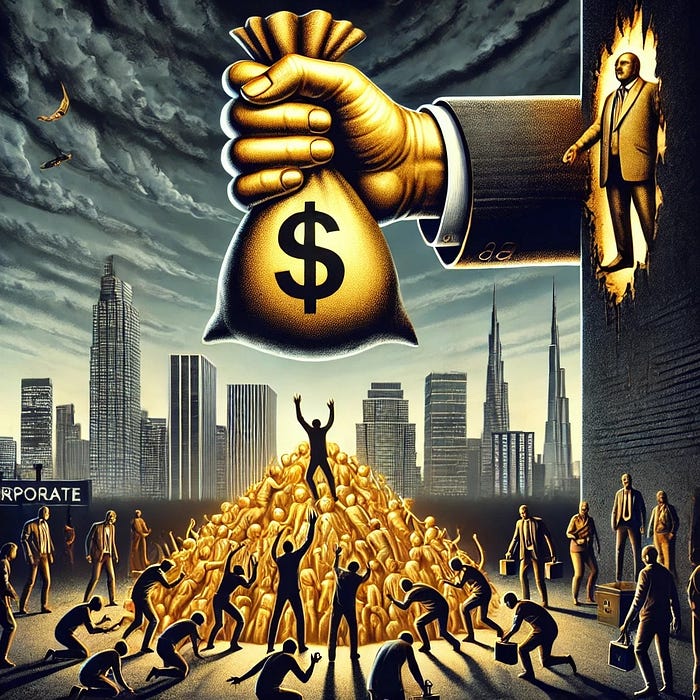
“Imagine an economy where the rules of the game are written not for the benefit of all, but for the privileged few. Where access to capital, regulatory loopholes, and government contracts are determined by who you know, not what you know. This isn’t a dystopian fantasy; it’s the reality of crony capitalism, a system that fuels the relentless rise of inequality and perpetuates a widening chasm between the haves and have-nots. The story of our time is increasingly one of stark economic division, a narrative where the rich get richer while the poor struggle to stay afloat, and the culprit often lurks in the shadows of backroom deals and political favors.
This article dissects the intricate web of crony capitalism and its role in the ascent of oligarchies, those powerful cliques that manipulate markets and bend policies to their advantage. We will explore how these networks, built on personal connections rather than merit, distort the natural flow of economic activity, stifling competition and choking off opportunities for those outside their inner circles. The result? A system where wealth concentrates at the top, not through innovation or hard work, but through privileged access and the ability to tilt the playing field.
We’ll delve into the mechanisms through which oligarchs secure their dominance, from influencing legislation to exploiting regulatory gaps, examining how these practices undermine the very principles of a fair and open market. We will trace the consequences of this system, highlighting the erosion of social mobility, the growing distrust in institutions, and the deepening of societal divisions. This is not simply an academic exercise; it’s a call to understand the forces that shape our economic landscape and to challenge the structures that perpetuate inequality. By shining a light on the hidden workings of crony capitalism, we aim to spark a conversation about how to restore fairness and create an economy that works for everyone, not just the select few.”
“The stark reality of widening economic inequality casts a long shadow over modern societies, prompting urgent questions about the forces that drive this divide. At the heart of this issue lie two interconnected phenomena: crony capitalism and oligarchy. Crony capitalism, in essence, is an economic system where success is determined not by merit or market forces, but by close relationships between business leaders and government officials. This preferential treatment manifests in various forms, including favorable regulations, lucrative government contracts, and insider access to resources, effectively rigging the system in favor of those with connections.
Complementing crony capitalism is oligarchy, a form of power structure where control rests with a small number of individuals or families. These oligarchs, often beneficiaries of cronyism, amass immense wealth and wield significant political influence, allowing them to further entrench their dominance. Together, these systems distort the very principles of free markets. Instead of competition driving innovation and efficiency, resources are misallocated, and opportunities are stifled, leading to a concentration of wealth in the hands of a select few.
This article argues that the symbiotic relationship between crony capitalism and oligarchy is a primary driver of escalating inequality. By examining how these systems operate, we will demonstrate how they exacerbate the gap between the rich and the poor, creating an economic landscape where the wealthy not only accumulate more wealth but also actively hinder the upward mobility of those less fortunate. We will delve into the specific mechanisms through which these systems operate, revealing how they undermine fair competition and perpetuate a cycle of economic disparity.”
The Nature of Crony Capitalism — Crony capitalism thrives on the insidious collusion between government and business elites, a partnership that systematically undermines the principles of a fair and competitive market. This unholy alliance creates a playing field tilted heavily in favor of the well-connected, fostering an environment where wealth accumulation is driven by privilege rather than merit. The mechanisms through which this unfair advantage manifests are varied and deeply entrenched.
- Preferential Policies and Subsidies: One of the most blatant forms of cronyism is the implementation of policies that directly benefit the wealthy. This can take the form of targeted subsidies for specific industries, often those dominated by influential corporations. For instance, large energy companies may receive generous tax breaks or direct financial support, effectively shifting the burden onto taxpayers while bolstering the profits of a select few. Similarly, bailouts during economic downturns often disproportionately favor large financial institutions, reinforcing the perception that the “too big to fail” are also “too connected to fail.”
- Tax Loopholes and Regulatory Capture: The tax code, often a labyrinth of complexity, becomes a playground for the well-connected. Lobbyists and influential firms exploit loopholes and carve out exemptions, minimizing their tax burden while ordinary citizens bear the brunt of fiscal responsibility. Furthermore, regulatory capture, where regulatory agencies are dominated by the very industries they are supposed to oversee, allows powerful corporations to shape rules and regulations to their advantage, effectively shielding themselves from accountability.
- Monopolies and Cartels: Crony capitalism fosters the growth of monopolies and cartels, which stifle competition and consolidate market power. By leveraging their political influence, these dominant players can erect barriers to entry, preventing new businesses from challenging their dominance. This lack of competition not only keeps prices artificially high, but also stifles innovation and limits consumer choice. The result is a system where wealth remains concentrated at the top, as smaller businesses and entrepreneurs are unable to compete with the established giants who have the ear of government officials. In essence, crony capitalism transforms the market into a closed club, where membership is determined by connections, not by the quality of goods or services offered.
The Rise of Oligarchy and Wealth Concentration — Crony capitalism lays the groundwork for the emergence of oligarchies, where a small, interconnected group of individuals and corporations wield disproportionate control over vast segments of the economy. This concentration of power not only exacerbates inequality but also undermines democratic processes and stifles economic dynamism.
Controlling the Economic Landscape: Oligarchs often amass their wealth and influence through strategic control of key industries, such as energy, finance, media, or natural resources. By dominating these sectors, they can manipulate prices, dictate market conditions, and limit competition, effectively carving out their own economic fiefdoms. This control extends beyond individual companies, often encompassing entire supply chains and distribution networks, further solidifying their grip on the economy.
The Influence of Lobbying, Campaign Financing, and Corporate Power: Lobbying, campaign financing, and corporate influence are the primary tools through which oligarchs shape policies to their advantage. By investing heavily in lobbying efforts, they can influence legislation and regulations, ensuring that laws are crafted to protect their interests. Similarly, generous campaign contributions allow them to cultivate relationships with politicians, securing favorable treatment and access to decision-making processes. Corporate influence extends beyond direct lobbying and campaign financing, encompassing think tanks, media outlets, and public relations firms, all of which work to shape public opinion and promote policies that benefit the wealthy.
Case Studies of Oligarchic Dominance:
- Russia: Post-Soviet Russia serves as a stark example of oligarchic control. A small group of individuals who amassed wealth during the privatization of state assets in the 1990s have maintained their grip on key industries and political power, leading to widespread corruption and economic inequality.
- Ukraine: Prior to recent events, Ukraine also faced significant challenges from oligarchic influence. Powerful individuals controlled key sectors of the economy, including energy and media, and wielded significant political power, hindering economic development and democratic reforms.
- Certain Latin American Nations: In various Latin American countries, historical patterns of land ownership and resource control have led to the emergence of powerful oligarchies that continue to influence politics and the economy, contributing to persistent inequality.
- The United States: While not an Oligarchy in the classic sense, the US experiences rising levels of wealth concentration, and increasing political influence from large corporations and wealthy donors. The influence of lobbying and campaign contributions has led to growing concerns about the role of money in politics.
These case studies illustrate the diverse ways in which oligarchies can emerge and consolidate power, highlighting the negative consequences for economic equality and democratic governance.
The Impact on Income Distribution — The corrosive effects of crony capitalism and oligarchy extend far beyond the corridors of power, profoundly impacting the lives of ordinary citizens by distorting income distribution and perpetuating economic inequality.
Wage Suppression and Limited Upward Mobility: Crony capitalism creates an environment where wages are suppressed and upward mobility is severely restricted. When market forces are distorted, and competition is stifled, workers have less bargaining power. Oligarchs and corporations, with their entrenched positions and political influence, can exert downward pressure on wages, knowing that workers have limited alternatives. Moreover, the lack of fair competition and the concentration of resources in the hands of a few limit opportunities for small businesses and entrepreneurs, effectively blocking pathways to upward mobility for those outside the elite circle. The playing field is not level, and meritocracy is undermined.
The Decline of the Middle Class and the Growing Wealth Gap: The most visible consequence of this system is the decline of the middle class. As wealth concentrates at the top, the middle class shrinks, and a growing proportion of the population finds itself struggling to make ends meet. The wealth gap between the top 1% and the rest has reached staggering proportions in many countries. This trend is not merely a matter of numbers; it represents a fundamental shift in the economic landscape, where a small elite captures an ever-larger share of the economic pie, leaving less for everyone else.
Real-World Data and Statistics:
- Wealth Concentration: Reports from organizations like Oxfam consistently demonstrate the alarming concentration of wealth in the hands of a tiny fraction of the global population. For example, statistics show that the wealthiest 1% own a disproportionate amount of global wealth, far exceeding the combined wealth of the bottom 50%.
- Income Inequality: The Gini coefficient, a measure of income inequality, reveals a widening gap in many countries. Data from organizations like the World Bank and the OECD show that income inequality has been on the rise in numerous developed and developing economies.
- Wage Stagnation: Data from national labor statistics often illustrate the phenomenon of wage stagnation, where real wages have failed to keep pace with productivity growth. This divergence indicates that the benefits of economic growth are not being shared equitably.
- Share buybacks and dividends: Statistics showing the increasing proportion of company earnings being spent on share buybacks, and dividend payouts, versus being reinvested into worker wages, and capital improvements, help to illustrate the trend of wealth being concentrated into the hands of shareholders and executives.
These statistics paint a clear picture of the growing wealth gap and the erosion of economic opportunity, highlighting the urgent need to address the systemic flaws that perpetuate inequality.
The Erosion of Economic Mobility — The promise of economic mobility — the idea that individuals can improve their economic standing through hard work and talent — is a cornerstone of a just and prosperous society. However, the insidious influence of crony capitalism and oligarchic structures has severely eroded this promise, creating a system where the poor are increasingly trapped and the wealthy are further entrenched.
Entrenched Barriers to Upward Mobility:
- The Weight of Education Costs: The escalating cost of higher education acts as a formidable barrier, particularly for those from disadvantaged backgrounds. Student debt burdens can cripple individuals for decades, limiting their ability to invest in homes, start businesses, or save for retirement. Furthermore, the increasing reliance on unpaid internships further disadvantages those without family wealth, effectively creating a “pay-to-play” system for career advancement.
- The Capital Chasm: Access to capital is the lifeblood of entrepreneurship and small business growth. However, the financial system often favors established corporations and wealthy individuals, leaving aspiring entrepreneurs from marginalized communities without the resources they need to launch their ventures. This “capital chasm” reinforces existing inequalities and stifles innovation.
- The Fraying Fabric of Labor Rights: The decline of union membership and the weakening of labor protections have significantly eroded workers’ bargaining power. This has led to wage stagnation, precarious employment, and a decline in workplace safety. The rise of the “gig economy” has further exacerbated these trends, creating a workforce of independent contractors with limited rights and protections.
The Twin Disruptions: Automation and Outsourcing:
- Automation’s Double-Edged Sword: While automation has the potential to boost productivity and create new opportunities, it also displaces workers in routine and repetitive tasks. This disproportionately affects low-skilled and middle-skilled workers, leading to job losses and downward pressure on wages. Without adequate retraining and social safety nets, these workers are left vulnerable to economic insecurity.
- The Global Shift: Job Outsourcing: The globalization of production and services has led to the outsourcing of jobs to countries with lower labor costs. While this has benefited corporations by reducing costs, it has also contributed to wage stagnation and the decline of manufacturing jobs in developed economies. This has created a “race to the bottom” in terms of wages and working conditions, further exacerbating inequality.
The Unequal Impact of Financial Crises:
- The Asymmetrical Recovery: Financial crises, such as the 2008 global financial crisis, have a devastating impact on economic mobility. While the wealthy often have the resources to weather these storms and even profit from them, the poor and middle class suffer long-term consequences.
- The Ripple Effect: Job losses, foreclosures, and the erosion of savings disproportionately affect those with limited financial resources. The recovery process is often uneven, with the wealthy recovering much faster than the rest of the population, further exacerbating inequality.
- Moral Hazard and Public Trust: The bailouts of “too big to fail” corporations, using taxpayer funds, creates a sense of moral hazard, where the wealthy are shielded from the consequences of their actions. This erodes public trust in institutions and reinforces the perception that the system is rigged in favor of the elite.
By highlighting these barriers, we can understand how crony capitalism and oligarchic structures create a system where economic mobility is increasingly out of reach for the majority of the population.
Political and Social Consequences — The profound economic disparities created by crony capitalism and oligarchic control are not confined to balance sheets and economic indicators. They permeate the very fabric of society, leading to political instability, social unrest, and a dangerous erosion of democratic principles.
The Nexus of Inequality, Populism, and Social Unrest:
- Fueling Political Instability: Extreme economic inequality breeds resentment and distrust in institutions. When a significant portion of the population feels disenfranchised and economically marginalized, they become more susceptible to populist rhetoric and extremist ideologies. This can lead to political polarization, social unrest, and even violent conflict.
- The Rise of Populism: Populist movements often capitalize on the anger and frustration caused by economic inequality. They offer simplistic solutions and scapegoats, exploiting the public’s sense of injustice. While populist leaders may promise to challenge the status quo, they often perpetuate the very systems that created the inequality in the first place.
- Social Disintegration: The widening gap between the rich and poor erodes social cohesion and trust. It creates a sense of “us vs. them,” where different segments of society are pitted against each other. This can lead to increased crime rates, social alienation, and a decline in civic engagement.
The Perils of Plutocracy:
- Policy Capture: In a plutocracy, policy decisions are driven by the interests of the wealthy elite, rather than the needs of the broader population. Tax codes, regulations, and public spending priorities are skewed to benefit those who have the most influence, further exacerbating inequality.
- Erosion of Public Services: When the wealthy elite control policy, they often prioritize policies that benefit themselves, even at the expense of essential public services like education, healthcare, and infrastructure. This can lead to a decline in the quality of life for the majority of the population.
- Distorted Priorities: Issues that impact the poor and middle class are often ignored or downplayed, while the concerns of the wealthy elite are given undue attention. This can lead to a sense of abandonment and betrayal, further fueling social unrest.
The Undermining of Democratic Institutions:
- Weakening of Checks and Balances: Oligarchic control can weaken the checks and balances that are essential for a healthy democracy. When powerful individuals and corporations have undue influence over government, they can undermine the independence of the judiciary, the media, and other institutions that are meant to hold them accountable.
- Erosion of Trust in Government: The perception that government is serving the interests of the wealthy elite erodes public trust in democratic institutions. This can lead to voter apathy, cynicism, and a decline in civic engagement.
- The Control of Information: Oligarchs often control large media outlets and platforms, which they use to shape public opinion and promote their own agendas. This control of information can undermine the ability of citizens to make informed decisions and hold their leaders accountable.
In essence, the political and social consequences of crony capitalism and oligarchy are far-reaching and deeply damaging. They threaten the very foundations of democratic societies and create a breeding ground for instability and unrest.
The Way Forward: Solutions and Policy Recommendations Addressing the deep-seated issues of crony capitalism and oligarchic control requires a multifaceted approach, encompassing policy reforms, institutional changes, and a renewed commitment to democratic principles. Here are some key solutions and policy recommendations:
Strengthening Antitrust Laws and Promoting Competition:
- Aggressive Enforcement: Antitrust laws must be rigorously enforced to break up monopolies and prevent the formation of cartels. This includes increased funding for antitrust agencies and a willingness to challenge powerful corporations.
- Modernizing Antitrust Frameworks: Antitrust laws need to be updated to address the challenges of the digital age, where market dominance can be achieved through control of data and platforms.
- Promoting Small Business: Policies that support small businesses and entrepreneurs, such as access to capital and reduced regulatory burdens, can help to foster a more competitive marketplace.
Increasing Progressive Taxation and Ensuring Fair Wealth Distribution:
- Higher Marginal Tax Rates: Increasing marginal tax rates on high incomes and wealth can help to redistribute wealth and reduce inequality.
- Closing Tax Loopholes: Closing tax loopholes and eliminating tax havens can ensure that corporations and wealthy individuals pay their fair share of taxes.
- Wealth Taxes: Consider the implementation of wealth taxes to address the extreme concentration of wealth in the hands of a few.
- Increased inheritance taxes: These taxes can help to reduce the ability for dynastic wealth to occur, which is a key component of Oligarchy.
Enforcing Transparency in Governance and Reducing Corporate Influence:
- Campaign Finance Reform: Implementing strict campaign finance regulations can limit the influence of money in politics and ensure that elected officials are accountable to their constituents.
- Lobbying Disclosure: Requiring greater transparency in lobbying activities can help to reveal the influence of special interests on policy decisions.
- Revolving Door Restrictions: Implementing stricter restrictions on the “revolving door” between government and the private sector can help to prevent conflicts of interest.
- Increased transparency in government contracts: Making government contracts more transparent, and open to bidding, can reduce the ability for cronyism to occur.
Investing in Education, Healthcare, and Social Welfare:
- Universal Access to Education: Investing in high-quality, affordable education can help to level the playing field and promote upward mobility.
- Universal Healthcare: Ensuring access to affordable healthcare can reduce financial insecurity and improve the overall well-being of the population.
- Strengthening Social Safety Nets: Expanding social safety nets, such as unemployment benefits and food assistance programs, can provide a buffer against economic hardship and promote economic security.
- Investing in job training programs: These programs can help workers who have been displaced by automation or outsourcing to acquire the skills they need to compete in the modern economy.
By implementing these policy recommendations, we can begin to dismantle the structures of crony capitalism and oligarchy and create a more equitable and just society.
Conclusion: The Need for Economic Reform — The evidence is undeniable: crony capitalism and the resulting rise of oligarchies have profoundly distorted our economies, creating a system where wealth concentrates at the top, opportunity is stifled, and the promise of economic mobility is increasingly hollow. We’ve seen how government-business collusion fosters unfair advantages, how lobbying and campaign financing skew policy decisions, and how the concentration of power undermines democratic institutions. The consequences are far-reaching, from wage stagnation and the decline of the middle class to political instability and social unrest.
The path forward requires a fundamental shift in our economic and political landscapes. We must enact meaningful policy changes, including strengthening antitrust laws, implementing progressive taxation, enforcing transparency in governance, and investing in education and social welfare. These reforms, while challenging, are essential for creating a level playing field and restoring fairness to our economies.
However, policy changes alone are not enough. Collective action is crucial. We must demand accountability from our leaders, challenge the influence of special interests, and advocate for policies that prioritize the well-being of all citizens. This requires a renewed commitment to democratic principles and a willingness to challenge the status quo.
Ultimately, the goal is to build fairer economic structures that benefit society as a whole. We must move away from a system where the rules are written for the privileged few and towards one where opportunity is accessible to all. This is not just a matter of economic justice; it is a matter of social stability and the preservation of our democratic values. Let us commit to building an economy that works for everyone, not just the wealthy and powerful.
Thanks.
 Pratik Ghansham Salvi Assistant Professor of Economics | Banking & Finance | IMF Finance & Development Contributor
Leave a comment