The Hidden crisis of Modern Advertisements : How Modern Marketing Fuels Misinformation, Market Distortion, Gender Inequality, Environmental Degradtion and Social Inequity in the 21st Century?
In the hyper-connected, visually saturated landscape of the 21st century, advertising has transcended its traditional role of simply informing consumers about products and services. It has morphed into a pervasive force, shaping perceptions, dictating trends, and influencing societal values on a global scale. While often celebrated for its creativity and economic contributions, the modern advertising industry harbors a hidden crisis, a complex web of unintended consequences that extend far beyond the immediate goal of driving sales. This article aims to dissect this multifaceted crisis, exposing the insidious ways in which contemporary marketing practices contribute to the proliferation of misinformation, exacerbate market distortions, perpetuate gender inequality, accelerate environmental degradation, and deepen social inequities.
The digital revolution has amplified the reach and impact of advertisements, enabling them to penetrate every aspect of our lives, from social media feeds to streaming platforms, from public spaces to the intimate confines of our personal devices. This unprecedented level of exposure, coupled with increasingly sophisticated targeting algorithms, allows advertisers to manipulate consumer behavior with alarming precision. However, this power comes at a significant cost. The relentless pursuit of consumer engagement often leads to the dissemination of misleading or outright false information, eroding trust in credible sources and fostering a climate of skepticism.
Furthermore, the aggressive marketing tactics employed by dominant corporations can distort market dynamics, stifling competition and limiting consumer choice. The relentless promotion of certain products and brands, often through manipulative psychological strategies, creates artificial demand and fosters a culture of excessive consumption. This, in turn, fuels environmental degradation as resources are depleted and waste accumulates at an unsustainable pace.
The portrayal of gender within advertisements continues to be a battleground for equality. Despite some progress, stereotypical representations of women and men persist, reinforcing harmful societal norms and perpetuating gender-based discrimination. The objectification of women, the promotion of unrealistic beauty standards, and the reinforcement of traditional gender roles contribute to a culture of inequality and marginalization.
Moreover, the advertising industry’s role in exacerbating social inequities cannot be ignored. The targeted marketing of unhealthy products to vulnerable communities, the exploitation of consumer anxieties, and the promotion of materialistic values contribute to a widening gap between the privileged and the marginalized. The relentless pursuit of profit often overshadows ethical considerations, leaving behind a trail of social and environmental damage.
This article will delve into each of these critical areas, providing concrete examples and analyzing the underlying mechanisms that drive these negative impacts. By exposing the hidden crisis of modern advertisements, we aim to spark a critical dialogue about the ethical responsibilities of marketers, the need for stronger regulatory frameworks, and the importance of fostering a more conscious and equitable consumer culture. Ultimately, this exploration seeks to illuminate the urgent need for a paradigm shift in the advertising industry, one that prioritizes social responsibility, environmental sustainability, and the well-being of all individuals over the relentless pursuit of profit.
The Allure and Influence of Modern Advertising — The evolution of advertising mirrors the trajectory of human communication itself, moving from rudimentary announcements to sophisticated psychological campaigns. In its nascent stages, advertising was a simple exchange of information: “Product X exists, and it does Y.” These early forms, often found in print or as simple public announcements, primarily aimed to inform consumers of a product’s presence and function. However, the advent of mass production and the rise of consumer culture catalyzed a dramatic shift.
As industrialization surged, the need to differentiate products and cultivate brand loyalty became paramount. This era saw the emergence of advertising as a tool for emotional engagement. The focus shifted from mere information dissemination to crafting compelling narratives that resonated with consumers’ desires and aspirations. Marketing began to tap into the human psyche, employing techniques designed to evoke feelings of belonging, status, and happiness. This marked the transition from simple product notification to the subtle art of emotional persuasion.
The digital revolution has amplified this trend exponentially. The internet and social media have created an ecosystem where advertising is not merely a peripheral activity, but an integrated part of daily life. Algorithms now personalize advertisements to an unprecedented degree, targeting individuals based on their browsing history, social interactions, and even their emotional responses. This rise of hyper-targeted marketing has created a landscape where the lines between content and advertisement blur, and the sheer volume of marketing messages can overwhelm the consumer.
This introduction establishes the core argument of this article: modern advertising transcends the simple act of selling products. It functions as a powerful cultural force, constructing narratives that shape our perceptions of reality. The products themselves become secondary to the myths and lifestyles they represent. Advertisements are now selling not just goods, but carefully curated illusions, subtly molding our desires and expectations. This process has profound economic and social implications, as it distorts market dynamics, promotes unsustainable consumption patterns, and perpetuates societal inequalities.
The narratives crafted by modern advertisements often diverge significantly from reality, promoting idealized lifestyles and unrealistic standards. This can lead to a culture of dissatisfaction and anxiety, as individuals strive to attain these unattainable ideals. Furthermore, the economic power wielded by advertising can manipulate markets, creating artificial demand and hindering fair competition. The relentless pursuit of consumer engagement can also lead to the spread of misinformation, as advertisers prioritize emotional impact over factual accuracy.
This article aims to dissect the intricate mechanisms through which modern advertising exerts its influence, exposing the hidden costs of this pervasive force. By examining the ways in which advertisements construct myths, distort reality, and reshape economies and societies, we seek to foster a more critical understanding of the role of marketing in the 21st century.
Misinformation and the Manipulation of Desire —
- Exaggerated Claims:
- Modern advertisements frequently transcend the boundaries of factual representation, employing hyperbole and superlative language to elevate products to unrealistic levels. This practice involves attributing almost miraculous properties to ordinary goods, suggesting that they possess the power to transform lives or solve complex problems. For example, cleaning products might be portrayed as capable of eradicating all household woes, or food items might be depicted as gateways to unparalleled happiness. This inflation of product capabilities fosters a culture of unrealistic expectations, where consumers are led to believe that material possessions hold the key to personal fulfillment.
2. Pseudo-science:
- To enhance perceived credibility, advertisers often resort to pseudo-scientific jargon and imagery. This tactic involves mimicking the language and visual cues of legitimate scientific discourse, even when the underlying claims lack empirical support. Advertisements may feature laboratory settings, graphs, and individuals in white coats, creating an illusion of scientific rigor. This manipulation of scientific authority is particularly insidious, as it exploits consumer trust in established institutions, leading them to make decisions based on fabricated evidence.
3. Deceptive Imagery:
- Visuals and symbolism play a crucial role in modern advertising, often used to evoke emotional responses and create false associations. Advertisers carefully curate images and symbols to align products with desirable lifestyles, values, and aspirations. For instance, luxury car advertisements might feature scenic landscapes and affluent individuals, implying that ownership of the vehicle will confer status and prestige. This manipulation of imagery can bypass rational thought, appealing directly to subconscious desires and creating a sense of longing.
4. Aspirational Manipulation:
- Modern advertising excels at tapping into fundamental human desires for status, beauty, and success. Advertisers craft narratives that portray products as gateways to these aspirations, suggesting that their use will lead to social acceptance, personal fulfillment, and enhanced self-worth. This form of manipulation preys on insecurities and vulnerabilities, creating a sense of inadequacy that can only be resolved through consumption.
5. Perfume Ads:
- A prime example of aspirational manipulation can be found in perfume advertisements, which often imply a direct correlation between fragrance and romantic or sexual success. These ads rarely focus on the olfactory qualities of the product, instead painting vivid scenarios of heightened allure and irresistible attraction. By associating perfume with romantic fantasy, advertisers create a powerful emotional connection, driving consumers to purchase the product in pursuit of these idealized experiences.
6. Fairness Creams:
- The marketing of fairness creams exemplifies the perpetuation of harmful beauty standards. These advertisements often promote a narrow, culturally specific definition of beauty, suggesting that lighter skin is synonymous with social acceptance and personal fulfillment. By exploiting insecurities related to skin tone, advertisers contribute to a culture of discrimination and self-doubt.
7. Greenwashing:
- In an era of increasing environmental awareness, companies often engage in “greenwashing,” a deceptive practice that involves portraying products as environmentally friendly through the use of vague sustainability claims and natural imagery. This tactic misleads consumers into believing they are making responsible choices, even when the product’s environmental impact may be negligible or harmful.
8. Irrational Choices:
- The cumulative impact of these manipulative tactics is profound. Consumers are increasingly making irrational choices based on emotional impulses, rather than informed judgment. The constant bombardment of misleading information and idealized imagery distorts their perception of reality, leading them to prioritize emotional gratification over rational assessment.
9. Erosion of Trust:
- When companies use these tactics, they are not only selling products, they are also eroding the trust that the consumer has in those companies, and in advertising as a whole. This erosion of trust, can lead to widespread skepticism of credible sources.
10. Distorted Perception:
- Continual exposure to these manipulated messages warps the consumer’s understanding of what is real, and what is a marketing tactic. It creates warped views on what is needed for a happy life, and what is needed for acceptance.
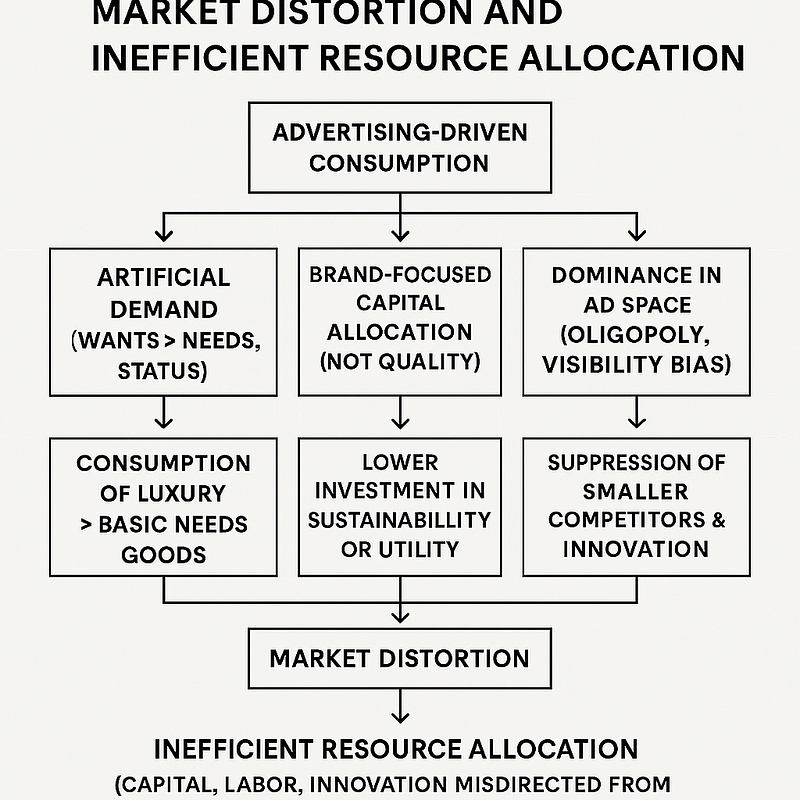
Market Distortion and Inefficient Resource Allocation through Advertising —
1. Artificial Demand Creation
Advertising often stimulates wants, not needs. It constructs consumer preferences for products based on branding, prestige, or emotional appeal, rather than utility or necessity.
- Example: Smartphones marketed with minor updates are aggressively advertised to create a sense of obsolescence, pushing consumers to upgrade frequently, even if their current devices function well.
This inflates demand for non-essential goods while essential goods and services (like healthcare, education, or nutrition) may receive relatively less attention and investment.
2. Misallocation of Capital — Firms allocate large budgets to marketing and branding rather than improving product quality, sustainability, or affordability.
- Fast Fashion: Brands spend heavily on influencer marketing and fast-paced trends instead of investing in ethical labor or durable fabrics.
- Personal Care: Products are sold at high margins due to branding, while the ingredients or effectiveness remain standard.
This results in allocative inefficiency, where resources (capital, labor, and innovation) are not used to maximize real consumer welfare or long-term productivity.
Market Power in Oligopolies —
In oligopolistic markets, a few large firms dominate advertising spaces and control consumer narratives.
- Example: Big Tech (Apple, Samsung, Google) dominate both product markets and ad ecosystems, limiting visibility for smaller, potentially more innovative or sustainable competitors.
This suppresses healthy competition and consolidates market power, further distorting consumption and production priorities.
Gender Inequality and Reinforcement of Stereotypes — Modern advertising, despite strides towards inclusivity, continues to be a significant contributor to gender inequality, perpetuating traditional gender roles and often objectifying women. These practices have profound social costs, normalizing sexism and distorting expectations.
Perpetuation of Traditional Gender Roles:
- Advertising frequently reinforces outdated notions of masculinity and femininity. Women are often portrayed as primarily responsible for domestic tasks, childcare, and maintaining household harmony. Men, conversely, are depicted as providers, authoritative figures, and stoic individuals. These representations, while seemingly innocuous, contribute to the persistence of rigid gender roles, limiting individual potential and perpetuating societal inequalities.
- The “buy X, get the girl” trope is a prime example of this. It reduces women to mere rewards or prizes, suggesting that male validation and romantic success are contingent upon the acquisition of material goods. This objectification not only devalues women but also reinforces a transactional view of relationships.
Ads Aimed at Men vs. Women:
- Advertisements targeting women often emphasize emotional labor and beauty pressure. Women are bombarded with messages that equate self-worth with physical appearance, promoting unrealistic beauty standards and fostering a culture of self-doubt. Products marketed to women frequently promise to enhance their attractiveness, manage their emotions, or maintain domestic order.
- Advertisements aimed at men frequently promote myths of toxic masculinity. They often portray men as emotionally detached, aggressive, and dominant. Products marketed to men are often associated with power, control, and sexual prowess. These representations contribute to a culture where men are discouraged from expressing vulnerability or seeking emotional support.
Social Costs:
- Normalization of Sexism: The constant exposure to stereotypical gender representations normalizes sexist attitudes and behaviors. It desensitizes individuals to discriminatory practices, making it harder to challenge and dismantle systemic inequalities.
- Distorted Expectations: Advertising creates distorted expectations about gender roles and relationships. It fosters unrealistic standards for beauty, behavior, and achievement, leading to feelings of inadequacy and dissatisfaction.
- Inequality in Labor and Consumer Behavior: Gender stereotypes influence labor market dynamics, contributing to wage gaps and occupational segregation. They also shape consumer behavior, driving women to prioritize beauty and domestic products, while men are encouraged to focus on power and status.
- The constant bombardment of these stereotypes, creates a culture where the inequality is seen as normal, and therefore is harder to overcome.
Environmental Degradation through Overconsumption — Modern advertising plays a significant role in driving unsustainable consumption patterns, contributing directly to environmental degradation. By fostering a culture of excess and promoting planned obsolescence, advertising exacerbates resource depletion and environmental pollution.
- Advertising as a Driver of Unsustainable Consumption:
- Advertising’s core function is to stimulate demand, often by creating a sense of need or desire for products that are not essential. This relentless promotion of consumption fuels a cycle of production and disposal that strains natural resources and generates excessive waste. Advertisements often emphasize the “newness” and “latest trends,” encouraging consumers to discard perfectly functional items in favor of newer models.
- The constant barrage of marketing messages normalizes a culture of overconsumption, where material possessions are equated with happiness and success. This leads to a mindset where excessive consumption is not only accepted but encouraged, disregarding the environmental consequences.
2. Promotion of Fast Fashion, Electronics, and Disposable Culture:
- Advertising heavily promotes industries that contribute significantly to environmental degradation. Fast fashion, with its emphasis on fleeting trends and low prices, encourages rapid consumption and disposal of clothing. The electronics industry, driven by frequent product updates and planned obsolescence, generates vast amounts of e-waste.
- The promotion of a “disposable culture” is another key aspect. Advertisements often portray single-use products as convenient and desirable, minimizing their environmental impact. This normalization of disposable goods contributes to pollution and resource depletion.
3. “Greenwashing”: Misleading Eco-friendly Claims:
- In response to growing environmental awareness, some companies engage in “greenwashing,” a deceptive practice that involves marketing products as environmentally friendly when they are not. This tactic often involves vague claims, misleading imagery, and a lack of transparency.
- Greenwashing allows companies to capitalize on consumer concerns about the environment without making meaningful changes to their practices. This misrepresentation erodes consumer trust and hinders genuine efforts to promote sustainable consumption.
- By misleading consumers, companies that participate in greenwashing, are able to continue with unsustainable practices, while appearing to be environmentally responsible. This adds to the overall environmental degradation.
Social Inequity and the Exclusion of the Marginalized — Modern advertising, despite its widespread reach, often perpetuates social inequity by excluding or stereotyping marginalized communities. This exclusion and misrepresentation contribute to a culture of otherness, reinforcing societal hierarchies and widening social divides.
- Exclusion and Stereotyping:
- Advertisements frequently fail to represent the diversity of society, often excluding or marginalizing individuals based on caste, class, race, body type, and other social categories. When marginalized groups are represented, they are often portrayed through harmful stereotypes, reinforcing negative perceptions and perpetuating discrimination.
- For example, racial groups may be portrayed using outdated or harmful stereotypes. People with non-normative body types are frequently excluded from mainstream advertising, reinforcing unrealistic beauty standards and contributing to feelings of inadequacy.
- Caste systems are often not represented, or are only shown in stereotypical ways, that do not show the modern reality of those groups.
2. Luxury Advertising and Aspiration Gaps:
- Luxury advertising plays a significant role in creating aspiration gaps, reinforcing consumer-based hierarchies and widening social divides. These advertisements often portray extravagant lifestyles and unattainable levels of wealth, creating a sense of longing and inadequacy among those who cannot afford such luxuries.
- This constant exposure to idealized lifestyles can lead to feelings of resentment and social exclusion, particularly among marginalized communities who are already facing economic and social disadvantages.
- This creates a society where material goods are directly tied to social value.
3. Widening Social Divides:
- Marketing campaigns that promote aspirational yet unattainable lifestyles contribute to the widening of social divides. These campaigns often create a sense of urgency and desire for products and experiences that are beyond the reach of many individuals, reinforcing feelings of social and economic inequality.
- The constant bombardment of these messages can lead to a culture of materialism and consumerism, where individuals are judged based on their ability to acquire material possessions. This can exacerbate feelings of social exclusion and contribute to a sense of hopelessness among marginalized communities.
- By showing only certain groups enjoying a high quality of life, advertising can create a false reality, that does not represent the actual makeup of society.
Rethinking Advertising in a Sustainable, Inclusive Economy
To mitigate the harmful impacts of modern advertising, a fundamental shift is needed towards a more ethical, sustainable, and inclusive approach. This requires the implementation of robust frameworks, the promotion of consumer literacy, and a commitment to responsible marketing practices.
- Need for Ethical Advertising Frameworks:
- The current advertising landscape often lacks sufficient ethical guidelines, leading to manipulative practices and harmful social consequences. There is a pressing need for comprehensive ethical frameworks that prioritize transparency, accountability, and social responsibility.
- These frameworks should address issues such as misleading claims, deceptive imagery, and the exploitation of consumer vulnerabilities. They should also promote responsible representation of diverse communities and discourage the perpetuation of harmful stereotypes.
- Enforcement of these frameworks through regulatory bodies and industry self-regulation is crucial to ensure compliance and accountability.
2. Encouraging Truth-in-Advertising, Gender-Neutral Representation, and Sustainability Metrics:
- Truth-in-Advertising:
- Advertisers must be held accountable for the accuracy and veracity of their claims. This involves providing clear and verifiable evidence to support product claims and avoiding deceptive or misleading language.
- Gender-Neutral Representation:
- Advertisements should strive for gender-neutral representation, avoiding stereotypical portrayals and promoting inclusive narratives. This involves depicting individuals in diverse roles and challenging traditional gender norms.
- Sustainability Metrics:
- Advertisers should incorporate sustainability metrics into their marketing strategies, promoting environmentally responsible products and practices. This involves transparently disclosing the environmental impact of products and encouraging sustainable consumption patterns.
3. Consumer Literacy: Education to Decode Media and Resist Manipulation:
- Empowering consumers with media literacy is essential to counter the manipulative tactics of modern advertising. This involves educating individuals about the techniques used by advertisers to influence behavior and promote consumption.
- Consumer education programs should focus on developing critical thinking skills, enabling individuals to analyze advertising messages, identify misleading claims, and make informed purchasing decisions.
- Promoting awareness of greenwashing, and other deceptive practices, will give the consumer the ability to make better informed decisions.
- By fostering a culture of informed and responsible consumption, we can mitigate the negative impacts of advertising and promote a more sustainable and equitable economy.
Conclusion — In the 21st century, advertising has transcended its conventional role, becoming a potent force that shapes not only consumer behavior but also the very fabric of our societies. As we’ve explored, the hidden crisis of modern advertisements lies in its insidious ability to fuel misinformation, distort markets, perpetuate gender inequality, accelerate environmental degradation, and exacerbate social inequities. The allure of persuasive narratives, coupled with the precision of digital targeting, has created a landscape where the lines between information and manipulation blur, and the pursuit of profit often overshadows ethical considerations.
This exploration has revealed that the consequences of unchecked advertising extend far beyond mere consumer choices. The proliferation of misleading claims and pseudo-scientific assertions erodes public trust in credible sources, while the relentless promotion of luxury and status goods distorts market dynamics and misallocates vital resources. The persistent reinforcement of gender stereotypes and the objectification of women perpetuate harmful social norms, while the promotion of unsustainable consumption patterns accelerates environmental degradation. Furthermore, the exclusion and misrepresentation of marginalized communities deepen social divides, reinforcing existing hierarchies and contributing to a culture of exclusion.
The urgency for change is undeniable. We cannot afford to remain passive observers in the face of this multifaceted crisis. The time has come to reclaim the narrative, to redefine the role of advertising in a manner that aligns with the principles of sustainability, inclusivity, and social responsibility. This necessitates a fundamental shift in mindset, a transition from a profit-driven approach to a value-driven paradigm.
The implementation of robust ethical advertising frameworks is paramount. These frameworks must prioritize transparency, accountability, and responsible representation, ensuring that advertising serves as a force for good rather than a tool for manipulation. Truth-in-advertising, gender-neutral representation, and sustainability metrics must become integral components of marketing strategies, guiding advertisers towards ethical and responsible practices.
Moreover, empowering consumers through media literacy is crucial. By equipping individuals with the critical thinking skills necessary to decode advertising messages and resist manipulative tactics, we can foster a culture of informed and responsible consumption. Education programs should focus on debunking misleading claims, promoting awareness of greenwashing, and encouraging conscious purchasing decisions.
Ultimately, the transformation of the advertising industry requires a collective effort. Advertisers, regulators, and consumers must work together to create a more equitable and sustainable marketplace. By prioritizing ethical practices, promoting responsible representation, and fostering consumer awareness, we can reclaim the narrative and build a future where advertising serves as a force for positive change. The 21st century demands a new era of advertising, one that prioritizes the well-being of individuals and the planet over the relentless pursuit of profit. Only then can we truly address the hidden crisis and create a more just and sustainable world for all.
Thanks.
 Pratik Ghansham Salvi Assistant Professor of Economics | Banking & Finance | IMF Finance & Development Contributor
Leave a comment