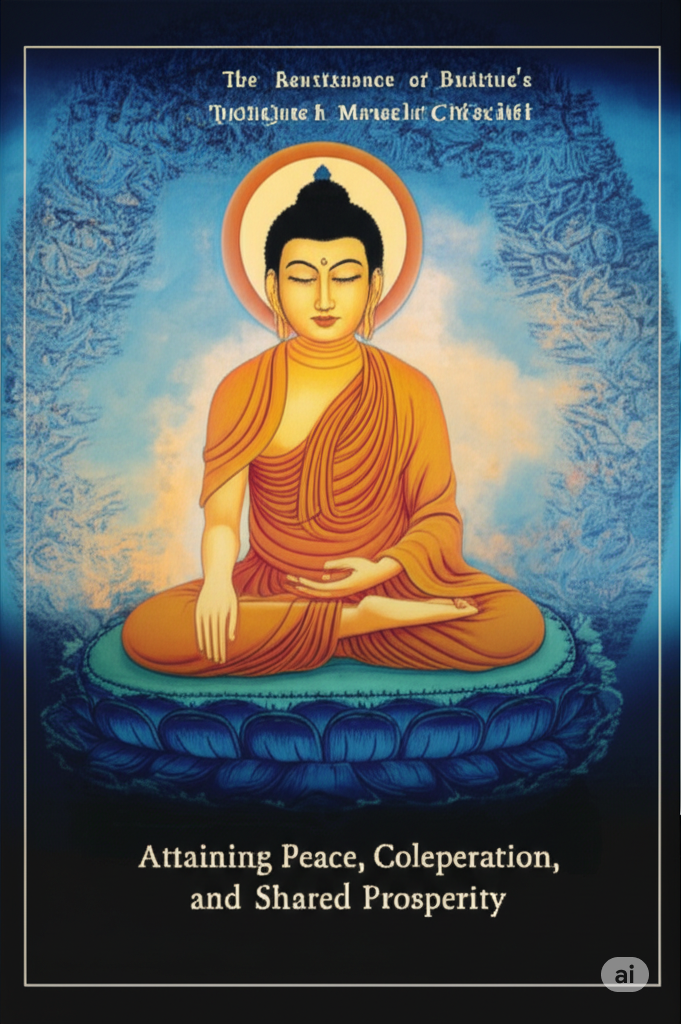
The Relevance of Buddha’s Thoughts in Modern World : Attaining Peace, Cooperation, and Shared Prosperity”
In an era marked by unprecedented technological advancement, economic interdependence, and global connectivity, humanity continues to grapple with deep-rooted issues such as conflict, inequality, environmental degradation, and social fragmentation. Despite material progress, the world remains mired in ideological polarizations, rising mental health crises, and a growing disconnection from ethical and spiritual values. In this context, the timeless teachings of Gautam Buddha offer not merely a religious or philosophical framework but a universally applicable ethical and socio-economic paradigm. His thoughts on non-violence (ahimsa), compassion (karuṇā), mindfulness (sati), and interdependence (pratītyasamutpāda) serve as powerful tools for navigating the complexities of the modern world.
Buddha’s teachings, rooted in the Dhamma, emphasize inner transformation as the foundation for social harmony and collective well-being. The Middle Path he advocated — avoiding both extreme indulgence and extreme austerity — finds renewed relevance today in formulating balanced approaches to economic development, environmental sustainability, and global governance. His vision of peace is not limited to the absence of war but extends to the cultivation of inner serenity and social justice. Similarly, his emphasis on mutual cooperation reflects a deeper understanding of human interconnectedness, which is crucial in an age where actions in one part of the world reverberate across continents.
Moreover, the Buddhist notion of right livelihood (sammā-ājīva) encourages ethical economic practices that promote dignity, reduce exploitation, and foster inclusive growth. In a world often dominated by profit-driven motives and structural inequalities, such principles offer a counter-narrative rooted in moral responsibility and shared prosperity. As nations and communities strive to meet the Sustainable Development Goals (SDGs), integrating Buddhist ethics into development discourse provides a moral compass to guide policy-making and international collaboration.
This article seeks to explore the enduring relevance of Gautam Buddha’s thoughts in addressing some of the most pressing challenges of the contemporary era. By examining his philosophical insights and their practical implications, the discussion aims to illuminate how Buddhist principles can inform global efforts toward peacebuilding, cooperative engagement, and equitable development in the 21st century.
Inner Peace as a Foundation for Outer Peace —
The starting point of Buddhist philosophy is the transformation of the mind. According to Buddha, the root of suffering lies within: ignorance (avidyā), attachment (taṇhā), and aversion. Mindfulness (sati) — the practice of non-judgmental awareness — becomes the antidote to this inner turmoil. In the modern world, where stress, anxiety, and disconnection have become endemic, mindfulness offers a psychological and ethical foundation for both personal and social peace.
Mindfulness is not merely a technique but a way of being. A mindful person becomes less reactive, more compassionate, and better equipped to navigate interpersonal and social tensions. This inner stability translates into outer peace: fewer conflicts in families, workplaces, and communities. Mindful citizens create mindful societies. Therefore, cultivating inner peace through mindfulness is not an isolated spiritual practice but a socio-political imperative.
Compassion (Karuṇā) as a Catalyst for Cooperation —
One of the central pillars of Buddhism is karuṇā — compassion, understood as the deep desire to alleviate the suffering of others. In an increasingly divided and competitive world, compassion is often dismissed as sentimental or naïve. Yet, it is perhaps the most radical and necessary force for human cooperation.
Compassion dismantles barriers between self and other, nation and nation, class and class. It fosters empathy, dialogue, and shared purpose — conditions necessary for any sustainable cooperative effort. From humanitarian aid to public health, from refugee assistance to climate solidarity, compassion urges us to see the pain of others as our own. Buddhist compassion is active, engaged, and non-discriminatory. It is a potent social ethic that can humanize our politics and reshape global governance in the service of shared humanity.
Interdependence (Pratītyasamutpāda) as a Basis for Shared Prosperity —
The doctrine of dependent origination (pratītyasamutpāda) is one of the most profound contributions of Buddhist thought to global ethics. It asserts that nothing exists in isolation; all things arise through complex webs of causality and mutual dependence. In the context of globalization, this insight becomes particularly relevant.
Economic interdependence, environmental interconnectivity, and transnational challenges like pandemics underscore the reality that no nation or community exists in a vacuum. Buddha’s vision compels us to reframe prosperity not as a zero-sum pursuit but as a shared condition. If one region thrives at the cost of another, if growth leads to ecological collapse elsewhere, then such prosperity is ultimately self-defeating.
Policies rooted in the understanding of interdependence would prioritize cooperation over competition, redistribution over accumulation, and sustainability over exploitation. Interdependence thus becomes the ontological foundation for a truly global ethic of shared prosperity.
Non-violence (Ahimsa) in Conflict Resolution —
Violence remains a persistent feature of modern life, manifesting in wars, systemic injustice, domestic abuse, and even in political rhetoric. The Buddhist principle of ahimsa — non-violence — is not a passive refusal to harm but an active commitment to nurture life, dignity, and justice. It challenges the very structures of domination and revenge that sustain cycles of conflict.
At the interpersonal level, ahimsa encourages restraint, empathy, and dialogue. At the societal and international levels, it informs models of restorative justice, peacebuilding, and conflict resolution that seek reconciliation rather than retribution. The teachings of Buddha have inspired countless non-violent movements — from Mahatma Gandhi’s struggle for Indian independence to the peace campaigns led by Buddhist monks in Southeast Asia. In our fractured world, ahimsa offers an alternative paradigm for resolving conflict without perpetuating new cycles of violence.
Ethical Economics and Right Livelihood (Sammā-ājīva) for Shared Prosperity —
Buddha’s teaching on right livelihood — sammā-ājīva — challenges us to rethink the moral foundations of economic life. In contrast to economies driven by exploitation, consumerism, and inequality, Buddhist ethics proposes that economic activity should serve human well-being and ecological balance.
Right livelihood means avoiding occupations that cause harm — whether through violence, deceit, or environmental destruction — and instead engaging in work that contributes positively to society. In contemporary terms, this could mean promoting fair-trade practices, green technologies, cooperative enterprises, and inclusive business models.
By aligning economic life with ethical purpose, Buddhist thought offers a way to humanize markets and resist the commodification of life. It insists that true prosperity is not measured by GDP alone but by the extent to which all beings can live with dignity and sufficiency.
Mindfulness in Leadership and Governance —
Leadership today is often marked by short-term thinking, reactive policy-making, and moral compromise. Buddhist teachings suggest that mindfulness can radically transform the nature of leadership. A mindful leader is self-aware, emotionally intelligent, and attentive to the broader consequences of their actions.
Such leadership fosters a culture of ethical reflection, transparent governance, and empathetic decision-making. In Buddhist terms, it integrates prajñā (wisdom) with karuṇā (compassion). Mindfulness can also enhance participatory democracy by encouraging active listening and reducing ideological polarization. The growing interest in “contemplative governance” and “mindful public service” signals a global appetite for leadership rooted in wisdom rather than dominance.
Addressing Modern Challenges through Buddhist Wisdom — Buddhist principles provide a rich ethical vocabulary for responding to 21st-century challenges:
- Climate Change: Interdependence compels us to recognize that harming the Earth is harming ourselves. Buddhist ecological ethics, grounded in non-harm and compassion for all life, promotes sustainable living.
- Social Injustice: The emphasis on compassion and right action supports a moral critique of casteism, racism, and economic inequality. Buddhist social engagement calls for solidarity with the marginalized.
- Global Conflicts: Ahimsa and right speech provide tools for non-violent communication, diplomacy, and peace negotiations.
In each case, Buddhist wisdom does not provide simple solutions but offers deep resources for ethical orientation, systemic critique, and compassionate engagement.
Universality and Timelessness of the Teachings —
While rooted in the historical context of ancient India, the ethical and philosophical insights of Buddhism possess a universality that transcends time and culture. The Four Noble Truths and the Eightfold Path do not belong to any one religion or ethnicity; they speak to the human condition as such. Concepts like compassion, mindfulness, and interdependence are now embraced across secular disciplines, including psychology, ecology, and peace studies.
This universality makes Buddha’s teachings highly adaptable. Whether applied in an urban school in New York, a rural development project in Sri Lanka, or a peace negotiation in Africa, they offer a shared moral language for collective flourishing.
The Middle Way as a Balanced Approach —
Finally, the Middle Way (Majjhimā Paṭipadā) stands as a profound metaphor for balance in a polarized world. It rejects both hedonism and extreme asceticism, advocating a path of moderation, self-discipline, and insight. This principle applies equally to policy-making, economics, and personal conduct.
In an age of extremes — economic inequality, ideological dogmatism, environmental exploitation — the Middle Way offers a path of ethical moderation and thoughtful deliberation. It promotes a sustainable equilibrium between growth and equity, freedom and responsibility, tradition and innovation.
Conclusion — The relevance of Buddha’s teachings in the modern world lies not in their antiquity but in their profound moral clarity and practical applicability. In a time marked by uncertainty and division, Buddhist thought offers a coherent vision of peace rooted in inner transformation, a politics of compassion, an economics of justice, and a global ethic of interdependence.
To embrace the Buddha’s path is not to retreat from the modern world, but to engage it more wisely and humanely. It is to reimagine the very foundations of our civilization on the basis of mindfulness, compassion, and ethical responsibility — so that peace, cooperation, and shared prosperity are not distant ideals, but lived realities.
Thanks.
 Pratik Ghansham Salvi Assistant Professor of Economics | Banking & Finance | IMF Finance & Development Contributor
Leave a comment