The Need of integrating Arttificial Intelligence (AI) Litracy in Development Frameworks: The Role of AI Literacy in Promoting Women’s and Children’s Safety and HDI Growth
In the 21st century, rapid advancements in Artificial Intelligence (AI) are transforming the social, economic, and cultural landscape at an unprecedented pace. While AI technologies hold immense potential for economic growth, efficiency, and innovation, their influence also extends to critical aspects of human security and well-being. Among these, the safety and protection of women and children have emerged as pressing concerns, particularly in the context of rising cybercrime, online harassment, exploitation, and technology-facilitated abuse. In an increasingly digitalized society, the lack of adequate AI literacy — defined as the knowledge, skills, and ethical awareness needed to understand, use, and critically evaluate AI systems — can significantly limit the ability of individuals and communities to safeguard themselves against such threats.
Human Development Index (HDI), a composite measure of life expectancy, education, and per capita income, offers a multidimensional perspective on societal progress. Safety and security are not explicitly captured within HDI, yet they form the bedrock upon which health, education, and income outcomes are built. Societies where women and children face persistent risks — both physical and digital — are less likely to achieve sustainable improvements in human development. AI literacy, when systematically integrated into national and local development frameworks, has the potential to empower vulnerable populations with the capacity to navigate digital environments, detect threats, and access protective mechanisms in both virtual and physical spaces.
For women, AI literacy can act as a catalyst for informed decision-making, enhanced digital participation, and reduced exposure to technology-enabled gender-based violence. For children, it can provide early-age awareness of safe online practices, foster critical thinking in navigating algorithmic environments, and build resilience against exploitation. At the policy level, incorporating AI literacy into development programs aligns with broader global agendas, including the United Nations Sustainable Development Goals (SDGs), particularly SDG 4 (Quality Education), SDG 5 (Gender Equality), and SDG 16 (Peace, Justice, and Strong Institutions).
However, the integration of AI literacy into development frameworks is not merely a technological or educational reform — it is a strategic imperative for enhancing human security, reducing inequality, and driving sustainable HDI growth. This requires a multi-stakeholder approach, involving governments, educational institutions, civil society organizations, technology companies, and local communities. By embedding AI literacy within capacity-building programs, social protection systems, and safety policies, societies can leverage the transformative potential of AI to foster a safer, more equitable, and development-oriented future.
This article examines the role of AI literacy in promoting women’s and children’s safety and its potential to enhance HDI outcomes. It argues that without AI literacy, the benefits of technological progress will remain unevenly distributed, and vulnerable groups will continue to face disproportionate risks. The discussion explores conceptual linkages between AI literacy, safety, and human development, identifies existing gaps, and proposes actionable pathways for integrating AI literacy into development policy frameworks.
A New Frontier in Human Development —
Artificial Intelligence has transitioned from a niche technological discipline into the architecture of modern life. From the voice assistants in smartphones to automated fraud detection in banks, from predictive policing to personalised learning algorithms, AI systems silently mediate billions of human interactions each day. Their influence extends beyond mere efficiency gains; AI now shapes how information is consumed, how services are delivered, and increasingly, how safety is ensured — or compromised.
Yet while AI’s reach is global, the ability to critically understand and navigate it — AI literacy — remains the privilege of a minority. This gap has profound consequences for vulnerable populations, particularly women and children, who are often the first to face the risks of technology misuse yet the last to be equipped with the tools to counter them.
Human Development Index (HDI), a composite measure encompassing health, education, and standard of living, provides a useful lens through which to view the stakes. HDI is not designed to measure safety directly, but safety is the foundation upon which its dimensions stand. Without security — physical, social, and increasingly digital — the gains in education and income risk being fragile, reversible, and exclusionary.
AI Literacy: Beyond Technical Skills
AI literacy is often misunderstood as a purely technical skill — knowing how to code or operate AI tools. In reality, it encompasses a far broader range of capabilities:
- Conceptual Understanding: Knowing what AI is, how it works, and where it is applied in daily life.
- Critical Awareness: Recognising algorithmic bias, manipulation, and the limits of AI’s decision-making.
- Practical Safety Skills: Detecting phishing scams, identifying deepfake videos, and using AI-enabled safety tools effectively.
- Ethical Judgment: Understanding the social consequences of AI use, from data privacy to discrimination.
For women and children, these skills are not optional — they are essential. AI literacy can mean the difference between falling victim to an AI-generated scam and reporting it; between being manipulated by personalised misinformation and resisting it.
The Gendered Risks of a Digital Era
The digitisation of abuse is one of the darker side-effects of AI’s rapid adoption.
- For Women: The rise of deepfake pornography, algorithm-driven harassment campaigns, and AI-facilitated identity theft disproportionately affect women. Research by the Sensity AI platform suggests that 96% of deepfake videos online are sexual in nature, and the overwhelming majority target women without their consent. Without AI literacy, victims may not even know the tools exist to detect, trace, or report such abuse.
- For Children: The risks include AI-powered grooming techniques, recommendation algorithms that promote harmful content, and location-tracking features embedded in apps. A UNICEF report warns that children are increasingly exposed to AI-mediated risks before they are emotionally or cognitively ready to handle them.
In both cases, AI literacy does not eliminate risk, but it drastically increases the ability to recognise threats early, respond effectively, and demand institutional accountability.
From Rhetoric to Integration in Development Frameworks — It is no longer enough to treat AI literacy as a side topic in technology policy or STEM education. To have meaningful impact on HDI, it must be institutionalised within the core of national and local development strategies.
Three priority pathways emerge:
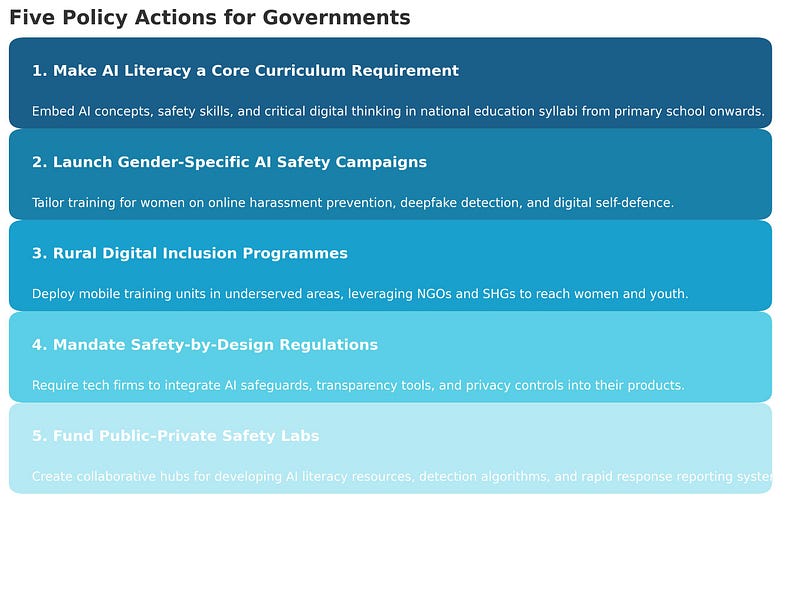
- Curricular Embedding from Early Education
- Introduce AI literacy modules at primary and secondary levels, using age-appropriate content to explain how algorithms work, how digital footprints form, and how to identify misinformation or unsafe digital interactions.
- Extend such training to parents and guardians, ensuring intergenerational awareness.
2. Community-Level Outreach in Rural and Underserved Areas
- Partner with NGOs, self-help groups (SHGs), and women’s cooperatives to deliver AI literacy workshops that combine digital skills with safety awareness.
- For rural women, focus on practical tools — recognising fraudulent job postings, avoiding financial scams, and using AI translation tools for information access.
3. Policy and Regulatory Alignment
- Mandate transparency and safety-by-design principles for AI systems, ensuring that private-sector innovation aligns with public safety goals.
- Establish public-private safety labs to develop AI literacy campaigns, detection tools, and rapid-response reporting channels.
The Link to HDI and Global Goals — The integration of AI literacy into development frameworks contributes directly to the United Nations Sustainable Development Goals:
- SDG 4 (Quality Education): AI literacy as a core competency prepares citizens for the digital economy.
- SDG 5 (Gender Equality): Targeted AI literacy training helps reduce gender-based digital violence and exclusion.
- SDG 16 (Peace, Justice, and Strong Institutions): Empowering citizens with AI literacy fosters resilience against cybercrime, misinformation, and erosion of civic trust.
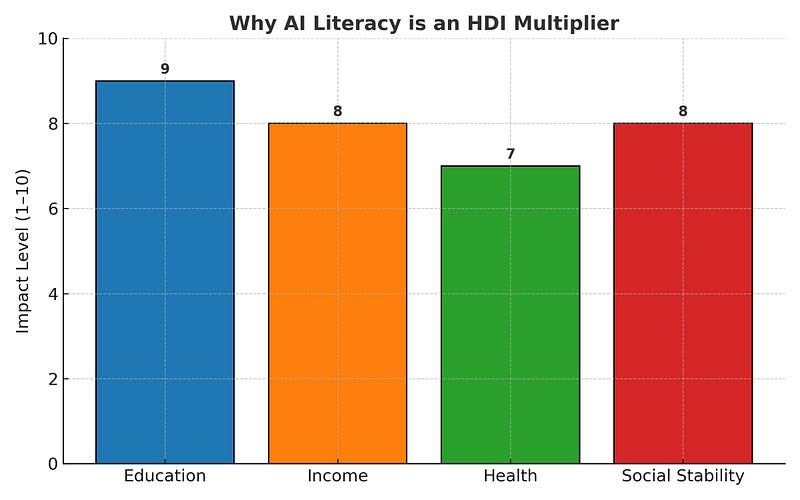
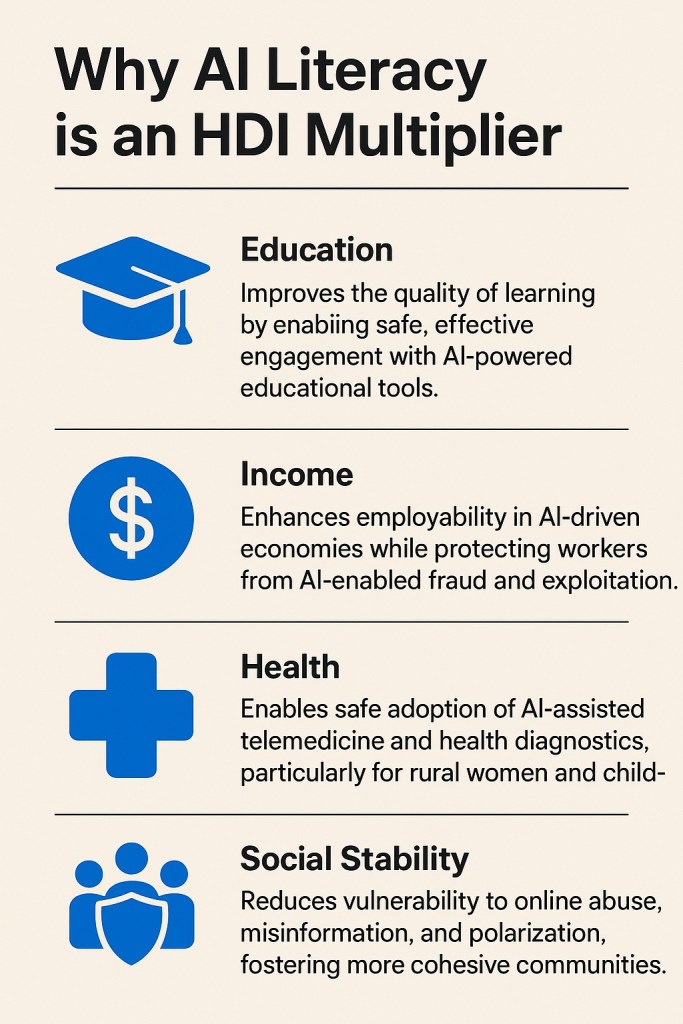
By reducing vulnerability and improving participation in digital economies, AI literacy indirectly supports HDI growth. Education levels rise when students can engage safely online; income levels rise when individuals can leverage AI tools without fear of exploitation; life expectancy benefits when digital health technologies are used effectively and safely.
The Cost of Inaction — Failing to integrate AI literacy has real and measurable costs:
- A widening digital divide, where vulnerable populations are excluded from AI-driven opportunities while remaining exposed to its risks.
- An erosion of trust in digital platforms, which can undermine civic engagement and economic participation.
- The persistence of structural inequality, where women and children bear a disproportionate burden of harm in unsafe digital environments.
Conclusion: Safety as a Development Metric —
In the industrial era, literacy campaigns were the cornerstone of development, enabling participation in democratic governance and industrial economies. In the AI era, AI literacy must play the same role — not as a luxury, but as a foundation for human dignity and societal resilience.
If development frameworks fail to integrate AI literacy, HDI scores may continue to rise in the short term through gains in health, income, and schooling, but these gains will be fragile, reversible, and unequally distributed. Societies that act now to embed AI literacy — especially for women and children — will not only protect their most vulnerable, but will also unlock the full promise of AI as a driver of safe, inclusive, and sustainable human development.
Thanks.
 Pratik Ghansham Salvi Assistant Professor of Economics | Banking & Finance | IMF Finance & Development Contributor
Leave a comment