Pratik Ghansham Salvi
Assistant professor in Economics, banking and finance
India’s Public health system operates under the persistent strain. In the Global Hunger Index of 2025, which is conducted by the Irish humanitarian organization ‘Concern Worldwide’ and German aid agency ‘Welthungerhilfe’ (with FAO, UNICEF, WHO, IFPRI) India ranks 102 out of 123 countries. And this is the serious concern for India’s Public health system because for economic development of country specifically for HDI the health indicator plays very important role. Although India some progress in reducing child mortality, preventable illness, diarrhoeal diseases and dehydration continue to claim lives, particularly among the children’s from low income and marginalised communities. The country’s health challenges are shaped by overcrowded public hospitals, uneven access to primary health care, nutritional deficits and deep inequalities in health awareness. In this context, low cost, awareness based government interventions is the key aspect to India’s public health sector.
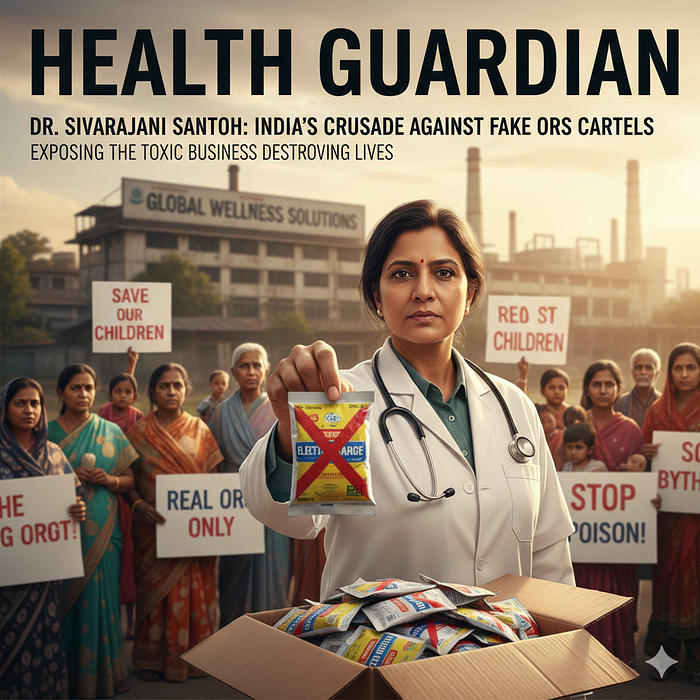
Oral Rehydration Solution (ORS) is endorsed by the World Health Organisation (WHO) is one such intervention at the international level which is simple inexpensive and life saving for many people in the world today. Yet, India’s health ecosystem is intersected with private markets and due to this factor the boundary between medical therapy and consumer product has grown blurred. The fact is that many commercial marketed beverages — often high in sugar content and electrolytically imbalanced have been sold under the label –“ORS”, capitalising on public trust while deviating from established medical standards. It is within this fragile public health environment that Dr. Sivarajani Santosh, a medical doctor and paediatrician from Hyderabad started her eight year struggle to expose and challenge the corporate business of fake ORS drinks in India. Her efforts highlights not only corporate malpractice but also deeper regulatory and governance failures in India’s health system.
Why ORS is the cornerstone of India’s health strategy?
ORS is not merely a medical product it is a public health cornerstone. It significantly reduced deaths from dehydration particularly in rural and urban poor settings where access to advanced medical and health care is very limited. The effectiveness of ORS lies in its precise formulation, which enables rapid absorption of fluids and electrolytes. Any dilution of its scientific integrity therefore carries serious public health consequences.
When a medical therapy is reduced to a marketing category?
ORS is effective because it is medically precise, not because it is popular or commercially attractive. Its success in reducing child mortality rests on a carefully calibrated balance of glucose and electrolytes that facilitates rapid fluid absorption in the intestine. The emergence of sugary drinks branded as “ORS” represents a fundamental shift — from therapy to branding. Companies exploited the public familiarity of the term while detaching it from its scientific foundation. For parents, especially those navigating illness with limited medical guidance, the distinction between genuine ORS and an electrolyte-flavoured beverage became nearly impossible to discern. Dr. Sivarajani Santosh’s fight challenged this transformation of a life-saving medical intervention into a loosely regulated consumer product.
Dr. Sivarajani Santosh’s intervention was rooted in clinical observation rather than ideology. Treating dehydrated children, she noticed that many failed to improve despite being given commercially available “ORS drinks”. In some cases, symptoms worsened. On examination, these products often contained sugar levels far exceeding WHO recommendations. Excess sugar increases osmotic pressure in the gut, aggravating diarrhoea and undermining rehydration. These were not abstract concerns but repeated, observable outcomes in real patients. By grounding her advocacy in clinical evidence, Dr. Sivarajani Santosh reframed the issue as a matter of patient safety rather than consumer preference.
Market incentives, information asymmetry, and ethical erosion?
The proliferation of fake ORS illustrates a classic market failure. Producers possessed full information about product composition, while consumers — often stressed parents — relied on labels and brand messaging. This information asymmetry allowed profit incentives to override ethical responsibility. In health-adjacent markets, where trust substitutes for technical understanding, misleading claims can have direct and immediate consequences. Dr. Sivarajani Santosh’s campaign exposed how weak regulation and aggressive marketing combined to normalise ethically questionable practices, particularly in markets serving vulnerable populations.
Eight years of resistance and the limits of India’s regulatory response?
That it took nearly eight years of sustained advocacy to challenge misleading ORS marketing reveals deep institutional inertia. Responsibility for such products is fragmented across food safety authorities, drug regulators, and advertising bodies, none of which moved decisively in isolation. The slow response underscores a systemic weakness: India’s regulatory institutions often struggle to address harms that are widespread but incremental. Dr. Santosh’s persistence thus highlighted not only corporate malpractice, but the cost of delayed regulation in public health.
Why this fight matters for India’s health governance?
The significance of Dr. Sivaranjani Santosh’s struggle extends far beyond ORS. It raises a fundamental question about how India governs health-related markets in an era of expanding private participation. If life-saving therapies can be diluted by branding and regulatory ambiguity, public trust in health systems erodes. Protecting ORS from commercial misuse is therefore not anti-market; it is essential to ensuring that markets operate within scientifically defined and ethically defensible boundaries. Dr. Santosh’s campaign serves as a reminder that sustainable development depends not only on innovation and growth, but on the integrity of institutions tasked with protecting public health.
Conclusion
In a country where preventable illnesses still place immense strain on families and health systems, the integrity of simple, evidence-based interventions cannot be left to market forces alone. Dr. Sivaranjani Santosh’s eight-year fight against the corporate business of fake ORS drinks stands as both a warning and a lesson — about the dangers of regulatory complacency and the enduring power of scientific integrity. It is a reminder that in public health, vigilance matters as much as innovation.
Thanks.
 Pratik Ghansham Salvi Assistant Professor of Economics | Banking & Finance | IMF Finance & Development Contributor
Leave a comment