When Growth Numbers Become Headlines and Reality Disappears in India?
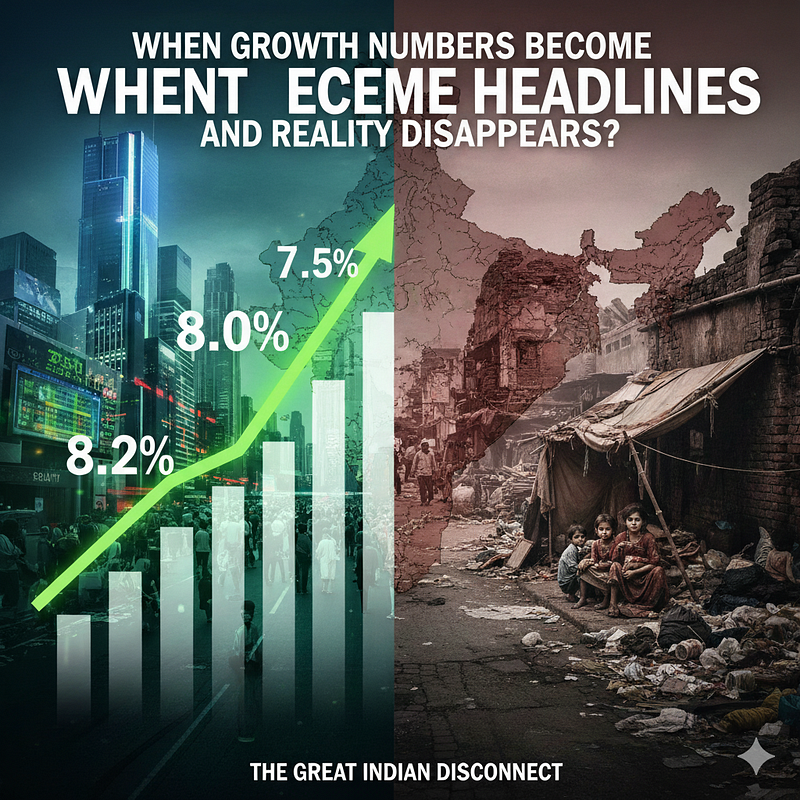
India’s economic growth figures increasingly arrive as headline-grabbing spectacles rather than instruments of public understanding. Quarterly GDP numbers are announced with triumph, amplified by political messaging and breathless media coverage, and quickly converted into claims of global leadership and domestic prosperity. Yet behind this choreography of statistics lies a more uncomfortable truth: growth has become a substitute for development, and numbers have begun to obscure reality rather than illuminate it.
The problem is not growth per se, but the uncritical reverence accorded to a single aggregate indicator. GDP captures the pace of economic activity, not its quality, distribution, or sustainability. It tells us little about stagnant real wages, precarious employment, deteriorating public services, or widening regional and social inequalities. When headline growth coexists with jobless expansion, rising household distress, and declining human development indicators, the disconnect between economic narration and lived experience becomes impossible to ignore.
In India, this disconnect is compounded by a policy discourse that treats growth statistics as political achievements rather than diagnostic tools. Government communication often frames GDP numbers as proof of success, while inconvenient indicators — unemployment surveys, consumption data, nutritional outcomes, and informal sector stress — are sidelined, delayed, or selectively interpreted. Much of the mainstream media, instead of interrogating these claims, functions as a megaphone, converting complex economic realities into simplified narratives of national ascent.
When growth numbers dominate headlines, economic debate shrinks. Questions about who benefits from growth, who is left behind, and whether the current growth path is resilient or inclusive are pushed to the margins. The result is a misinformed public discourse — one where optimism is manufactured through aggregates, and structural weaknesses are rendered statistically invisible. This article argues that India’s economic outlook cannot be assessed through GDP alone, and that reclaiming reality from the tyranny of headline growth is essential for meaningful development policy.
GDP Growth Has Become a Political Signal, Not an Economic Diagnosis —
In contemporary India, GDP growth has ceased to function primarily as an economic diagnostic tool and has instead become a political signal. Quarterly growth releases are choreographed events — interpreted as verdicts on governance rather than inputs for policy correction. The language surrounding growth has shifted from cautious assessment to triumphalist assertion, turning economic measurement into political messaging.
This transformation alters incentives. When growth numbers are framed as achievements to be defended, rather than indicators to be interrogated, policymakers become less responsive to negative signals embedded within the economy. Structural weaknesses are downplayed, and dissenting economic interpretations are dismissed as pessimism or anti-nationalism. Growth, in this context, becomes an optic — designed to reassure and impress — rather than a mirror reflecting economic reality.
The Conceptual Limits of GDP as a Measure of Development
GDP measures aggregate economic activity, not social progress. It does not account for the nature of production, the security of employment, the distribution of income, or the sustainability of growth. Nor does it distinguish between growth driven by productivity gains and growth sustained through fiscal stimulus, household debt, or environmental depletion.
In a country like India — marked by a large informal sector, sharp regional disparities, and unequal access to public services — this limitation is especially severe. A rise in GDP can coincide with declining real wages, deteriorating public health, and shrinking household resilience. When GDP is treated as a comprehensive measure of development, these contradictions are not merely overlooked; they are structurally erased from economic discourse.
Jobless Growth and the Erosion of the Labour–Growth Link
One of the most troubling features of India’s recent growth trajectory is the weakening relationship between output expansion and employment creation. Despite periods of high growth, job generation has remained insufficient, particularly in formal, stable, and well-paid employment. The economy has increasingly favoured capital-intensive sectors, automation, and scale-driven consolidation, limiting labour absorption.
This pattern has profound macroeconomic implications. Employment is not merely a social outcome; it is a core driver of demand, productivity, and political stability. When growth fails to generate jobs, consumption weakens, inequality rises, and growth itself becomes fragile. Jobless growth thus represents not a transitional phase, but a structural flaw in the growth model.
Distributional Distortions and Concentrated Gains
GDP growth is silent on who benefits. In India, growth has increasingly accrued to a narrow segment of large firms, asset holders, and urban elites, while rural households, informal workers, and small enterprises face stagnant or declining incomes. This concentration of gains is not incidental — it reflects policy choices, market structures, and institutional asymmetries.
Rising inequality weakens the economy in multiple ways. It suppresses broad-based demand, reduces social mobility, and undermines trust in institutions. Yet distributional outcomes rarely feature in headline growth narratives. By focusing on aggregates alone, economic discourse normalises inequality as an acceptable by-product of growth rather than recognising it as a constraint on sustainable development.
Selective Data Visibility and the Shrinking of Economic Debate
India’s growth narrative is sustained not only by what is highlighted, but by what is obscured. Data on employment, consumption, nutrition, and informal sector health have often been delayed, revised, or relegated to the margins of public discussion. This selective visibility distorts economic understanding and narrows the scope of debate.
When inconvenient indicators disappear from mainstream discourse, policymaking loses feedback mechanisms. Economic governance becomes less adaptive and more insulated. Over time, this erosion of transparency damages institutional credibility and weakens public trust in official statistics — an outcome far more costly than acknowledging uncomfortable truths.
Media Simplification and the Performance of Economic Success
Much of the media ecosystem reinforces growth-centric narratives by treating GDP numbers as self-explanatory indicators of success. Rankings, international comparisons, and celebratory headlines replace analysis of composition, employment intensity, and social impact. Economic reporting becomes performative — focused on spectacle rather than substance.
This simplification has consequences beyond misreporting. It reshapes public expectations and political accountability. Citizens are encouraged to evaluate economic performance through abstract numbers rather than lived experience, while policymakers face limited pressure to address underlying structural issues. Growth, once simplified, becomes a shield against scrutiny.
Human Development as the Missing Foundation of Growth
Sustained economic progress depends on human capabilities — health, education, nutrition, and skills. Yet India’s human development outcomes remain misaligned with its growth ambitions. Persistent underinvestment in social sectors constrains productivity, limits labour mobility, and weakens the demographic dividend.
Growth without human development is not merely inequitable; it is strategically unsound. An economy cannot consistently outperform the capabilities of its workforce. When growth races ahead of human development, it creates bottlenecks that eventually slow momentum, increase vulnerability to shocks, and amplify social stress.
Reframing Economic Success Beyond Headline Numbers
India’s challenge is not to reject growth, but to redefine how it is understood and evaluated. Economic success must be assessed through a multidimensional lens — employment quality, income security, access to public services, environmental sustainability, and institutional strength.
GDP should initiate inquiry, not conclude it. A mature economic discourse treats growth as a means to development, not as proof of it. Reclaiming reality from headline growth is essential for honest policymaking, democratic accountability, and the construction of an economy that works not just on paper, but in people’s lives.
India’s growth story, as told through headline GDP figures, offers comfort — but not clarity. When growth numbers are elevated from indicators to affirmations of success, economic discourse loses its critical edge. The celebration of aggregates obscures the deeper questions that define development: the quality of jobs created, the security of household incomes, the reach of public services, and the sustainability of the growth process itself.
An economy cannot be judged solely by how fast it expands, but by how widely and durably its gains are shared. Persistent employment distress, rising inequality, uneven human development, and selective visibility of data suggest that India’s current growth trajectory, while impressive on paper, remains fragile in substance. Ignoring these signals in favour of headline optimism risks policy complacency and institutional erosion.
Reclaiming economic reality requires a shift in both measurement and mindset. GDP must return to its rightful place — as a starting point for inquiry, not the conclusion of debate. A more honest assessment of economic performance would integrate employment, distribution, human development, and environmental resilience into the core of public discourse. Such a recalibration is not anti-growth; it is pro-development.
Until India moves beyond the comfort of numbers and confronts the complexities beneath them, growth will continue to dominate headlines while everyday economic realities remain unresolved. The true test of India’s economic success lies not in quarterly growth rates, but in whether economic progress is felt, sustained, and trusted by the society it claims to serve.
Thanks.
 Pratik Ghansham Salvi Assistant Professor of Economics | Banking & Finance | IMF Finance & Development Contributor
Leave a comment