Can India Topple the Chip Giant? Inside India’s Ambitious Plan to Challenge China’s Semiconductor Supremacy
In Semiconductor industry China played an important role as it provides more than 80% of exports of semiconductor chips and related raw materials throughout the world. Other key exporting countries of semiconductors are the USA, Japan, Korea,etc. However, the important thing is that how china became the leading exporter country of semiconductors worldwide? There are various possible reasons for the development of chip manufacturing but among them the most important constituent is that reserves of “Lithium”. So in this article I will be disscuss impotantce of the growth of semiconductor industry for sustainable development as well as how other countries can adopt these policies to boost the semiconductors and achieve Net-Zero targets. Moreover, I am providing the analysis of India’s Semiconductor Industry growth in recent times as well.
Introduction:
In the heart of modern technology, tucked away within tiny, intricately etched squares of silicon, lies the invisible engine that drives our world. Semiconductors, these microscopic marvels, power everything from the smartphones in our pockets to the fighter jets slicing through the skies. And at the helm of this critical industry sits China, a formidable Goliath dominating the global chip landscape.
But on the horizon, a challenger emerges — India. A nation long reliant on imported chips is experiencing a tectonic shift. Driven by ambition, fueled by an ever-growing tech-savvy workforce, and backed by a government wielding a hefty financial war chest, India is daring to dream big. This isn’t just about building a domestic chip manufacturing industry; it’s about wresting the scepter of semiconductor supremacy from China’s grasp.
This, however, is no fairytale David-and-Goliath duel. China’s chip empire is deeply entrenched, its technological prowess honed over decades. The road ahead for India is fraught with challenges: navigating the labyrinthine complexities of chip fabrication, overcoming the dominance of established players, and weathering the unpredictable storms of global geopolitics.
Yet, India possesses potent weapons in its arsenal. Its vast pool of talented engineers and scientists fuels innovation. Its strategic geographic location positions it as a potential manufacturing hub for a resource-hungry industry. And most importantly, its government has embarked on a multi-pronged offensive, showering the nascent chip industry with financial incentives, establishing research hubs, and forging strategic partnerships.
This article delves deep into the intricate tapestry of India’s semiconductor ambitions. We’ll peel back the layers of this audacious undertaking, exploring the driving forces behind it, dissecting the strategies being deployed, and illuminating the formidable roadblocks that lie ahead. Will India manage to carve its own silicon valley, etching its name onto the global tech map? Will it succeed in dismantling China’s chip monopoly, rewriting the script of the tech battlefield?
China’s Entrenched Dominance: A Head Start Forged in Supply Chains, Technology, and Market Share
China’s economic prowess cannot be understated. Its rise as a dominant player on the global stage is remarkable, and its current position reflects a strategic confluence of factors that have cemented its entrenched dominance in many sectors. Let’s delve into the key pillars of this dominance:
1. Established Supply Chains: China has spent decades meticulously building a vast and intricate network of production facilities, raw material sourcing, and logistics infrastructure. This interconnected web allows for efficient and cost-effective manufacturing, making Chinese goods highly competitive in the global market. From textiles to electronics, China’s established supply chains offer unparalleled scale and scope, giving them a significant advantage over many competitors.
2. Advanced Technology: While often associated with manufacturing, China has made significant strides in technological advancement. Investments in research and development,coupled with a large pool of skilled engineers and scientists, have propelled China to the forefront of certain technological domains. Artificial intelligence, renewable energy, and robotics are just a few areas where China is rapidly closing the gap, or even surpassing, established players. This technological prowess further strengthens its economic dominance by enhancing production efficiency, creating new industries, and driving innovation.
3. Significant Market Share: China’s sheer population size translates to a massive domestic market, absorbing a substantial portion of its own production. This internal demand provides a solid foundation for its economy, insulating it somewhat from external fluctuations. Additionally, China’s aggressive export strategies have secured it large market shares in various sectors across the globe. This extensive reach gives China significant leverage in terms of trade negotiations and pricing power, further solidifying its economic advantage.
However, it’s important to acknowledge that China’s dominance is not without its challenges. Concerns regarding intellectual property rights, environmental impact, and labor practices continue to raise ethical and practical questions. Additionally, rising internal costs and growing competition from other developing nations might necessitate strategic adjustments in China’s economic model.
China’s entrenched dominance is a multifaceted phenomenon built on a foundation of established supply chains, advanced technology, and significant market share. While this position carries undeniable advantages, it also comes with its own set of challenges and potential shifts in the global economic landscape. Understanding the factors behind China’s dominance and its potential future trajectory is crucial for navigating the complexities of the interconnected global economy.
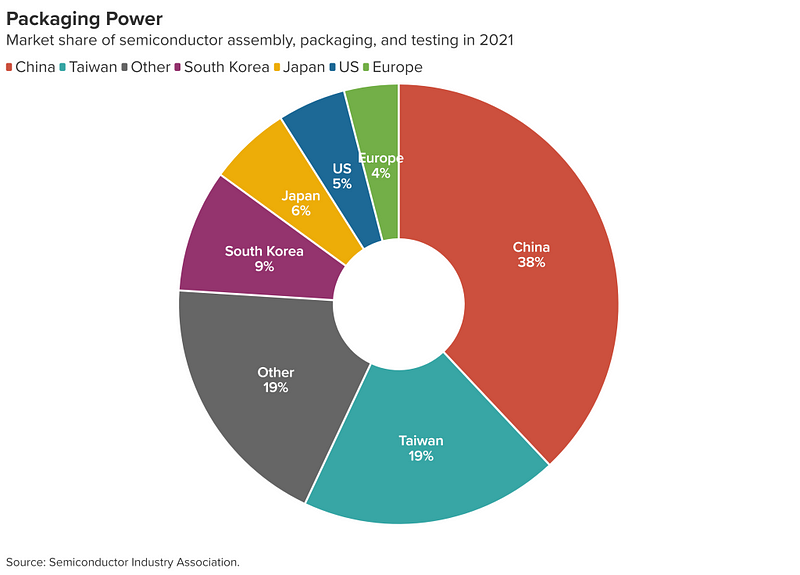
The chart titled “Packaging Power”, which represents the market share of semiconductor assembly, packaging, and testing in 2021. Here’s a detailed breakdown:
- China: With a red segment in the chart, China holds the largest market share at 38%.
- Taiwan: Represented by a teal segment, Taiwan holds 19% of the market share.
- Other: This dark grey segment also represents 19% of the market share, but it’s not specified which countries or regions this includes.
- South Korea: The purple segment represents South Korea’s market share, which is 9%.
- Japan: Represented by a yellow segment, Japan holds 6% of the total market share.
- US: The US, represented by a blue segment, holds 5% of the market share.
- Europe: The smallest share is held by Europe, represented by a green segment, at 4%.
The source of this data is the Semiconductor Industry Association. The chart provides a visual representation of the distribution of market shares in the semiconductor assembly, packaging, and testing industry in 2021. The use of different colors for each region/country helps in distinguishing between them. The inner white circle creates a donut effect for better visual representation.
Bridging the Technological Gap: India’s Pursuit of Chip Design and Fabrication
India’s emerging role in the semiconductor industry is undeniable. However, a crucial gap remains in its technological prowess, particularly in the realm of chip design and fabrication. This critical domain, often the “brains” of modern electronics, forms the bedrock for various sectors, from smartphones and computers to medical devices and national security.
The Challenge:
- Limited R&D: India’s investment in research and development (R&D) for chip design and fabrication lags behind global leaders. This translates to a scarcity of cutting-edge expertise and indigenous technologies, making India heavily reliant on imports.
- Fabrication Bottleneck: Setting up semiconductor fabs, the complex facilities where chips are physically manufactured, requires immense upfront investment and cutting-edge. India currently lacks the robust infrastructure and ecosystem to support domestic fabrication.
- Talent Drain: The brain drain phenomenon continues to pose a challenge, with skilled engineers and scientists often lured by lucrative opportunities abroad. This further hinders India’s ability to build a critical mass of talent in chip design and fabrication.
The Stakes:
- Strategic Vulnerability: Reliance on foreign chips exposes India to potential supply chain disruptions and geopolitical uncertainties. This can have cascading effects on national security, critical infrastructure, and economic stability.
- Missed Economic Opportunities: A thriving domestic chip industry could unlock a plethora of economic benefits, from creating high-skilled jobs and attracting foreign investment to fostering innovation and entrepreneurship across various sectors.
- Limited Technological Independence: Without indigenous chip design and fabrication capabilities, India remains beholden to the technological advancements of other nations, hindering its ability to fully chart its own technological course.
Bridging the Gap:
- Government Initiatives: The Indian government has recognized the criticality of chip development and launched various initiatives, including the India Semiconductor Mission (ISM) and the Production Linked Incentive (PLI) scheme. These programs aim to attract investments, incentivize domestic chip production, and foster collaboration between academia and industry.
- Strengthening R&D: Increased funding for research institutions, universities, and private companies is crucial to nurturing a culture of innovation and developing本土人才. Establishing dedicated R&D hubs and fostering partnerships with global chipmakers can further accelerate knowledge transfer and technological advancements.
- Building the Ecosystem: Attracting leading foundries and chip design houses to set up operations in India is essential. This requires creating a robust infrastructure with reliable power supply, advanced logistics, and skilled workforce. Additionally, fostering a vibrant startup ecosystem within the chip design and fabrication sector can drive innovation and create new opportunities.
The Road Ahead:
Bridging the technological gap in chip design and fabrication is a formidable challenge. However, with concerted efforts from the government, industry, and academia, India has the potential to establish itself as a major player in this critical domain. By nurturing本土人才, fostering innovation, and creating a conducive ecosystem, India can not only reduce its dependence on foreign chips but also unlock a new era of technological independence and economic prosperity.
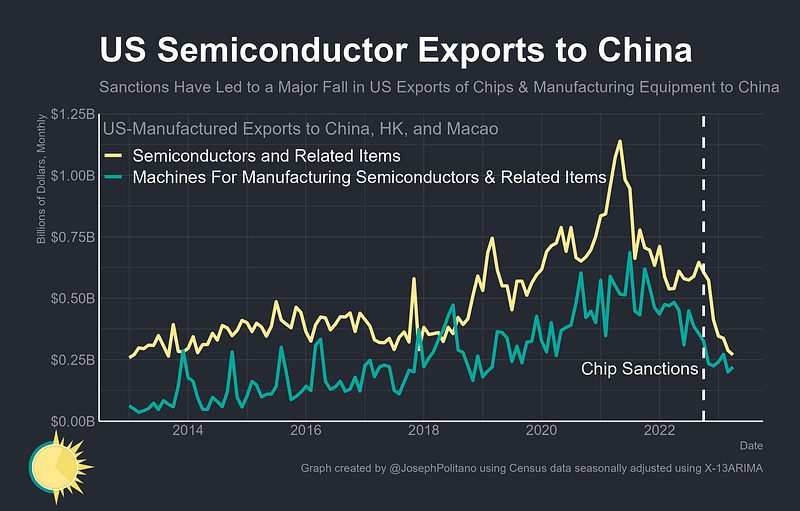
A line graph titled “US Semiconductor Exports to China”. It represents the trend of US-manufactured exports to China, Hong Kong, and Macao from 2014 onwards. Here’s a detailed breakdown:
- Semiconductors and Related Items: This data is represented by a yellow line in the graph.
- Machines for Manufacturing Semiconductors & Related Items: This data is represented by a blue line.
Both lines show an increase until around 2020, after which there is a marked decline. This decline is particularly noticeable for “Semiconductors and Related Items”.
A note on the graph indicates that sanctions have led to a major fall in US exports of chips & manufacturing equipment to China. There’s an annotation labeled “Chip Sanctions” indicating the point where the sanctions were imposed, leading to a drastic fall in export values.
The y-axis is labeled with values ranging from $0.00B to $1.25B, while the x-axis represents years from 2014 onwards. The graph was created by @JosephPolitano using Census data seasonally adjusted using X-13ARIMA. This graph provides a visual representation of the impact of sanctions on the US semiconductor exports to China.
Geopolitical Rebalancing: A successful Indian chip industry could weaken China’s technological dominance and shift power dynamics :
Geopolitical rebalancing refers to the redistribution of power and influence among nations on the global stage. In recent years, there has been a growing recognition of the critical role played by technology in shaping geopolitical dynamics. One area where this is particularly evident is the semiconductor industry, which is integral to the development of advanced technologies such as artificial intelligence, 5G, and the Internet of Things (IoT). In the context of geopolitical rebalancing, the emergence of a successful Indian chip industry has the potential to reshape the power dynamics in the technology sector, particularly by challenging China’s technological dominance.
China has become a global leader in various technological domains, with a significant emphasis on semiconductor manufacturing. The country has invested heavily in building a robust semiconductor industry, aiming to reduce its dependence on foreign suppliers. However, this has also raised concerns among other nations about China’s growing technological prowess and the potential risks associated with a concentration of semiconductor production in one country.
India, recognizing the strategic importance of a robust semiconductor industry, has been taking steps to develop its own capabilities in this field. A successful Indian chip industry could have several implications for the balance of power in the technology sector and beyond:
1. Reduced Dependence on China: Many countries, including India, currently rely on China for semiconductor components. The development of a domestic chip industry in India would reduce dependence on Chinese suppliers, providing countries with an alternative source for critical components.
2. Technological Innovation: A thriving Indian chip industry would contribute to global technological innovation. It could become a hub for research and development, fostering collaboration with other tech-driven economies. This innovation would not only benefit India but also contribute to a more diverse and competitive global technology landscape.
3. Economic Growth: A successful semiconductor industry in India would lead to economic growth by creating high-tech jobs, attracting investments, and fostering a culture of innovation. This economic strength can translate into increased geopolitical influence for India.
4. Balancing Power in Asia: The technological competition between India and China could serve as a balancing factor in the geopolitical landscape of Asia. As both nations strive for technological dominance, it could prevent a single country from exerting disproportionate influence over the region.
5. Global Supply Chain Resilience: The concentration of semiconductor manufacturing in a few countries, particularly China, has highlighted vulnerabilities in the global supply chain. The diversification of semiconductor production to include India enhances the resilience of the global supply chain, making it less susceptible to disruptions.
However, it’s essential to note that building a competitive semiconductor industry is a complex and long-term endeavor. It requires substantial investments in research and development, infrastructure, and a skilled workforce. Additionally, geopolitical factors, trade policies, and international collaboration will play a crucial role in determining the success of India’s efforts to rebalance the power dynamics in the semiconductor industry.
The emergence of a successful Indian chip industry has the potential to weaken China’s technological dominance and contribute to a more balanced global power structure in the technology sector. It would enhance India’s role in the global supply chain, foster innovation, and serve as a counterbalance to China’s influence in the region and beyond.
Challenges to Global Supply Chains: A new player like India could potentially disrupt existing chip supply chains and lead to price fluctuations —
The intricate web of global supply chains that weave together the production and distribution of goods faces constant challenge and evolution. The emergence of a new player like India in the world of chip manufacturing holds both promise and potential disruption, introducing a host of complexities to consider.
Potential Disruptions:
- Shifting Power Dynamics: The existing chip manufacturing landscape is dominated by a handful of established players, primarily in East Asia and the United States. India’s entry could redistribute market share, potentially destabilizing established relationships and price structures. This could lead to:
- Competition and Price Fluctuations: Increased competition could drive down prices in the short term, but also lead to instability as new players try to establish themselves.
- Geopolitical Realignments: Reliance on new sources of chips could alter existing geopolitical dependencies and alliances, leading to potential trade conflicts and power struggles.
- Supply Chain Fragility: Complex global supply chains are inherently vulnerable to disruptions. While diversification through India could offer redundancy and resilience, integrating a new player also introduces additional complexity and potential points of failure. This could lead to:
- Bottlenecks and Shortages: Integrating new production facilities and logistics networks takes time and investment. Initial hiccups and delays could exacerbate existing chip shortages, particularly if demand remains high.
- Quality and Security Concerns: Establishing robust quality control and intellectual property protection measures takes time and expertise. Concerns about reliability and potential security vulnerabilities in chips from new sources could arise.
Potential Benefits:
- Increased Resilience and Diversification: A diversified chip manufacturing landscape reduces dependence on any single region or player. This makes the global supply chain more resilient to disruptions caused by geopolitical events, natural disasters, or pandemics.
- Lower Costs and Increased Innovation: Increased competition can drive down prices and incentivize further innovation in chip design and fabrication. This could benefit consumers and lead to the development of more efficient and advanced technologies.
- Boost for India’s Economy: A thriving chip manufacturing industry could create high-skilled jobs, attract foreign investment, and accelerate India’s technological development. This would have a significant positive impact on the country’s overall economy.
Managing the Disruption:
Navigating the potential disruptions and harnessing the benefits of India’s entry requires a proactive approach:
- Collaboration and Transparency: Open communication and collaboration between established players, newcomers like India, and consumer nations are crucial for building trust and ensuring a smooth transition. Sharing best practices and establishing standardized protocols can address quality and security concerns.
- Investment in Infrastructure and Talent: India needs to invest heavily in building the necessary infrastructure, including advanced fabrication facilities, reliable power grids, and skilled workforce. This will require collaboration with established players and technology transfer agreements.
- Risk Management and Flexibility: Supply chains need to be designed with flexibility and redundancy in mind to mitigate the impact of potential disruptions. Diversification across different regions and players can help build resilience.
Conclusion: Silicon Seeds of Sovereignty — A Glimpse into India’s Chip Future
As the final lines of this article fade, one question remains: will India’s audacious bid to carve its own niche in the silicon landscape bear fruit? The answer, like the intricate circuitry of a chip itself, is nuanced and layered.
Certainly, the challenges are formidable. China’s entrenched dominance looms large, and the technological chasm yawns wide. Infrastructure deficiencies and talent gaps threaten to trip India’s ambitious strides. Yet, amidst the daunting landscape, glimmers of hope shine through.
The Indian government’s unwavering support, its strategic investments, and its commitment to fostering a vibrant semiconductor ecosystem are potent catalysts. The nation’s burgeoning pool of tech-savvy minds, its strategic location, and its burgeoning entrepreneurial spirit offer a fertile ground for innovation to bloom.
Perhaps India’s journey won’t be a meteoric rise, but a gradual, persistent ascent. It may begin with assembling less complex chips, slowly climbing the technological ladder. Partnerships with global players and academia can accelerate its learning curve. Every fabricated chip, every skilled engineer onboard, every hurdle overcome will be a testament to India’s unwavering resolve.
The road to semiconductor supremacy is long and winding, paved with both triumphs and setbacks. But India’s journey carries within it the seeds of a potential revolution. It’s not just about chips; it’s about asserting technological sovereignty, fostering self-reliance, and writing a new chapter in the narrative of global tech dominance.
As I conclude this article, remember that the silicon story is still being etched. The final verdict on India’s chip ambitions is yet to be written. But one thing is certain: with each silicon wafer carefully placed, with each line of code meticulously inscribed, India is quietly, determinedly building a future where its name will be synonymous with not just technological prowess, but with the audacious spirit of a nation daring to dream in silicon.
And in that future, perhaps the world will witness not just a challenger to China’s chip throne, but a new contender, carving its own path, etching its own legacy, and forever redefining the landscape of silicon sovereignty.
Thanks.


Leave a Reply