Understanding the Bretton Woods System: Fixed Exchange Rates and the formulation of IMF
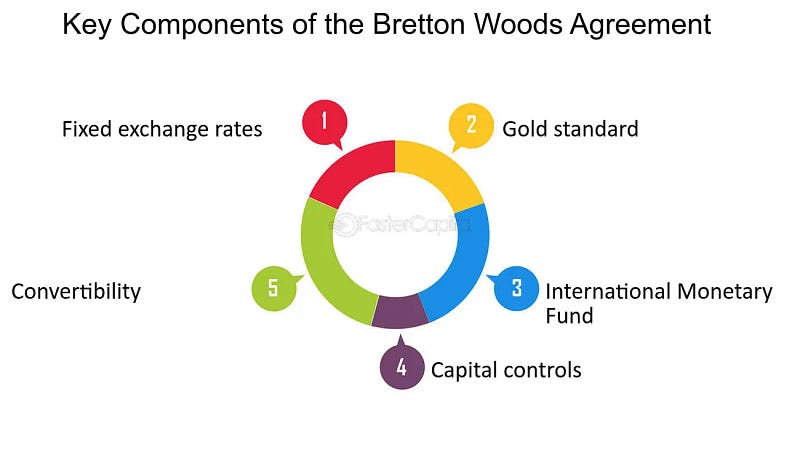
The aftermath of World War II demanded a new international economic order. The chaos of the Great Depression, fueled by competitive currency devaluations and trade barriers, was fresh in everyone’s minds. This article delves into the Bretton Woods System, a landmark agreement established in 1944 that aimed to foster global economic stability and growth.
We’ll explore the core principle of the system: fixed exchange rates. Currencies were pegged to a stable anchor — the U.S. dollar, which itself was backed by gold. This arrangement aimed to eliminate the uncertainty and volatility associated with fluctuating exchange rates.
But the Bretton Woods System wasn’t just about exchange rates. It also gave birth to a crucial international institution: the International Monetary Fund (IMF). We’ll examine the IMF’s role in overseeing the system, promoting international cooperation, and providing financial assistance to member countries.
By understanding the Bretton Woods System, we gain insight into the evolution of the global financial landscape. The system’s successes and eventual demise offer valuable lessons for navigating the complexities of international trade and finance today.
The Economic Ruins of War and the Shadow of Depression: Context for a New System — World War II left a trail of economic wreckage across the globe. Cities were reduced to rubble, factories lay shattered, and entire agricultural fields were ravaged by combat. The human cost was staggering, but the economic toll was just as immense.
Devastation and Debt:
- Physical Destruction: Infrastructure, essential for trade and production, was in ruins. Transportation networks crumbled, factories were bombed out, and entire cities needed to be rebuilt. Rebuilding from scratch placed a massive strain on national budgets.
- Crippling Debt: The war effort was financed by enormous borrowing. Countries emerged from the conflict with mountains of debt, hindering their ability to invest in reconstruction and growth.
- Disrupted Trade: Traditional trade routes were severed, and global markets were in disarray. This disrupted the flow of essential goods and raw materials, further impeding economic recovery.
The Specter of the Great Depression:
The memories of the Great Depression loomed large. This economic catastrophe, triggered by a stock market crash in 1929, had plunged the world into a decade of despair. Policymakers were determined to avoid a repeat.
The Limitations of Gold:
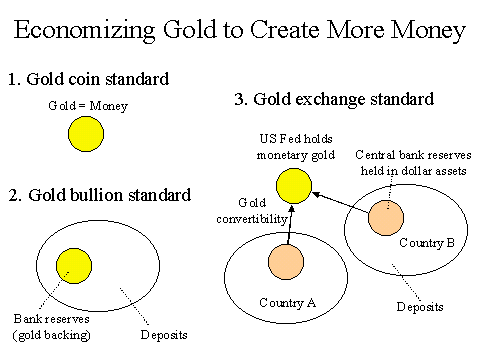
Prior to World War II, the international monetary system relied on the gold standard. Currencies were pegged to the value of gold, which limited the ability of governments to control their money supply and respond to economic crises.
- Deflationary Pressures: The gold standard often led to deflation, a decrease in the general price level. This discouraged investment and spending, further hindering economic growth.
- Limited Flexibility: The system offered little flexibility for countries facing economic downturns. Governments couldn’t easily devalue their currencies to stimulate exports or increase the money supply to boost domestic demand.
The devastation of World War II and the fresh memory of the Great Depression created a strong desire for a new, more stable international monetary system. The limitations of the gold standard became clear, and a new framework was needed to foster global economic cooperation and prevent future crises.
The Bretton Woods System: Building Stability Through Fixed Exchange Rates — The Bretton Woods Agreement, forged in 1944, aimed to establish a new international monetary order. This system, known as the Bretton Woods System, rested on several core principles designed to promote stability and growth in the post-war world.
Fixed Exchange Rates: A Framework for Stability
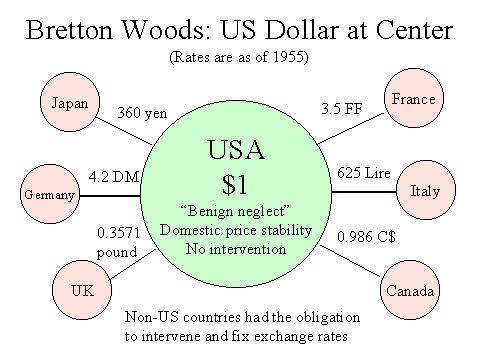
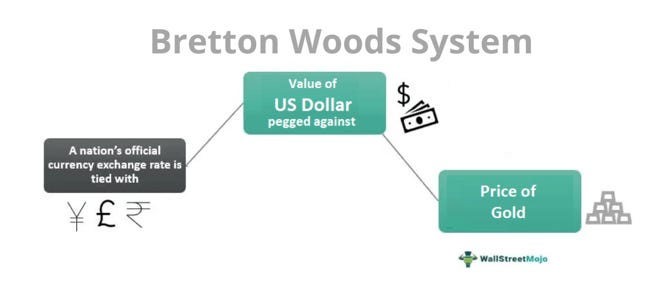
The Bretton Woods System championed a system of fixed exchange rates. Under this system, the value of a country’s currency was pegged to another currency, typically a strong and stable one. In the Bretton Woods system, all currencies were pegged — directly or indirectly — to the US dollar, which became the world’s reserve currency.
- Maintaining Parity: Each country committed to maintaining its currency’s exchange rate within a narrow band (plus or minus 1%) around the agreed-upon peg. This fostered predictability and stability in international trade. Businesses could more easily calculate costs and risks associated with cross-border transactions.
The US Dollar: The Anchor of the System
The US dollar served as the linchpin of the Bretton Woods System. Several factors contributed to its central role:
- Post-War Economic Power: The United States emerged from World War II as the world’s dominant economic power. It possessed vast gold reserves and a relatively stable domestic economy.
- Convertibility to Gold: The US dollar was, in essence, backed by gold. The US government guaranteed to exchange one ounce of gold for $35 to foreign governments and central banks on demand. This convertibility to a tangible asset instilled confidence in the dollar’s value.
Adjustable Pegs: Allowing for Flexibility
The system wasn’t entirely rigid. The concept of “adjustable pegs” allowed for limited exchange rate adjustments under specific circumstances. If a country faced a persistent trade imbalance or a severe economic crisis, it could, with the approval of the International Monetary Fund (IMF) — another key institution created at Bretton Woods — devalue or revalue its currency by up to 10%.
However, these adjustments were meant to be exceptional measures, not routine occurrences. The overall aim was to maintain a stable and predictable exchange rate system to facilitate international trade and economic growth.
The International Monetary Fund (IMF): Guardian of Stability in the Bretton Woods System — The Bretton Woods Agreement not only established a system of fixed exchange rates, but also created two key institutions: the International Monetary Fund (IMF) and the World Bank. The IMF played a crucial role in maintaining the stability of the Bretton Woods System.
Establishment of the IMF:
Forged at the Bretton Woods Conference in 1944, the IMF was envisioned as a global watchdog overseeing the smooth functioning of the international monetary system. Membership was open to all countries that signed the Bretton Woods Agreement.
The IMF’s Three-Pronged Approach:
The IMF assumed a multifaceted role in upholding the Bretton Woods System:
- Exchange Rate Surveillance: The IMF acted as a monitor, scrutinizing member countries’ adherence to their exchange rate commitments. It identified potential imbalances and encouraged corrective actions to maintain currency stability within the agreed-upon bands.
- Financial Assistance: Recognizing that temporary economic difficulties could threaten exchange rate stability, the IMF provided financial assistance to member countries facing balance of payment problems. These loans, with attached conditions, helped countries stabilize their economies and avoid devaluations that could disrupt the entire system.
- Promoting Cooperation: The IMF fostered international monetary cooperation by providing a platform for dialogue and policy coordination among member countries. It encouraged sound economic policies and discouraged beggar-thy-neighbor practices that could destabilize the global financial system.
By monitoring exchange rates, providing financial assistance, and promoting cooperation, the IMF played a critical role in upholding the Bretton Woods System. It aimed to prevent competitive devaluations and foster a stable environment for international trade and economic growth. However, as the system matured, challenges emerged that would ultimately lead to its demise.
The Bretton Woods System: Ushering in an Era of Growth and Cooperation — The Bretton Woods System, though not without its flaws, ushered in a period of remarkable economic prosperity and international financial cooperation following the devastation of World War II. Here’s a closer look at the key benefits it brought:
1. Flourishing International Trade:
- Stable Exchange Rates: Fixed exchange rates fostered predictability in international transactions. Businesses could confidently plan and price their goods and services for export, knowing the value of their currency wouldn’t fluctuate dramatically. This reduced transaction costs and encouraged international trade.
- Reduced Currency Risk: The elimination of frequent currency fluctuations minimized the risk of losses for businesses engaged in international trade. This encouraged companies to expand their operations overseas, boosting global trade volumes.
2. A Predictable Financial Landscape:
- Confidence in the Dollar: The US dollar, backed by gold and the world’s dominant economy, served as a stable anchor for the system. This instilled confidence in international financial markets, facilitating the flow of capital across borders. Businesses and investors were more willing to engage in cross-border transactions due to the reduced risk of currency instability.
3. A Framework for Cooperation:
- The IMF as a Pillar of Stability: The International Monetary Fund (IMF) played a vital role in maintaining exchange rate stability. By monitoring exchange rates, providing financial assistance to member countries facing difficulties, and promoting sound economic policies, the IMF helped prevent crises that could have destabilized the system.
- A Platform for Dialogue: The Bretton Woods institutions, the IMF and the World Bank, provided a platform for dialogue and policy coordination between member countries. This fostered cooperation on issues related to international finance and trade, promoting a more coordinated approach to global economic challenges.
The outcome? The Bretton Woods System coincided with a period of unprecedented economic growth in the post-war era. International trade flourished, fueled by predictability in exchange rates and reduced transaction costs. The framework for cooperation fostered by the IMF also contributed to this period of relative stability and prosperity.
It’s important to note that the Bretton Woods System wasn’t without its limitations, and these limitations would ultimately contribute to its demise in the early 1970s. However, its contribution to post-war economic recovery and the creation of a framework for international financial cooperation remains undeniable.
Challenges and Demise of the Bretton Woods System — While the Bretton Woods System ushered in an era of economic growth and stability, it wasn’t without its flaws. Over time, internal contradictions and external factors placed increasing strain on the system, ultimately leading to its collapse in the early 1970s.
The Seeds of Discontent:
Several factors chipped away at the Bretton Woods System’s foundation:
- The Eroding US Dollar: The US dollar, the linchpin of the system, began to weaken. The Vietnam War and expansive social programs fueled inflation and a growing US trade deficit. This eroded confidence in the dollar’s ability to maintain its fixed exchange rate with gold.
- Capital on the Move: As economies grew and financial markets became more sophisticated, international capital mobility increased. This made it more difficult for governments to maintain fixed exchange rates. Large capital flows could overwhelm currency interventions by central banks.
- Policy Constraints: The fixed exchange rate system limited the ability of governments to pursue independent monetary policies. For example, if a country faced a recession, it couldn’t easily devalue its currency to stimulate exports as this would violate the Bretton Woods rules.
The Unsustainable Triangle:
These factors created an unsustainable situation often referred to as the “trilemma” or the “impossible trinity.” A country could only choose two of the following three options:
- Fixed Exchange Rates: Maintain a fixed exchange rate with another currency.
- Open Capital Markets: Allow free movement of capital across borders.
- Independent Monetary Policy: Pursue domestic monetary policies to achieve economic goals like full employment or price stability.
The Bretton Woods System attempted to have all three, but it proved untenable. As international capital mobility increased, governments found it increasingly difficult to maintain both fixed exchange rates and open capital markets.
The Collapse and its Aftermath:
By the late 1960s, the Bretton Woods System was under immense pressure. Several devaluations of major currencies and a loss of confidence in the dollar’s convertibility to gold at the fixed price of $35 per ounce ultimately led to the system’s collapse in 1971. President Nixon of the United States formally ended the convertibility of the dollar to gold, marking the official demise of the fixed exchange rate system.
The Bretton Woods System’s demise ushered in a new era of floating exchange rates, where currency values are determined by supply and demand in the foreign exchange market. This system has its own challenges, but the Bretton Woods legacy lives on in the form of the IMF, which continues to play a vital role in promoting international financial cooperation and stability.
The Enduring Legacy of Bretton Woods: A Stepping Stone to a New Era — The Bretton Woods System, though ultimately unsustainable, left a lasting mark on the global financial landscape. Following its collapse in the early 1970s, the world transitioned to a system of floating exchange rates, where currency values are determined by market forces.
A New Era of Floating Rates:
The post-Bretton Woods era ushered in a new paradigm — a system of floating exchange rates. In this system, currency values fluctuate based on supply and demand in the foreign exchange market, influenced by factors like interest rates, inflation, and economic growth. This system offered greater flexibility for governments to pursue independent monetary policies, but it also introduced new challenges, such as increased exchange rate volatility.
Bretton Woods’ Lasting Impact:
Despite its demise, the Bretton Woods System left behind a significant legacy:
- The Birth of the IMF: A cornerstone of the Bretton Woods System, the International Monetary Fund (IMF) continues to play a vital role in the global financial system. It monitors exchange rates, provides financial assistance to member countries in times of crisis, and promotes international financial cooperation.
- Importance of Cooperation: The Bretton Woods System highlighted the importance of international financial cooperation in fostering global economic stability and growth. The IMF and the World Bank, established at Bretton Woods, continue to be important platforms for dialogue and policy coordination among member countries on critical financial issues.
- The Exchange Rate Debate: The Bretton Woods System’s collapse ignited an ongoing debate about the optimal exchange rate regime. While some argue for the benefits of a fixed exchange rate system in promoting stability, others favor the flexibility offered by floating rates. The debate continues, with no universally accepted “best” system.
A Stepping Stone:
The Bretton Woods System wasn’t a perfect solution, but it provided a crucial framework for international financial cooperation and economic recovery in the post-war era. The institutions it created — the IMF and the World Bank — continue to play a vital role in the global financial system today. The ongoing debate about exchange rate regimes reflects the enduring influence of Bretton Woods and its contribution to shaping the world’s financial architecture.
Conclusion — The Bretton Woods System, with its emphasis on fixed exchange rates and international cooperation, ushered in a period of remarkable economic growth and stability following the devastation of World War II. It fostered a predictable environment for international trade, anchored by the US dollar and the newly created International Monetary Fund (IMF). However, internal contradictions and external pressures ultimately led to the system’s demise in the early 1970s.
The Bretton Woods era may be over, but its legacy lives on. The IMF continues to be a crucial institution in the global financial system, promoting international financial cooperation and providing stability in times of crisis. The system’s collapse sparked the ongoing debate about optimal exchange rate regimes, a testament to the enduring influence of Bretton Woods on shaping the world’s financial architecture. As we navigate the complexities of the global economy today, understanding the Bretton Woods System remains essential for appreciating the evolution of international financial cooperation and the ongoing quest for a stable and prosperous global financial order.
Thanks.


Leave a Reply