Democracy in Decline: Indirect Fascism and Its Consequences for Inclusive and Sustainable Development
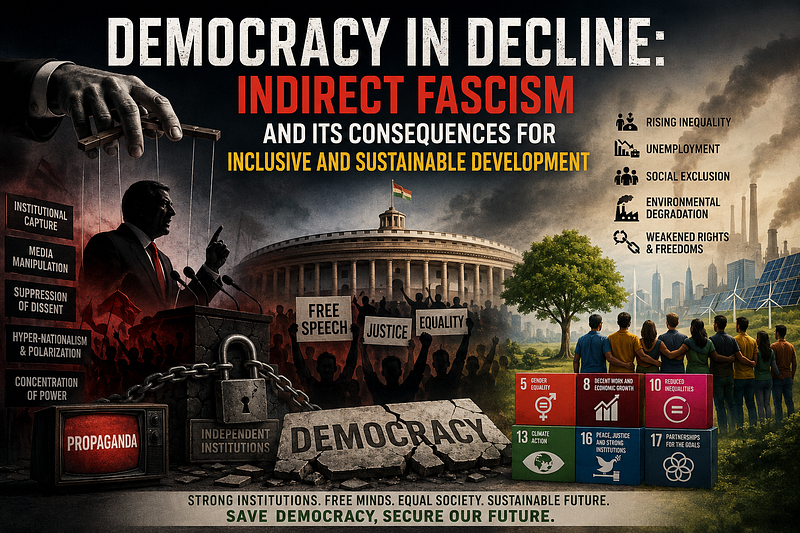
The twenty-first century was expected to strengthen the global expansion of democracy, human rights, and inclusive development. Instead, the world is increasingly witnessing the gradual weakening of democratic institutions and the rise of authoritarian political tendencies within formally democratic systems. Across several countries, elected governments continue to function, constitutions remain intact, and elections are regularly conducted, yet the spirit of democracy is steadily being eroded from within. This phenomenon, often described as democratic backsliding or indirect fascism, represents a modern form of authoritarianism that operates not through open dictatorship alone, but through the systematic weakening of institutional independence, suppression of dissent, manipulation of media narratives, hyper-nationalism, and concentration of political power.
Unlike classical fascism of the twentieth century, modern indirect fascism does not always abolish elections or suspend constitutions. Rather, it gradually captures democratic institutions and transforms them into instruments of political control. Independent institutions such as the judiciary, election commissions, investigative agencies, universities, and media organizations increasingly come under political influence, thereby reducing accountability and weakening democratic checks and balances. Governments often use nationalism, religious polarization, fear politics, and digital propaganda to consolidate public support while portraying dissenters, activists, minorities, and opposition groups as anti-national threats. As a result, democracy formally survives, but its substantive values — freedom, equality, pluralism, and participation — begin to decline.
Recent global developments provide important examples of this democratic crisis. The economic collapse and political instability in Sri Lanka demonstrated how weak governance, corruption, policy failures, and concentration of power can destabilize both democratic institutions and economic systems. The severe financial crisis triggered mass protests and eventually led to the collapse of the government, exposing the vulnerability of democratic systems when accountability mechanisms fail.
Similarly, the political turmoil in Bangladesh following mass protests and the constitutional crisis after the resignation of Sheikh Hasina reflected the growing tensions between authoritarian governance and democratic aspirations. In the context of India, concerns regarding democratic backsliding have increasingly become part of both domestic and international debates. Critics argue that under the rule of the Bharatiya Janata Party (BJP), several independent institutions have faced political pressure and declining autonomy. Allegations regarding the misuse of investigative agencies against opposition leaders, weakening parliamentary deliberation, increasing media bias in favor of the ruling government, and restrictions on dissent have intensified concerns regarding institutional erosion. At the same time, persistent unemployment, widening inequality, agrarian distress, and poverty continue to challenge the promise of inclusive economic development despite high GDP growth narratives. The growing concentration of media ownership and the emergence of pro-government media ecosystems have further weakened the role of the press as an independent democratic watchdog. At the global level, geopolitical conflicts such as the Russian invasion of Ukraine and the escalating tensions involving Israel and Iran reveal how authoritarian nationalism, militarization, and information warfare are reshaping international politics. These conflicts not only threaten global peace and economic stability but also intensify democratic anxieties through propaganda, polarization, media manipulation, and securitization of political discourse.
Wars and geopolitical rivalries often strengthen executive power, justify surveillance, suppress critical voices, and divert public attention away from pressing socio-economic and environmental concerns.
The consequences of democratic decline extend far beyond politics. Inclusive and sustainable development fundamentally depends on transparency, institutional accountability, freedom of expression, social justice, and citizen participation. As democratic institutions weaken, marginalized communities face greater exclusion, minority rights become vulnerable, gender justice movements encounter resistance, and environmental sustainability is subordinated to aggressive economic nationalism and corporate interests. In authoritarian political environments, public welfare policies often become tools of political legitimacy rather than mechanisms of equitable development.
Moreover, the weakening of democracy poses long-term risks to economic growth itself. Sustainable economic progress requires stable institutions, innovation, rule of law, social trust, and policy accountability. When governments suppress dissent, undermine institutional independence, and centralize power, economic policymaking becomes less transparent and more vulnerable to corruption, inefficiency, and policy failures. The erosion of democratic accountability can therefore produce economic instability, rising inequality, unemployment, and declining public trust in governance.
Against this background, this article critically examines the phenomenon of democracy in decline through the framework of indirect fascism and explores its implications for inclusive development, environmental sustainability, gender justice, and long-run economic growth. By analyzing contemporary developments in countries such as Sri Lanka, Bangladesh, India, and the broader geopolitical context shaped by the Russian invasion of Ukraine and the Iran–Israel conflict, the article seeks to understand how democratic erosion threatens the foundations of equitable, peaceful, and sustainable human development in the contemporary world.
Meaning of Indirect Fascism — A concept that political scientists and sociologists often call “Indirect Fascism,”“Illiberal Democracy,” or “Competitive Authoritarianism.”
Unlike the blunt, mid-20th-century fascism of Mussolini or Hitler — which relied on stormtroopers, the explicit abolition of parliaments, and one-party dictatorships — modern indirect fascism uses a much more sophisticated, legalistic playbook. It doesn’t break the system; it hollows it out from the inside.
Here is a breakdown of how this mechanism operates in practice.
The Mechanics of Indirect Fascism
- Autocratic Legalism — Instead of violent coups, indirect fascism relies on the letter of the law to violate the spirit of the law. Leaders use majoritarian mandates to pass constitutional amendments, redraw voting districts (gerrymandering), or change judicial appointment rules. Every step looks legal on paper, but the cumulative effect is the dismantling of checks and balances.
2. Institutional Capture — Rather than shutting down institutions like the judiciary, free press, or election commissions, the regime populates them with loyalists.
- The Judiciary: Judges are replaced with partisans, turning courts into rubber stamps for executive power.
- The Press: Independent media isn’t banned outright; instead, it is starved of government advertising, hit with tax audits, or bought out by state-aligned oligarchs.
3. The Illusion of Choice (Electoral Legitimacy) — Elections still happen, and multiple parties appear on the ballot. However, the playing field is heavily tilted. The ruling party controls the state apparatus, monopolizes media coverage, and uses state resources for campaigning. The opposition can compete, but they cannot realistically win — a dynamic known as competitive authoritarianism.
4. Cultural and Identity Weaponization — To maintain popular support without relying purely on economic performance, indirect fascism manufactures continuous crises. It leverages:
- Hyper-nationalism: Framing political opponents not as rivals, but as “traitors” or “enemies of the state.”
- Polarization: Exploiting religious, ethnic, or cultural fault lines to create an “Us vs. Them” mentality, making compromise look like weakness.
“Democratic backsliding today doesn’t happen through tanks in the streets. It happens at the ballot box, one subtle legislative amendment at a time.”
The primary danger of indirect fascism is its stealth nature. Because citizens still vote and grocery stores remain stocked, it is difficult to identify the exact moment a democracy transitions into an autocracy until the consolidation of power is already complete.
Major Characteristics of Modern Indirect Fascism
1. Institutional Capture: The Mechanics of “Autocratic Legalism”
Indirect fascism does not smash the referee; it quietly hires them. The regime uses perfectly legal legislative processes to systematically eliminate any institutional check on its power.
How the Judiciary is Subverted ?
Instead of arresting troublesome judges, the regime uses structural reforms to purge the courts:
- Court Packing: The government expands the size of the supreme court or constitutional court, allowing the executive to immediately appoint a flood of loyalist judges to outvote independent ones.
- Forced Retirement: The regime lowers the mandatory retirement age for judges overnight. This instantly forces out senior, independent judges, allowing the ruling party to fill the vacancies with younger ideologues.
- Selective Promotion: Independent judges are exiled to remote, low-profile regional courts, while judges who consistently rule in favor of the government are fast-tracked to supreme benches.
Weaponization of Investigative Agencies — Tax authorities, financial crime units, and intelligence agencies are redirected from national security to political survival:
- The “Tax Raid” Strategy: Investigative journalism outlets, independent NGOs, and opposition donors are hit with sudden, highly disruptive tax audits, asset freezes, or foreign-funding investigations.
- Selective Enforcement: Corruption laws are strictly enforced against opposition politicians while the ruling party’s own scandals are buried. This forces opposition figures to either defect to the ruling party for immunity or face financial ruin and imprisonment.
2. Media Manipulation: From Direct Censorship to “Information Choking”
In the digital age, direct state-run television is too obvious. Instead, indirect fascism creates a sophisticated, multi-layered ecosystem that makes independent journalism economically and socially unsustainable.
Economic Strangulation and “Chilling Effects” —
- Starving the Independent Press: Governments are major buyers of media advertising. Indirect fascist regimes completely cut off state advertising from critical media houses and divert those massive budgets exclusively to sycophantic outlets.
- Oligarchic Buyouts: Friendly billionaires and corporations aligned with the ruling party buy up struggling independent newspapers, radio stations, and digital platforms. Overnight, editorial policies shift from critical investigation to overt praise.
- The Lawsuit Weapon (SLAPPs): Strategic Lawsuits Against Public Participation. Wealthy politicians and state-backed entities file multi-million dollar defamation or national security lawsuits against independent journalists. Even if the journalist wins, the legal fees bankrupt the media outlet.
Digital Distraction and Information Pollution
- The “Firehose of Falsehood”: Rather than blocking information, the state floods social media with automated bots, paid influencers, and coordinated troll armies. They amplify conspiracy theories, fake news, and trivial scandals to drown out actual investigative reporting.
- Algorithmic Weaponization: The regime uses state-backed data firms to optimize outrage. Algorithms are manipulated to ensure that divisive, hyper-nationalist content spreads faster than nuanced, fact-checked journalism.
3. Suppression of Dissent: The Administrative Panopticon
Because indirect fascism avoids mass violence (which triggers international sanctions and domestic unrest), it relies on bureaucratic harassment and social ostracization to silence critics.
The Criminalization of Everyday Activism
- Vague National Security Laws: The state passes broad, vaguely worded anti-terror, sedition, or cyber-security laws. Under these laws, “endangering economic security” or “defaming public officials online” can be classified as acts of terrorism or anti-national behavior.
- Pre-trial Detention as Punishment: By using laws that deny bail, the state can imprison activists, academics, and journalists for months or years before a trial even begins. The process itself becomes the deterrent for the rest of society.
The Destruction of Civil Society
- NGO Cracking: Legislation is passed restricting foreign funding for non-governmental organizations. This effectively shuts down environmental groups, human rights watchdogs, and anti-corruption organizations that rely on global grants.
- Academic Purges: University boards are packed with regime loyalists. Research grants are denied to sociologists, historians, or economists whose data contradicts government narratives, forcing academia into ideological compliance.
4. Hyper-Nationalism and Polarization: The Manufacture of Insecurity
A populace that feels safe will demand economic accountability, healthcare, and education. A populace that feels an existential threat will gladly surrender their rights to a “protector.”
The “Us vs. Them” Dynamic
- The Cult of Victimhood: Even while holding absolute power, the regime portrays the dominant majority group as the “true victims” — under threat from minorities, foreigners, and internal elites.
- Dehumanization of the Opposition: Political opponents are no longer treated as citizens with different ideas, but as “traitors,” “foreign agents,” or “termites” destroying the nation from within. Once the opposition is successfully dehumanized, the public views the suppression of their rights not as tyranny, but as self-defense.
- Cultural Wars as a Smoke Screen: Whenever economic indicators drop or a corruption scandal breaks, the regime intentionally triggers a highly emotional cultural, religious, or ethnic controversy to hijack the public discourse and redirect anger away from the state.
5. Centralization of Power: The Rise of the “Delegative Democracy”
The ultimate goal of this process is to bypass the messy, slow nature of democratic deliberation and centralize all decision-making within the office of a single leader.
The Subversion of Parliament
- Ordinance Governance: The executive branch increasingly bypasses the legislature entirely, ruling through executive orders, decrees, and emergency powers.
- Guillotoining Debate: When bills are brought to parliament, the ruling party uses its captured majority to suspend opposition lawmakers, skip committee reviews, and force votes within minutes, turning the legislature into a literal rubber stamp.
The Cult of Personality
- Direct Unmediated Access: The leader bypasses traditional accountability (like press conferences or parliamentary questioning) and communicates directly with the public via heavily scripted podcasts, rallies, or social media broadcasts.
- Infallibility Narrative: The state structure is re-organized around the idea that the leader is the nation. Therefore, any critique of the leader’s policies is framed as an attack on the country itself. Institutional governance dies, replaced by a system based entirely on personal loyalty to the autocrat.
Because the transition happens through dozens of minor, seemingly unconnected legal adjustments, the public rarely finds a single “trigger moment” to revolt. By the time the full picture becomes clear, the institutional tools required to remove the regime democratically have already been dismantled.
Global Examples of Democratic Backsliding
A. Sri Lanka: The Economic Consequence of Absolute Power
Sri Lanka provides a textbook case of what happens when a highly centralized executive completely hollows out institutional accountability.
1. The Rajapaksas and Institutional Capture —
For years, the Rajapaksa family built a highly centralized governance model driven by majoritarian Sinhalese-Buddhist nationalism. Following their election victory in 2019, they passed the 20th Amendment to the Constitution, which systematically dismantled checks and balances. It stripped power away from the Prime Minister and Parliament, giving the President absolute authority to appoint judges, the election commission, and anti-corruption units.
2. The Silencing of Expert Dissent — With institutions captured, executive decisions were made based on loyalty and political theater rather than data.
- The Overnight Chemical Fertilizer Ban: In 2021, the executive abruptly banned chemical fertilizers overnight to force a shift to organic farming. Agricultural experts who warned of a food crisis were ignored or silenced. Tea production plummeted, and domestic food security collapsed.
- Economic Recklessness: Against the advice of the central bank’s technical staff, the government enacted massive tax cuts for the wealthy and refused to restructure its debt or seek early IMF intervention, driven by ideological hubris.
3. The 2022 Collapse and the Aragalaya — Because the institutional safety valves (parliament, courts, independent media) failed to check these disastrous policies early on, the crisis could not be mitigated through standard democratic channels. It resulted in catastrophic inflation, zero fuel reserves, and mass starvation, triggering the Aragalaya (The Struggle) — a massive, organic public uprising that overthrew the regime.
B. Bangladesh: The Illusion of Stability
For over a decade, Bangladesh functioned as a classic example of competitive authoritarianism, where democracy remained formally intact on paper, but was substantively dismantled through sheer executive aggrandizement.
1. Systematic Electoral Engineering
The Awami League government under Sheikh Hasina systematically dismantled the opposition’s ability to compete. In 2011, the government abolished the neutral caretaker government system — a constitutional mechanism that ensured independent bodies ran elections. Consequently, successive general elections (2014, 2018, and early 2024) were marred by massive opposition boycotts, voter intimidation, and widespread allegations of rigging, turning the parliament into a single-party echo chamber.
2. Legal Terror and Shrinking Space
The regime used sophisticated digital and bureaucratic tools to freeze civil society:
- The Digital Security Act (DSA): This draconian law was used aggressively to arrest journalists, cartoonists, and social media users who criticized the Prime Minister or her family.
- Enforced Disappearances: Human rights organizations documented hundreds of cases of extrajudicial killings and enforced disappearances carried out by the Rapid Action Battalion (RAB), an elite paramilitary unit, targeting opposition leaders and activists.
3. The 2024 Tipping Point
For years, the regime pointed to its high GDP growth and massive infrastructure projects to justify its authoritarian grip (the “development over democracy” narrative). However, under the surface, deep-seated resentment regarding crony capitalism, inflation, and a total lack of political expression was brewing. In mid-2024, a student-led protest against civil service quotas rapidly transformed into a nationwide anti-government movement. Within weeks, the seemingly unshakeable regime collapsed, forcing Hasina to flee the country.
C. India: Sophisticated “Executive Aggrandizement”
Unlike countries that experienced sudden collapses, India presents a highly sophisticated model of democratic backsliding, where the formal constitutional machinery remains perfectly operational while its democratic essence is steadily hollowed out.
1. Weaponization of the State Apparatus
Instead of banning opposition parties, the ruling Bharatiya Janata Party (BJP) government has heavily utilized state investigative agencies to systematically cripple them.
- The ED and CBI: Agencies like the Enforcement Directorate (ED) and Central Bureau of Investigation (CBI) have been disproportionately deployed against opposition politicians, chief ministers, and party donors. Leaders face prolonged pre-trial detentions under stringent laws like the PMLA (Prevention of Money Laundering Act), where the burden of proof is reversed, making bail nearly impossible.
- Financial Asymmetry: Through mechanisms like the now-struck-down Electoral Bonds scheme and tax freezes on opposition party accounts, the ruling party secured a massive, unassailable financial monopoly over campaigns.
2. The Capture of Information and Public Discourse
- The “Godi Media” Phenomenon: India’s mainstream television networks have largely transitioned into aggressive propaganda machineries for the state. Outlets actively demonize political dissenters, student activists, and minority groups while entirely bypassing critical reporting on pressing economic issues like historic unemployment or agrarian distress.
- Digital Panopticon: The government has used the IT Rules and sweeping internet shutdowns to censor independent digital journalists, international documentaries, and critical social media accounts, enforcing compliance from global tech platforms.
3. Majortarian Polarization as Governance
The regime relies heavily on structural polarization to maintain its electoral majority. By keeping the political discourse centered on religious friction (e.g., citizenship laws, rewriting history textbooks, and local vigilantism), the state builds an emotional, identity-driven voting base. This effectively shields the government from accountability regarding the widening chasm between high corporate wealth/GDP figures and the stark reality of rural poverty and inequality.
In all three instances, the core theme of indirect fascism holds true: the formal democratic structure is treated not as a system to ensure the public good, but as a mechanism to shield those in power from accountability.
Role of Media in Democratic Decline- In a classic democracy, the media acts as the “Fourth Estate” — an independent entity keeping the three branches of government accountable. Under indirect fascism, however, the regime realizes that directly shutting down news stations looks too dictatorial. Instead, they transform the media into a political shield and megaphone.
1. The Death of the Watchdog: Consolidation and Oligarchic Ownership
Independent journalism requires financial independence. Indirect fascist regimes systematically destroy the economic foundations of free media to force corporate submission.
- Corporate Capture (Crony Capitalism): The state assists friendly billionaires and major corporate conglomerates in buying out independent newspapers, television channels, and digital media houses. These oligarchs maintain a symbiotic relationship with the state: their media arms praise the government, and in return, their main businesses (infrastructure, defense, mining) receive lucrative state contracts and regulatory clearances.
- The Advertising Noose: In many democracies, government notices and public awareness campaigns make up a massive percentage of a media house’s revenue. The regime weaponizes this by completely cutting off state advertising from any outlet that publishes critical investigative pieces, forcing them into financial ruin or compliance.
- The “Tax Raid” as Editorial Control: Media houses that refuse to bend face sudden, highly publicized investigations by financial crime units, tax authorities, or anti-terror agencies. The objective is not necessarily to secure a conviction, but to tie up the media house in legal battles and scare off corporate advertisers.
2. The Great Diversion: Outrage over Substance
A functioning democracy requires citizens to debate policy, public healthcare, school infrastructure, and employment numbers. To prevent this, the captured media actively engineers public attention away from structural failures.
- Manufacturing Cultural Wars: If unemployment reaches historic highs or an agrarian crisis triggers farmer protests, the media machine immediately pivots. They will spend weeks broadcasting highly sensationalized, emotional debates surrounding religious monuments, historical revisions, or minority customs.
- The “Internal Enemy” Narrative: Mainstream news channels shift from questioning ministers to questioning the opposition, civil society activists, and student protestors. Anyone challenging the executive is branded on prime-time television as “anti-national,” a “foreign agent,” or a “traitor.”
3. Weaponization of the Prime-Time Discourse: The Theatre of Sensationalism
The format of news delivery is intentionally altered to kill nuanced democratic deliberation and replace it with tribal warfare.
- The Gladiator Arena Format: Traditional, calm, fact-based reporting is replaced by highly chaotic panel debates. Anchors do not moderate; they actively participate, shouting down opposition voices and validating hyper-nationalist rhetoric. The goal is to maximize viewers’ adrenaline and anxiety, making rational political compromise seem impossible.
- The Firehose of Falsehood: Capturing television is no longer enough; the regime establishes massive digital propaganda cells. Coordinated networks on WhatsApp, X (Twitter), and Facebook blast identical, unverified infographics and doctored videos simultaneously. By flooding the ecosystem with noise, they exhaust the public’s cognitive capacity to distinguish between fact and fabricated narrative.
4. The Democratic Consequence: Epistemic Chaos
When the media functions as a political amplifier, the basic foundational requirement for a democracy — an informed electorate — is destroyed.
- The Loss of Objective Truth: When every piece of data (from poverty rates to GDP metrics) is contested as a partisan conspiracy, citizens give up on trying to find the truth. This leads to political apathy, where people vote entirely based on raw identity or personal loyalty to a charismatic leader rather than performance.
- Echo Chambers and Radicalization: Because the pro-government media constantly pumps out an “Us vs. Them” narrative, society fractures into hostile echo chambers. Polarized citizens begin to see the political opposition not as fellow countrymen with different ideas, but as an existential threat that must be crushed at any cost.
Without a free, fact-driven media ecosystem, democratic elections become nothing more than a hollow ritual. The public is forced to choose a leader based entirely on a carefully manufactured simulation of reality.
Geopolitical Conflicts and Authoritarianism — When a state enters a state of perpetual external conflict or high-voltage geopolitical tension, democratic institutions are almost always the first casualties.
A. The Russian Invasion of Ukraine: The Global Authoritarian Accelerator
The war in Ukraine is not just a territorial conflict; it has fundamentally altered the domestic politics of both the combatants and onlookers by supercharging the tools of indirect fascism.
1. Intensified Nationalism and Information Warfare
- The “With Us or Against Us” Ultimatum: Inside Russia, the war completely wiped out the remaining remnants of independent civil society. By framing the invasion as an existential defense against Western encirclement, the state successfully codified hyper-nationalism into law. Dissent became literal treason.
- The Legal Fabric of War Propaganda: Laws were enacted criminalizing any depiction of the military’s actions that contradicted state media narratives (such as calling the “Special Military Operation” a war). This drove the last independent domestic journalists into exile, creating a total information monopoly.
2. Strengthening Executive Powers via Security Narratives
- The Normalization of the “State of Exception”: War gives executives a blank check. In Russia, it justified total crackdowns, surveillance expansion, and economic mobilization. Even in neighboring democratic nations, the threat of conflict has sometimes been used to justify increased state surveillance, border closures, and fast-tracked executive decisions that sidestep parliamentary debate.
- Economic Instability as a Tool: Global food and energy spikes caused by the war have fueled right-wing, populist, and anti-democratic movements globally. Autocratic leaders use the resulting inflation to discredit existing democratic systems, arguing that “strong, decisive leadership” is needed to navigate the chaos.
B. Israel–Iran Tensions: The Securitization of the Middle East
The long-standing regional proxy war between Israel and Iran — which escalated dramatically into direct military confrontations — perfectly illustrates how external conflict acts as a shield for domestic democratic backsliding.
1. The Securitization Trap and Surveillance Expansion
- The Surveillance Panopticon: Under the absolute imperative of national security, both regimes have dramatically expanded their domestic surveillance apparatuses. Advanced AI-driven tracking, facial recognition, and digital communication monitoring are deployed. While justified as tools to catch foreign spies or terrorists, these technologies are seamlessly redirected inward to monitor and intimidate domestic political opponents, anti-war activists, and student movements.
- The Legal Silencing of Critique: In both countries, though to vastly different systemic degrees, criticizing the military command or the executive’s wartime decisions during an active geopolitical crisis is framed as a direct attack on national morale. This severely chills investigative journalism and opposition politics.
2. The Great Diversion from Socio-Economic Crises
- Burying Domestic Failures: Prior to major escalations, both regimes faced severe domestic pressure — Israel was experiencing historic, massive public protests against executive overreach and judicial overhauls, while Iran was dealing with profound economic stagnation, currency collapse, and deep-seated social unrest following the “Woman, Life, Freedom” protests.
- The Security Smoke Screen: Active military engagement instantly resets the political clock. The state pivots the entire media apparatus to wartime patriotism. Critical domestic crises — such as corruption scandals, environmental collapse, inflation, and crumbling civic infrastructure — are completely buried. The public is told that demanding economic accountability or civil liberties during a wartime crisis is a luxury the nation cannot afford.
Ultimately, perpetual geopolitical tension creates a self-fulfilling loop. Autocratic regimes require external enemies to justify their internal tyranny, and because they are tyrannical and unaccountable, they are far more likely to engage in aggressive, destabilizing foreign policies.
Impact on Inclusive Development — When democracy erodes into indirect fascism, the first casualties are not just abstract legal structures, but the concrete mechanisms of inclusive development.
True human development requires a state to actively correct historical inequalities. However, under an indirect fascist or highly majoritarian regime, the state shifts from an instrument of social equity to an instrument of political patronage. When accountability vanishes, development ceases to be inclusive and becomes highly selective, leaving vulnerable groups to bear the brunt of the systemic decay.
A. Marginalization of Vulnerable Groups: The Cost of Majoritarianism
In a healthy democracy, constitutional guarantees and human rights frameworks protect minority and vulnerable populations from the “tyranny of the majority.” Indirect fascism deliberately weakens these protections to build a unified voting bloc out of the dominant group.
- De-prioritization of Social Justice: Autonomous bodies like human rights commissions, minority panels, and tribal welfare boards are defanged through underfunding or by appointing regime loyalists to head them. Consequently, institutional remedies for discrimination, hate crimes, and land displacement disappear.
- The “Encroacher” Narrative: To justify the exclusion of marginalized groups (whether ethnic, religious, or indigenous), the state and captured media systematically paint them as “threats to national security” or “drains on public resources.” This creates a social climate where discrimination in housing, employment, and justice is normalized.
- Spatial and Economic Segregation: As state protection recedes, vulnerable communities are forced into geographic and economic ghettos. Major public infrastructure projects — like elite transport corridors, modern hospitals, and top-tier universities — are disproportionately routed away from these communities, deepening the structural divide.
B. Gender Justice: The Alliance of Autocracy and Patriarchy
Authoritarianism and hyper-nationalism almost always rely on a nostalgic, highly conservative vision of society. To maintain social control, indirect fascist movements frequently ally with traditional patriarchal structures.
- The Weaponization of “Family Values”: Feminist movements, LGBTQ+ advocacy, and demands for bodily autonomy are framed by the state as dangerous, “foreign-inspired” attacks on traditional culture. State rhetoric shifts toward glorifying women primarily as protectors of domestic virtue and demographic reproducers of the nation, rather than independent economic and political agents.
- The Structural Chilling Effect: When independent civil society is crushed, specialized legal aid cells, domestic violence shelters, and labor unions supporting women workers are closed down due to state harassment or loss of funding. This drastically reduces women’s safety and access to justice.
- Erasure from Public Space: As politics becomes more aggressive, hyper-polarized, and muscle-driven, the public sphere becomes increasingly hostile. This serves as a massive barrier to women’s political participation, stalling progress on equal representation in parliaments and local governance bodies.
C. Public Welfare Distortion: Transactional Populism
Under indirect fascism, the government does not stop spending money on the poor. Instead, it alters why and how it spends it, transforming universal economic rights into conditional state favors.
- Rights-Based Development vs. Patronage Populism: A progressive democracy builds long-term, rights-based infrastructure — such as robust public healthcare systems, high-quality public schools, and structural agrarian reforms. Indirect fascism replaces these with highly visible, short-term cash transfers, free grain distribution, or subsidized individual goods (like cooking cylinders or directly wired cash).
- The “Cultur of Gratitude”: These welfare handouts are deeply branded with the face and name of the executive leader. The narrative is altered from “This is your right as a citizen” to “This is a personal gift from your savior.” Welfare is weaponized as a tool of political survival: citizens are subtly or overtly told that if they vote for the opposition, these essential lifelines will be taken away.
- The Neglect of the Commons: Because the regime’s focus is on immediate electoral returns and enriching its oligarchic backers, long-term capital investments in the public commons are severely neglected.
While billions are spent on media-friendly handout schemes, the foundational pillars of inclusive development — public primary education, rural employment guarantees, environmental sustainability, and labor protections — are quietly defunded and allowed to collapse.
Ultimately, indirect fascism breaks the core promise of development. It creates a highly unequal K-shaped society, where a small circle of corporate cronies controls the nation’s wealth, the dominant majority is kept emotionally satisfied via hyper-nationalism, and vulnerable populations are progressively pushed into social and economic invisibility.
Impact on Environmental Sustainability: The Ecology of Extraction — When a regime removes democratic friction, it removes the very environmental protections that shield human life from corporate overreach. Under indirect fascism, nature is treated as a resource to be rapidly liquidated for political and financial capital.
The Deregulation Loop: Crony Capitalism Meets Ecology
To fund expensive elections and control the media, the ruling party requires massive financial backing from corporate oligarchs. In return for this funding, the state alters environmental policy.
- Diluting Impact Assessments: Environmental Impact Assessment (EIA) clearances are fast-tracked, bypassed, or completely rewritten. The public consultation process — where local, indigenous, or rural communities can voice objections to destructive projects — is systematically weakened or removed.
- Opening Protected Lands: Dense forests, ecologically sensitive coastal zones, and indigenous lands are reclassified or opened up for corporate mining, infrastructure, and industrial corridors, bypassing long-term ecological risks like deforestation, water scarcity, and biodiversity loss.
The Silencing of Green Dissent
Because environmental destruction directly impacts real people (through land displacement or toxic pollution), ecological movements often become the front lines of anti-regime protests. The state uses its standard playbook to crush them:
- The “Anti-Development” Label: Environmentalists, local community leaders, and climate activists are framed by the state and captured media as foreign-funded saboteurs trying to stall national economic progress.
- Cutting Lifelines: Laws regulating foreign funding are weaponized against green NGOs, cutting off their resources and forcing them to close down their legal and scientific research divisions.
Economic Consequences of Democratic Decline — The core economic tragedy of indirect fascism is the creation of a K-shaped reality: the illusion of explosive growth driven by a few hyper-wealthy conglomerates, masking a fragile undercurrent of unemployment, rural distress, and institutional decay.
A. The Destruction of Institutional Trust
Modern economies run on trust. When investor confidence shifts from “trust in the legal system” to “trust in personal connections with the leader,” the economy changes fundamentally.
- The Death of Regulatory Predictability: Independent regulators (like central banks, competition commissions, and revenue boards) lose their autonomy. Economic policies can change overnight based on political whims or to favor a specific state-backed corporate ally, creating high regulatory risk.
- Capital Flight: While speculative, short-term foreign capital may enter the market, long-term, high-quality investments that require a stable rule of law begin to back away, looking for environments with predictable legal protections.
B. Opaque Policymaking and Systemic Corruption
Because there is no robust parliamentary debate, expert scrutiny, or investigative journalism, economic policies are often drawn up in secret, leading to massive policy failures.
- The Legalization of Corruption: Classic corruption (bribes to low-level officials) is replaced by institutionalized corruption. Laws are written specifically to benefit chosen monopolies, turning the state into a mechanism for corporate rent-seeking.
- Blinded by Propaganda: Because the state-aligned media is forbidden from reporting on economic pain points — such as falling rural wages or manufacturing slowdowns — the government becomes blind to economic warnings until a full-blown crisis erupts.
C. The Illusion of Growth: Rising Inequality and Joblessness
The regime relies heavily on gross domestic product (GDP) numbers to project an image of a thriving nation, but this growth is highly unequal and non-inclusive.
- The Growth-Employment Mismatch: Capital-intensive industries run by major conglomerates drive up GDP numbers, but they do not generate mass employment. Structural joblessness — especially among educated youth — reaches historic highs, but it is masked by a media ecosystem that refuses to cover unemployment data.
- The Concentration of Wealth: As the state systematically weakens labor unions, reduces corporate tax rates, and hands over public infrastructure assets to private monopolies, wealth concentrates rapidly at the absolute top. The middle class shrinks, and the working class is kept afloat entirely through state-branded survival handouts rather than meaningful, high-wage employment.
When you dismantle democracy to build a highly centralized, indirect fascist state, you exchange long-term stability for short-term control. By destroying institutional trust, exhausting the environment, silencing experts, and allowing wealth to concentrate in a few hands, the regime builds an incredibly brittle economy — one that is highly vulnerable to external shocks, environmental crises, and internal social unrest.
The Culture of Fear: The Internalization of Autocracy — The ultimate success of indirect fascism lies in its ability to make direct enforcement unnecessary. It creates an environment where citizens willingly silence themselves out of a sense of self-preservation.
The Normalization of Self-Censorship
- The “Chilling Effect” in Daily Life: When citizens watch prominent journalists lose their jobs, academics get suspended, or activists face years of jail time without trial, they internalize the risk. Self-censorship moves from a professional survival tool to a personal one. People stop posting their political opinions online, clean up their social media histories, and avoid discussing governance even in private settings.
- The Academic and Intellectual Deep Freeze: Universities, which should serve as laboratories for critical thought and policy critique, pivot to survival mode. Vice-chancellors and professors alter their course syllabi, cancel seminars on sensitive socio-economic topics, and deny research grants to students working on topics that might conflict with official state narratives.
The Death of Participatory Democracy
- From Citizens to Spectators: As open criticism is systematically decoupled from legitimate citizenship, the public sphere empties out. Democratic dialogue is replaced by a safe, manufactured compliance.
- The Tribalization of Trust: Because institutional trust is shattered, people stop believing in the neutrality of courts, police, or election bodies. Instead, they place their absolute trust entirely in their respective political or identity silos, destroying the shared factual baseline required for a society to function.
Why Modern Democracies Are Vulnerable: The Structural Fault Lines — Autocrats do not create these systemic vulnerabilities out of thin air; they exploit deep, pre-existing fractures within modern democratic and economic systems.
1. The Broken Economic Promise
- Growth Without Prosperity: For decades, globalized economic models prioritized GDP growth while allowing wealth concentration to skyrocket. When vast segments of the population face persistent unemployment, rising inflation, and severe agrarian or rurale distress despite high-growth narratives, they lose faith in the system.
- The “Democracy Dividend” Failure: If citizens find that decades of voting have failed to secure basic healthcare, decent schools, or stable jobs, they stop viewing democracy as a system that works for them. This intense economic insecurity breeds a deep, burning resentment against the existing political establishment.
2. The Rise of Identity Politics and Savior Narratives
- Exploiting the Void: When traditional democratic institutions fail to deliver material security, populist leaders step into the void. They shift the conversation entirely away from economic performance toward raw identity politics.
- The Appeal of the Strongman: To a public exhausted by economic precarity and institutional paralysis, the slow, messy nature of democratic consensus-building looks like weakness. The populist “Strongman” offers a seductive alternative: “Give me absolute power, and I will smash through the bureaucracy to protect you from your enemies.”
3. The Digital Propaganda Panopticon
- The Hyper-Optimized Outrage Machine: Modern digital ecosystems are designed to maximize user engagement through algorithmic outrage. These platforms are perfectly tailored for indirect fascism.
- The Erasure of Civic Culture: When digital echo chambers replace robust civic education, public discourse is reduced to a series of highly emotional, continuous crises. Nuance is erased, and misinformation becomes a highly effective tool to keep the electorate permanently distracted, polarized, and emotionally mobilized.
Conclusion — The decline of democracy in the contemporary world represents one of the most serious political and developmental crises of the twenty-first century. Unlike the authoritarian regimes of the past, modern indirect fascism operates gradually and often invisibly within democratic structures themselves. Elections continue to take place, constitutions formally remain intact, and institutions appear functional, yet the substantive foundations of democracy — institutional independence, freedom of expression, pluralism, accountability, and citizen participation — are steadily weakening.
The experiences of Sri Lanka, Bangladesh, and India, along with global conflicts such as the Russian invasion of Ukraine and tensions between Israel and Iran, reveal how concentration of political power, media manipulation, hyper-nationalism, and weakening institutional accountability are reshaping democratic systems across the world. These developments demonstrate that democratic erosion is no longer confined to military dictatorships or openly authoritarian states; it increasingly emerges within electoral democracies themselves.
The consequences of this democratic decline extend far beyond politics. Weakening democracy threatens inclusive development, environmental sustainability, gender justice, minority rights, and long-term economic stability. Sustainable economic growth cannot survive without transparent institutions, rule of law, social trust, and accountable governance. Similarly, social justice and environmental protection cannot flourish in political environments dominated by fear, polarization, propaganda, and centralized authority.
The greatest danger of indirect fascism lies in its normalization. Democracies rarely collapse overnight; they weaken slowly through gradual institutional erosion, shrinking democratic space, suppression of dissent, and public acceptance of authoritarian narratives in the name of nationalism, security, or stability. By the time societies fully recognize the depth of democratic decline, the institutions meant to protect democracy may already have lost their autonomy and credibility.
Therefore, safeguarding democracy today requires more than merely conducting elections. It requires strengthening constitutional institutions, protecting media freedom, ensuring judicial independence, encouraging civic participation, defending dissent, and promoting inclusive and equitable development. Democracy must remain not only an electoral mechanism but also a living system of accountability, freedom, social justice, and human dignity.
Ultimately, the future of sustainable development and global peace depends upon whether societies can resist the silent rise of indirect authoritarianism and reaffirm the democratic values of pluralism, equality, justice, and institutional accountability. Without such commitment, democracy risks surviving only in form while disappearing in substance.
Thanks.


Leave a Reply