Building Human Capital for Sustainable Economic Development: Lessons from the World Bank Report 2026
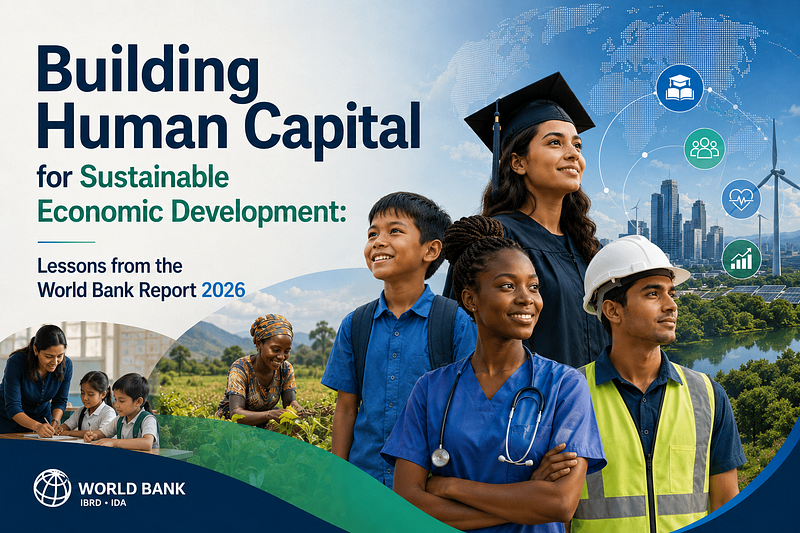
As governments across the world debate highways, ports, digital networks, and industrial corridors, an uncomfortable truth continues to surface in development economics: concrete alone does not create prosperity. The real infrastructure of economic growth is human capital — the health, education, skills, and productive capacities of people.
The latest insights from the World Bank’s Human Capital Report arrive at a critical moment for the global economy. Nations are confronting slower productivity growth, technological disruption, demographic transitions, rising inequality, and intensifying climate vulnerabilities. In this uncertain environment, countries that fail to invest in human capital risk entering a prolonged cycle of low productivity, social instability, and uneven development.
For decades, economists have recognised that physical capital and financial investment are insufficient without a capable and healthy workforce. Yet public discourse often treats expenditure on education, healthcare, nutrition, and skill development as welfare spending rather than productive investment. This misunderstanding has imposed enormous long-term economic costs, especially on developing economies.
The evidence is now overwhelming. Countries with stronger human capital systems demonstrate higher labour productivity, better innovation capacity, stronger institutional resilience, and greater adaptability to technological change. Human capital is no longer merely a social objective; it has become a strategic economic imperative.
The productivity challenge — The global economy is entering an era defined not only by growth uncertainty but by a widening productivity divide. Advanced economies continue to benefit from high-skilled labour, research ecosystems, and technological innovation, while many developing nations remain trapped in low-productivity sectors.
This divide cannot be explained solely by differences in capital accumulation or trade integration. It increasingly reflects unequal investments in people.
A child denied quality education today becomes part of tomorrow’s low-productivity workforce. A malnourished population weakens national labour efficiency. Inadequate healthcare systems reduce workforce participation and increase economic vulnerability. Weak skill development systems leave millions unprepared for digital transformation.
In many emerging economies, including India, the contradiction is striking. There is rapid expansion in higher education enrolment, digital connectivity, and economic aspirations, yet persistent deficits in foundational learning, healthcare access, employability skills, and labour-market readiness.
Economic growth without corresponding human capital development creates structural imbalances. It produces economies that grow statistically but struggle socially — where GDP rises but productivity gains remain uneven and employment quality stagnates.
The demographic window will not remain open forever Developing economies frequently celebrate their youthful populations as demographic dividends. But — demographics alone do not guarantee growth.
A large population becomes an economic asset only when supported by education, healthcare, nutrition, and employable skills. Otherwise, the demographic dividend can quickly transform into a demographic burden.
India illustrates both the promise and the risk. With one of the world’s youngest populations, the country possesses extraordinary economic potential. However, unless investments in public education, healthcare infrastructure, women’s empowerment, digital literacy, and vocational training accelerate significantly, demographic advantage may not translate into sustained productivity growth.
The challenge is particularly acute in rural and semi-urban regions where educational quality, health outcomes, and labour-market opportunities remain uneven. Human capital disparities within nations are becoming as economically significant as disparities between nations.
This has broader implications for social cohesion. Economic systems that fail to create opportunities for large sections of young populations often experience rising frustration, inequality, and political instability.
Technology rewards skilled societies — The rapid expansion of artificial intelligence, automation, and digital platforms is reshaping labour markets at unprecedented speed. Routine jobs are declining while demand for cognitive, technical, and adaptive skills is rising.
This transformation creates both opportunity and risk.
Countries with strong educational ecosystems and continuous skill-development frameworks will likely capture the benefits of technological progress. Those with weak human capital foundations may experience widening unemployment, labour displacement, and social fragmentation.
The future of economic competitiveness will depend less on cheap labour and more on productive labour.
This requires governments to rethink education policy fundamentally. The focus can no longer remain confined to literacy rates or enrolment figures. Economies need systems that cultivate analytical thinking, digital capability, adaptability, creativity, and lifelong learning.
Equally important is the need to bridge the gap between formal education and employability. Across many developing economies, graduates often possess degrees without market-relevant skills. This disconnect imposes hidden economic costs by reducing workforce efficiency and weakening innovation potential.
Health is economic policy — One of the most important lessons reinforced by recent global crises is that healthcare is not merely a social sector issue — it is central to macroeconomic stability.
The Covid-19 pandemic exposed how fragile health systems can destabilise labour markets, public finances, supply chains, and economic confidence. Countries with stronger healthcare systems recovered faster and experienced lower long-term economic disruption.
Yet healthcare expenditure in many developing countries remains inadequate relative to developmental needs.
Poor health outcomes reduce labour productivity, increase absenteeism, lower educational attainment, and push households into financial insecurity. Malnutrition, maternal health challenges, and unequal access to healthcare continue to undermine human capital formation across large sections of the developing world.
Investment in preventive healthcare, nutrition, sanitation, and mental health must therefore be viewed not as fiscal burdens but as productivity-enhancing economic investments.
Women’s empowerment is central to human capital — No serious discussion of human capital can ignore gender inequality.
Female labour-force participation remains significantly below potential in many economies despite rising educational attainment among women. Social barriers, unpaid care responsibilities, unequal access to opportunities, and safety concerns continue to restrict economic participation.
This is not only a social injustice; it is an economic inefficiency.
Economies that fail to utilise the productive potential of half their population cannot maximise growth. Expanding women’s access to education, finance, digital tools, healthcare, and formal employment generates multiplier effects across households and communities.
Human capital investment becomes substantially more effective when women are economically empowered.
The policy shift governments must make — The fundamental policy question is not whether nations can afford to invest in human capital. It is whether they can afford not to.
Governments often prioritise short-term fiscal targets over long-term social investment. But underinvestment in education, health, and skills eventually appears elsewhere — through unemployment, low productivity, social instability, and weak competitiveness.
Human capital policy must therefore move from the margins of development planning to the centre of economic strategy.
This requires:
- Greater investment in public education quality rather than mere expansion;
- Stronger healthcare systems with emphasis on preventive care;
- Skill-development frameworks aligned with future labour-market demands;
- Digital inclusion and technological accessibility;
- Nutrition and early-childhood development programmes;
- Policies that improve female labour-force participation;
- Greater coordination between universities, industries, and governments.
The countries that succeed in the coming decades will not necessarily be those with the largest natural resources or the biggest infrastructure projects. They will be the nations that build capable, healthy, adaptable, and innovative populations.
Investing in people is the new development consensus — Development economics is increasingly converging around a simple conclusion: sustainable growth depends on human capability.
Economic history repeatedly demonstrates that societies prosper when they expand educational opportunity, improve public health, empower workers, and create systems that enable people to realise their productive potential.
In the twenty-first century, human capital is not supplementary to development; it is development.
The global economy is entering a period where resilience, adaptability, and innovation will matter more than ever before. Countries that continue to treat human capital as secondary spending may find themselves economically vulnerable despite physical infrastructure expansion.
The most valuable national asset is no longer oil, minerals, or industrial machinery. It is people.
And nations that invest seriously in people will shape the future global economy.
Conclusion -The future of economic prosperity will depend less on the accumulation of physical assets and more on the development of human c apabilities. In an increasingly uncertain world shaped by technological disruption, climate risks, and demographic change, nations can no longer afford to treat education, healthcare, nutrition, and skills development as secondary policy concerns.
Human capital is not simply a social objective; it is the foundation of productivity, innovation, institutional resilience, and inclusive growth. Countries that invest consistently in people are more likely to build competitive economies, reduce inequality, and sustain long-term development.
The message emerging from the World Bank’s Human Capital Report is therefore both economic and moral: societies that neglect human development ultimately weaken their own future. Governments may build roads, ports, and digital networks, but lasting national progress will depend on whether citizens possess the health, knowledge, and capabilities needed to thrive in a rapidly changing global economy.
The strongest economies of the future will not necessarily be those with the largest natural resources or industrial capacity. They will be those that invest most effectively in human potential.
Thanks.


Leave a Reply